
The B2B Buyer’s Guide to Sourcing Flawless Multi-Color Hotfix Rhinestones
The B2B Buyer’s Guide to Sourcing Flawless Multi-Color Hotfix Rhinestones
In the high-stakes world of B2B fashion manufacturing and textile decoration, the transition from single-color applications to complex, multi-color rhinestone designs represents both a significant value-add and a logistical minefield. For procurement officers, brand owners, and production managers, sourcing “multi-color” isn’t just about picking different bags of stones; it is about managing chemical consistency, light refraction variables, and adhesive reliability across a diverse spectrum of glass chemistry.
Whether you are producing high-end dancewear, decorative footwear, or branded apparel, the visual impact of a multi-color hotfix motif is undeniable. However, the technical challenges—ranging from dye lot variations across different sizes to the risk of color fading during industrial washing—can jeopardize an entire production run. This comprehensive guide provides a deep dive into the technicalities of sourcing flawless multi-color hotfix rhinestones at scale, ensuring your supply chain remains robust and your final products remain consistent.
Chapter 1: The Technical Complexity of Multi-Color Hotfix Sourcing
When a B2B buyer orders 1,000 gross of “Crystal SS16,” the variables are limited. But when that order expands to include 20 different shades across five different sizes, the complexity increases exponentially. In the rhinestone manufacturing industry, particularly within the Guangzhou and Yiwu hubs, “color” is not a static attribute. It is the result of precise mineral inclusions in the glass melt and specific conditions in the vacuum plating chambers.
1.1 The Science of the Glass Melt
Most premium hotfix rhinestones are made from lead-free or low-lead glass. The color is achieved by adding metal oxides to the molten glass. For example, cobalt is used for blues, manganese for purples, and chromium for greens. In a large-scale factory, these batches are melted in massive furnaces. A “dye lot” refers to a single furnace cycle. Even a 0.1% variance in the oxide concentration or a 10-degree Celsius fluctuation in furnace temperature can result in a visible “color shift.”
1.2 Why Multi-Color Orders Are High-Risk
In multi-color designs, rhinestones of different hues are often placed in close proximity. This creates a high-contrast environment where even slight deviations in shade become glaringly obvious. If your “Light Siam” from the January batch doesn’t match the “Light Siam” from the March batch, your gradient designs will look disjointed, leading to rejected shipments from retail partners.
Chapter 2: The Challenge of Color Consistency Across Different Sizes
One of the most common complaints from B2B buyers is that an SS6 “Rose” stone does not look exactly like an SS30 “Rose” stone from the same supplier. To the untrained eye, this looks like a mistake. To the manufacturer, it is a byproduct of physics.
2.1 Volume-to-Surface Ratio
Larger stones (like SS30 or SS34) have more mass. When light enters a larger colored glass body, it travels a longer path through the pigment before reflecting back. This makes the color appear deeper and more saturated. Conversely, an SS6 stone has very little “body” for the light to pass through, often making it appear lighter or more “watery.”
2.2 The Cooling Rate Variable
During the molding process, smaller stones cool down almost instantly, while larger stones retain heat longer. This cooling rate can affect the final “index of refraction” of the glass, slightly altering how the color is perceived. A professional factory must calibrate its glass formulas specifically for different size ranges to counteract these natural phenomena—a process known in the industry as “size-matching color calibration.”
Chapter 3: Managing Dye Lot Variations in Bulk Manufacturing
For wholesale buyers, the “Dye Lot” is the single most important concept to master. A dye lot variation occurs when two production runs of the same color yield slightly different results.
3.1 The “Perpetual Inventory” Trap
Many wholesalers keep massive stocks of stones. If you order 500 bags, you might receive 300 bags from a June production run and 200 bags from a September run. If these are mixed on a single garment, the “banding effect” can ruin the aesthetic. When sourcing for multi-color projects, always specify that each color must come from a single dye lot.
3.2 Buffer Stock Strategy
When embarking on a large multi-color production, savvy B2B buyers calculate a 10-15% “buffer” for each color. Sourcing this buffer at the start of the project ensures that if you need more stones to finish the run, you aren’t forced to buy from a new (and potentially different) dye lot later.
Chapter 4: Color Fading and Chemical Stability
Not all rhinestone colors are created equal. Some colors are “integral” (pigment is inside the glass), while others are “surface-coated” (colors like AB, Aurum, or Neon shades).
4.1 The Risk of Vacuum Plating Oxidation
Specialty colors, particularly those with an Aurora Borealis (AB) coating or metallic finishes, are created through Physical Vapor Deposition (PVD). In this process, a thin layer of metal ions is bonded to the surface of the glass. If the vacuum pressure isn’t perfect or the protective top-coat is too thin, these colors can fade when exposed to:
- UV light (sunlight exposure during display).
- High-alkaline detergents.
- Friction during wear.
4.2 Testing for Color Fastness
Before approving a multi-color batch, buyers should request a “wash test report.” A standard B2B test involves 10-20 cycles in an industrial washing machine at 40°C. If the “Jet Black” stones start looking “Grey” or the “Gold” stones lose their luster, the chemical bonding of the color or the coating is insufficient.
Chapter 5: The 3-Step Factory QC Protocol for Multi-Color Orders
To guarantee “Flawless” sourcing, you must work with factories that implement a rigorous Quality Control (QC) system tailored for multi-color batches. Here is the 3-step protocol that distinguishes a Tier-1 manufacturer from a secondary trader.
Step 1: Raw Material Spectroscopy
Before the glass is even molded into chatons, the raw glass cullet should undergo spectroscopy. This ensures that the chemical composition matches the master “Color Standard.” By checking the raw material first, the factory prevents the production of thousands of gross of off-color stones.
Step 2: In-Line Color Comparison (The D65 Light Box)
During production, QC technicians must take samples every hour and compare them to the “Golden Sample” under a D65 standardized light source. D65 simulates natural daylight (6500K color temperature), which is the industry standard for color matching. Relying on warehouse fluorescent lighting is the primary cause of color mismatching in the wholesale industry.
Step 3: Post-Production “Mixed-Batch” Audit
Once the stones are bagged, a final audit should be conducted where one bag from each color in the multi-color order is opened and placed side-by-side. This allows the QC manager to see the “interplay” of the colors. Does the “Emerald” look too dark next to the “Peridot”? Is the “Siam” shifting toward “Hyacinth”? This holistic view ensures the final design’s palette is harmonious.
Chapter 6: Sourcing Strategy for Mixed-Color Batches
Ordering “Mixed Bags” (pre-mixed colors in one bag) is popular for retail, but for B2B manufacturing, it is usually a mistake. Here is why and how to source smarter.
6.1 Avoid Pre-Mixed Wholesale Bags
Pre-mixed bags often contain “floor sweeps” or remnants from various production runs. The quality and color consistency in these bags are notoriously low. For professional manufacturing, always buy individual colors in bulk and use an automated “Stone Setting Machine” or a custom-made “Transfer Template” to create your multi-color patterns.
6.2 Technical Data Sheets (TDS)
Demand a Technical Data Sheet for each color. This sheet should list the stone’s resistance to heat (crucial for the hotfix press), the type of glue used (usually German or grey glue for multi-color applications), and its lead content status. This documentation is vital for compliance (REACH/CPSIA) and production planning.
Chapter 7: The Role of Hotfix Glue in Color Perception
An often overlooked aspect of sourcing multi-color stones is the glue backing. The color of the glue can actually change the appearance of the rhinestone once it is applied to the fabric.
7.1 Grey Glue vs. Transparent Glue
Most high-quality Chinese manufacturers use a grey “high-bond” glue. The grey color is opaque, which prevents the fabric color from “bleeding” through the stone. This is essential for lighter colors like “Silk” or “Light Peach.” If you use stones with transparent glue on dark fabric, the stones will appear darker and duller because the fabric color absorbs the light passing through the glass.
7.2 Melt Point Consistency
In a multi-color design, you might be pressing 10 different colors at once. If the “Crystal” stones have a glue that melts at 160°C, but the “Cobalt” stones have a glue that melts at 180°C, you will end up with either scorched fabric or stones that fall off. Ensure your factory uses a standardized glue formula across all colors in your order.
Chapter 8: Communication and Sampling for B2B Buyers
The biggest barrier to flawless sourcing is often a “language gap” in technical specifications. “Blue” is not a specification; “Capri Blue, SS16, 2-cut, Grey Glue, Dye Lot #442” is a specification.
8.1 Physical Master Samples
Never approve a multi-color order based on a digital photo. Phone screens and monitors have different color calibrations. Always request a physical “Color Card” or “Master Sample” from the factory. Once you approve a sample, it becomes the “Quality Benchmark” for all future orders.
8.2 Pantone Matching?
While some factories claim they can match Pantone colors, remember that glass chemistry is different from ink printing. It is better to choose the closest standard rhinestone color and adjust your fabric or print to match the stone, rather than requesting a custom glass melt (which usually requires a massive MOQ of 5,000+ gross per color).
Chapter 9: Logistics and Packaging for Multi-Color Orders
When shipping hundreds of kilograms of multi-color stones, the packaging is your last line of defense.
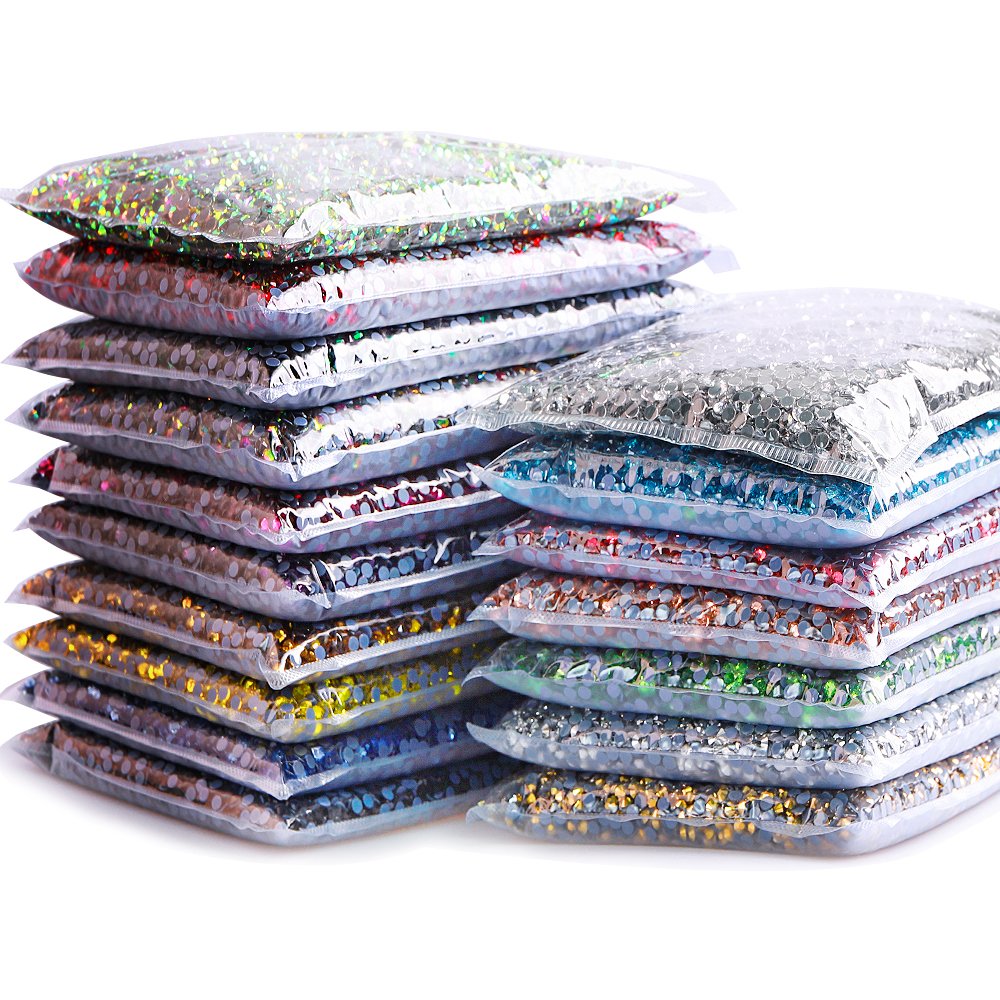
- Moisture Protection: Rhinestone glue is hygroscopic (it absorbs moisture). Multi-color orders should be packed in sealed poly-bags with desiccant packs to prevent the glue from degrading during sea freight.
- Labeling: Each bag must be clearly labeled with the Color Name, Size, Quantity, and Dye Lot Number. This simplifies inventory management for the production team.
- Double-Bagging: To prevent “color contamination” (one bag breaking and mixing with another color), premium suppliers double-bag all wholesale orders.
Chapter 10: Environmental Compliance and Safety in Multi-Color Manufacturing
For B2B buyers, especially those supplying brands in the EU or USA, color sourcing is inextricably linked to chemical compliance. The pigments used to create certain vibrant colors—historically reds and yellows—often relied on heavy metals like lead or cadmium.
10.1 Lead-Free and Cadmium-Free Standards
Modern B2B standards, such as REACH (Europe) and CPSIA (USA), mandate strict limits on heavy metals. When sourcing a wide palette of colors, you must ensure that every single color meets these standards. It is common for a “Crystal” stone to be lead-free while a “Siam” or “Citrine” from the same factory still contains traces of lead due to older pigment formulas. Request a consolidated test report that covers the entire color spectrum you are ordering.
10.2 OEKO-TEX Standard 100
If your multi-color designs are intended for children’s wear or intimate apparel, OEKO-TEX certification is non-negotiable. This certification ensures that the stones, the pigments, and the hotfix glue are free from harmful substances. A “mixed color” order that fails an OEKO-TEX audit can lead to a full product recall, costing your company hundreds of thousands of dollars.
Chapter 11: Application Technology for Multi-Color Designs
The method you use to apply your multi-color stones is just as important as the sourcing itself. There are two primary industrial methods for multi-color applications.
11.1 Ultrasonic Setting Machines
For high-speed, multi-color production, ultrasonic machines are the gold standard. These machines use sound waves to melt the glue on each individual stone. Advanced models can be programmed to pull from 4 to 6 different color hoppers simultaneously, allowing for the automatic creation of complex gradients. When sourcing stones for ultrasonic machines, consistency in the stone’s “waist” (the middle part of the stone) is critical, as it affects how the machine’s vacuum nozzle picks up each color.
11.2 Heat Press and Transfer Motifs
Most multi-color designs are first created as “Hotfix Transfers” (stones arranged on a sticky plastic sheet). This allows the entire design to be pressed onto the garment in one go using a flatbed heat press. The challenge here is the “Pressure Differential.” Because different colors and sizes of stones may have slightly different heights, a standard heat press might apply more pressure to an SS20 stone than an SS10 stone. To solve this, always use a silicone foam pad on your heat press to evenly distribute pressure across all colors and sizes.
Chapter 12: Cost Optimization Strategies for Multi-Color Sourcing
Multi-color orders are inherently more expensive to process than single-color orders due to the increased labor in picking, packing, and QC. However, there are ways to optimize costs without sacrificing quality.
12.1 Consolidating Your Color Palette
While a design might call for 30 different shades, a professional sourcing agent can often help you “value-engineer” the design down to 12-15 core colors. By increasing the volume per color, you can unlock better “Bulk Tier Pricing” and reduce the risk of dye lot variation. Fewer colors also mean faster production on the assembly line.
12.2 Negotiating “Mixed-Lot” Volume Discounts
Many B2B buyers make the mistake of negotiating prices on a per-color basis. Instead, negotiate based on the total order weight. For example, if you are ordering 2,000 gross across 10 colors, you should be receiving the 2,000-gross price tier for all colors, not the 200-gross price tier. A Tier-1 factory will agree to this “Project Volume” pricing model.
Chapter 13: Case Study: Navigating a Gradient Production for High-Performance Activewear
To illustrate these principles, let’s look at a recent project involving a global cheerleading uniform manufacturer. The design required a “Sunburst Gradient” using 8 shades of orange, yellow, and red across three different sizes (SS10, SS16, SS20).
The Challenge: The initial prototype used stones from three different suppliers. The resulting gradient looked “choppy” because the orange from Supplier A had a different refractive index than the yellow from Supplier B.
The Solution: The manufacturer consolidated the entire order to a single factory in Guangzhou. By using a single “Base Glass Formula” across all 8 colors, the refractive indices were matched. The factory then implemented a “Staged Dye Lot” schedule, producing all orange and yellow shades in consecutive furnace cycles. The result was a seamless, professional gradient that passed all 50-cycle industrial wash tests.
Conclusion: Building a Reliable Multi-Color Supply Chain
Sourcing multi-color hotfix rhinestones is a test of a B2B buyer’s technical knowledge and their supplier’s manufacturing discipline. By focusing on dye lot integrity, understanding the physics of size-to-color variation, and insisting on a 3-step QC process, you can eliminate the “surprises” that often plague bulk rhinestone procurement.
The goal is not just to buy stones, but to source a component that enhances the value of your final textile product. As the fashion industry moves toward more intricate, multi-dimensional designs, the ability to deliver consistent, vibrant, and durable multi-color rhinestone applications will remain a key competitive advantage for any apparel manufacturer. Work closely with your factory, demand transparency in their chemical processes, and always prioritize technical consistency over the lowest possible price point. In the world of hotfix rhinestones, brilliance is found in the details.
Get a free sample pack and factory pricing – WhatsApp us at +86 13692450325 or request a quote to check stock, bulk pricing, and lead time for your order.
Related reading: