
Tanzanite-Hued Hotfix Crystals and Supplier Vetting for Bespoke Tailoring in Italy
Tanzanite-Hued Hotfix Crystals: Supplier Vetting for Bespoke Tailoring in Italy
A Deep-Dive Guide for Luxury Fashion Procurement and Bespoke Design Houses
Introduction: The Prestige of Italian Bespoke Tailoring and the Role of Luxury Embellishments
In the high-stakes world of Italian bespoke tailoring, perfection is the baseline, and the pursuit of the “extraordinary” is the mission. Whether it is the storied ateliers of Milan, the historical tailoring houses of Naples, or the innovative design studios in Florence, the Italian fashion industry is built upon a legacy of meticulous craftsmanship. However, in the modern era, the soul of a garment often lies in its finer details. Among these, the use of Tanzanite-hued hotfix crystals—specifically those categorized as premium Tanitite—has become a hallmark of contemporary luxury, especially for evening wear, red-carpet couture, and high-end accessories.
For a B2B manufacturer based in Guangzhou, the challenge is not just producing a stone that shines; it is about meeting the rigorous, almost fanatical standards of Italian designers who demand consistency, clarity, and uncompromising safety. This guide explores the critical vetting process for suppliers of Tanzanite-hued hotfix crystals, focusing on the technical benchmarks of K9 glass, the importance of OEKO-TEX certification, and the specialized requirements of the Italian bespoke market.
The Allure of the Tanzanite-Hued Crystal: Why “Tanitite” is Trending
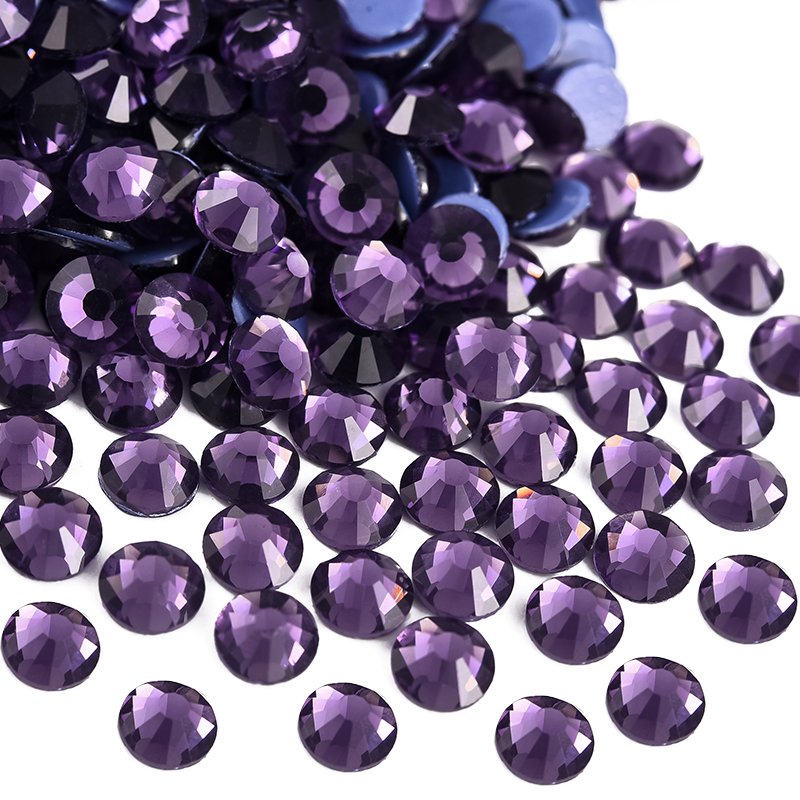
Tanzanite is one of the rarest gemstones in the world, known for its mesmerizing trichroism—displaying shades of blue, violet, and burgundy depending on the angle of light. Replicating this depth in a hotfix crystal requires more than just blue pigment; it requires a sophisticated understanding of light refraction and color theory. In the wholesale industry, these are often referred to as Tanitite or Tanzanite-hued crystals.
The color itself occupies a unique space in the designer’s palette. It is more sophisticated than a standard sapphire blue and more regal than a traditional amethyst purple. For Italian bespoke tailors, this hue offers a bridge between classic elegance and modern audacity. It pairs exceptionally well with charcoal wools, midnight navy silks, and deep black velvets—fabrics that are foundational to Italian sartorial excellence. When a designer chooses a Tanzanite-hued crystal, they are looking for a stone that does not just sit on the surface of the fabric but interacts with it, changing mood as the wearer moves through a room.
Technical Benchmarks: High-End K9 Glass and Optical Clarity
When vetting a Guangzhou-based supplier, the first technical hurdle is the material composition. In the world of hotfix crystals, not all glass is created equal. High-end K9 glass (also known as K9 crystal) is the industry standard for those seeking a diamond-like brilliance without the cost of leaded crystal. K9 glass is a type of optical borosilicate glass that is prized for its high refractive index and exceptional clarity.
For Italian bespoke tailoring, where garments are often inspected under the unforgiving lights of a runway or a gala, the “fire” of the crystal is paramount. K9 glass allows for precise machine cutting, resulting in sharp, uniform facets that maximize light return. A premium Tanzanite-hued crystal should ideally feature 12 to 16 facets, each polished to a mirror finish. During the vetting process, procurement officers should request a “refraction test” or a sample batch to check for common defects such as bubbles, cloudy inclusions, or asymmetrical cuts. In the B2B wholesale sector, the ability of a manufacturer to maintain this level of clarity across millions of units is what separates a true partner from a mere vendor.
OEKO-TEX Standard 100: The Non-Negotiable Asset for Global Export
In the luxury sector, “quality” extends beyond aesthetics to encompass safety and ethical manufacturing. For Italian tailoring houses exporting to the EU, North America, and beyond, compliance with OEKO-TEX Standard 100 is non-negotiable. This certification ensures that the hotfix crystals—and specifically the chemical components used in the glass and the adhesive—are free from harmful substances such as lead, cadmium, and phthalates.
Why is this so critical for bespoke tailoring? Often, these crystals are applied to garments that come into direct contact with the skin, such as silk gowns or structured jackets. If a supplier uses low-grade pigments or lead-heavy glass, it can lead to skin irritation or, worse, failure to meet the REACH (Registration, Evaluation, Authorisation and Restriction of Chemicals) regulations in Europe. A reputable Guangzhou manufacturer will proactively provide their OEKO-TEX certification, proving that their Tanzanite-hued crystals are safe for human ecological requirements. This level of transparency is a key indicator of a supplier’s commitment to the high-end market.
Supplier Vetting: A Step-by-Step Guide for B2B Procurement
Vetting a manufacturer for Italian bespoke needs requires a multi-dimensional approach. Here is a framework for procurement managers:
1. Color Batch Consistency (The “Delta E” Factor)
One of the biggest headaches for a bespoke tailor is receiving a second batch of stones that doesn’t match the first. Tanzanite hues are notoriously difficult to keep consistent due to the balance of blue and purple pigments. A top-tier supplier uses spectrophotometers to measure color variance, ensuring that every batch falls within a strict Delta E tolerance. When vetting, ask the manufacturer about their color-matching protocols and how they handle “dye lot” variations.
2. Facet Precision and Machine Cutting
Hand-cut or molded stones are insufficient for the luxury market. Insist on machine-cut K9 crystals. The precision of the cut determines how the light hits the Tanzanite hue. If the facets are rounded or uneven, the stone will look “plastic” rather than like a gemstone. Request high-resolution macro photography of the stones from the manufacturer’s QC department before placing a bulk order.
3. Adhesive Strength and “German Glue” Technology
The “hotfix” part of the crystal is just as important as the glass. In Guangzhou, the best manufacturers use premium grey glue (often referred to as German-style glue) on the back of the crystals. This adhesive has a lower melting point but a higher bond strength, ensuring that the crystals stay attached to delicate Italian fabrics like georgette or fine wool without damaging the fibers. During vetting, perform a “wash test” and a “pull test” on sample garments to ensure the longevity of the bond.
4. Factory Audits and Capacity
A supplier might produce a perfect sample but fail on a 500-gross order. Investigate the factory’s production capacity. Do they have the latest automated sorting machines? What is their daily output for SS16 and SS20 sizes (the staples of the tailoring industry)? A manufacturer that invests in automation is more likely to provide the consistency required by Italian fashion houses.
Bridging Guangzhou and Milan: The Manufacturer’s Duty
The relationship between a Guangzhou manufacturer and an Italian design house is one of symbiosis. The manufacturer provides the scale, technical expertise, and cost-efficiency, while the design house provides the creative vision and the high-standard demand. To bridge this gap, the manufacturer must act as more than just a source of goods; they must act as a consultant.
For example, if an Italian designer is working with a particularly heavy velvet, the manufacturer should be able to recommend the correct crystal size and glue type to ensure the embellishments don’t weigh down the drape of the fabric. In the case of Tanzanite-hued crystals, the manufacturer might suggest a “mixed-cut” arrangement—using both round and baguette shapes—to create a more dynamic, “crushed ice” effect on the garment. This level of technical support is what turns a one-off purchase into a long-term B2B partnership.
Application in Italian Bespoke Tailoring: Case Studies in Luxury
How are these Tanzanite-hued crystals actually used in the ateliers of Italy? Let’s look at three primary applications:
1. The “Starry Night” Evening Jacket
A classic navy silk-wool blend jacket for men’s evening wear is the perfect canvas for Tanzanite crystals. By using a gradient of SS6 to SS16 sizes, a tailor can create a subtle “nebula” effect on the lapels. The Tanzanite hue provides a regal depth that standard silver or clear crystals cannot match. Because these jackets are high-value items, the crystals must be OEKO-TEX certified to ensure no leaching of chemicals into the luxury fabric.
2. Red-Carpet Gowns and Fluidity
For women’s couture, the focus is on movement. Tanzanite-hued crystals are often applied in “cascades” down the spine or across the bodice. The K9 glass clarity ensures that as the wearer turns, the stones flash with violet and blue light, mimicking the movement of water. Here, the weight of the stone is critical; high-quality K9 glass is lighter than leaded crystal, allowing for more dense embellishment without compromising the gown’s silhouette.
3. Bespoke Footwear and Accessories
The Italian leather industry also utilizes hotfix crystals. From bespoke stilettos to luxury clutches, Tanzanite-hued stones provide a striking contrast to metallic leathers or soft suedes. The vetting process here focuses heavily on the glue’s ability to bond with organic materials like leather, which requires a specialized heat-press technique.
The B2B Wholesale Landscape: Navigating Lead Times and Logistics
For Italian businesses, time is often the most expensive commodity. When sourcing from Guangzhou, logistics and lead times are part of the vetting process. A reliable manufacturer will have streamlined export processes and partnerships with global couriers like DHL or FedEx. Typically, a bulk order of Tanzanite-hued crystals should have a lead time of 7 to 10 days, with 3 to 5 days for shipping to Italy.
Furthermore, the packaging must be designed for the wholesale market. Stones should be packed in secure, anti-static bags with clear labeling of size, color, and batch number. This allows the Italian ateliers to integrate the stones into their inventory systems without manual sorting errors. A manufacturer that understands the “assembly line” nature of a tailoring house—even a bespoke one—is a valuable asset.
Sustainability and the Future of Hotfix Embellishments
As the fashion industry moves toward a more sustainable future, the materials used in embellishments are under scrutiny. Lead-free K9 glass is inherently more environmentally friendly than traditional leaded glass. Furthermore, the longevity of the glue bond is a sustainability factor; a garment where the crystals fall off after one wear is a failed product. By providing high-durability hotfix solutions, Guangzhou manufacturers are helping Italian brands maintain their reputation for “slow fashion”—garments that are designed to last a lifetime.
We are also seeing a shift toward “Ethical Tanzanite” narratives. While these are glass crystals, the storytelling around the color (the rarity of the original gemstone and the precision of the replication) adds a layer of value that resonates with the modern, conscious consumer who appreciates the “art of the imitation” when done with high-end materials.
The Importance of Professional Samples and Prototyping
Before a single stone is applied to a five-thousand-euro suit, a rigorous prototyping phase must occur. A reputable B2B supplier will offer comprehensive sample kits. These kits should not just include the Tanzanite-hued crystals but also comparative samples of other shades (like Capri Blue or Heliotrope) so the designer can see the Tanzanite’s unique violet undertone in person.
During the prototype phase, the tailor will test the heat-press settings. Since different fabrics react differently to heat, the manufacturer should provide a “technical data sheet” for their hotfix glue, specifying the optimal temperature (usually between 150°C and 170°C) and dwell time (8 to 12 seconds). This level of detail is what prevents costly mistakes in the atelier.
Conclusion: Selecting Your Guangzhou Partner for the Italian Market
In conclusion, the journey of a Tanzanite-hued hotfix crystal from a factory in Guangzhou to a bespoke garment in Milan is a testament to the global nature of modern luxury. Success in this niche market depends on a rigorous vetting process that prioritizes technical excellence, safety certifications, and a deep understanding of the client’s sartorial needs.
By focusing on high-end K9 glass, insisting on OEKO-TEX Standard 100 compliance, and demanding color batch consistency, Italian design houses can source with confidence. For the manufacturer, the goal is to be invisible—to provide a product so reliable and a shine so consistent that the designer never has to think about the stone, only the beauty it adds to their creation. The Tanzanite hue, with its regal depth and shifting colors, remains the perfect choice for those who want to push the boundaries of bespoke tailoring into a new era of crystalline brilliance.
Related reading: