
Quality Control in Bulk Rhinestone Manufacturing and What B2B Buyers Must Know
Quality Control in Bulk Rhinestone Manufacturing: What B2B Buyers Must Know
For B2B buyers in the fashion, apparel, and footwear industries, the procurement of hotfix rhinestones is more than just a transaction—it is a critical link in the global supply chain. When sourcing in bulk, the difference between a high-grade machine-cut stone and a substandard imitation isn’t just aesthetic; it’s financial. A single batch of poorly manufactured rhinestones can lead to massive product recalls, damaged brand reputations, and significant revenue loss.
In the competitive landscape of Guangzhou’s rhinestone manufacturing hubs, quality control (QC) is the primary differentiator. This comprehensive guide delves into the technical metrics that B2B buyers must understand to ensure they are receiving world-class components that meet international standards. From facet symmetry to the chemical composition of glue backings, here is everything you need to know about quality control in bulk rhinestone manufacturing.
1. The Science of Facet Symmetry and Cutting Precision
The “sparkle” of a rhinestone is not accidental—it is a product of geometry and physics. In high-end manufacturing, the number and precision of facets determine the stone’s ability to refract light. Standard high-quality stones typically feature 12, 14, or 16 facets. However, it isn’t just the number that matters; it is the symmetry.
The Importance of Machine Cutting: Low-cost rhinestones are often molded or hand-cut, leading to rounded edges and inconsistent facet shapes. In a B2B context, where thousands of stones are applied to a single garment via automated machines, inconsistency is a disaster. High-precision machine cutting ensures that every stone in a 100-gross bag is identical in height, diameter, and facet alignment. If the facets are asymmetrical, the light will scatter unevenly, resulting in a “dull” appearance that fails to meet luxury or retail standards.
Technical Metric: During the QC process, manufacturers use high-magnification lenses to inspect the “table” (the top flat facet) and the “girdle” (the edge). The table must be perfectly centered. Any deviation, even by a fraction of a millimeter, indicates a calibration error in the cutting machinery which, if left unchecked, will compromise the entire bulk order.
2. Optical Clarity: Eliminating Impurities and Clouds
Optical clarity refers to the internal purity of the glass used in rhinestone production. For B2B buyers, this is a non-negotiable metric. Substandard manufacturers often use recycled glass or lower-grade silica that contains microscopic air bubbles, “seeds” (unmelted raw materials), or a yellowish tint.
The Refraction Index: High-lead or high-index glass provides the highest level of brilliance. While many markets are moving toward lead-free requirements for environmental and safety reasons (such as OEKO-TEX or REACH compliance), the manufacturing challenge is to maintain clarity without the traditional lead content. Quality control teams in Guangzhou must verify the raw material composition before the melting process even begins.
Visual Inspection: Bulk orders are sampled and placed under standardized lighting conditions (usually D65 daylight simulators). QC inspectors look for “clouding”—a phenomenon where the interior of the stone appears milky. This is often caused by improper cooling (annealing) of the glass. For a B2B buyer, clouding is a sign of structural weakness, making the stones more prone to cracking during the heat-press application process.
3. Glue Backing Consistency: The Hotfix Foundation
For hotfix rhinestones, the glue backing is just as important as the glass itself. The adhesive is typically a heat-activated polyurethane or polyamide glue, often identifiable by its grey, black, or green color on the back of the stone. In bulk manufacturing, glue consistency is the most common failure point.
No Bubbles, No Gaps: A critical QC check involves inspecting the glue application. The glue must be applied evenly across the entire base of the rhinestone. If there are air bubbles trapped in the glue, or if the glue does not reach the edges (gaps), the bond with the fabric will be weak. During the application process, these air bubbles can expand, causing the stone to “pop” off the garment after the first wash.
Glue Thickness: If the glue is too thin, it won’t penetrate the fabric fibers sufficiently. If it’s too thick, it can seep out from the edges of the stone, creating a messy, “cheap” look on the finished product. Advanced factories use automated dispensers to ensure that every SS16 or SS20 stone receives the exact milligram of adhesive required for its surface area.
4. Dye Lot Color Matching and Batch Uniformity
One of the greatest challenges in B2B rhinestone sourcing is maintaining color consistency across multiple orders. This is known as “dye lot” matching. Whether you are ordering Crystal AB, Rose Gold, or Cobalt Blue, the color must remain consistent from January to December.
The Delta E Metric: Manufacturers use spectrophotometers to measure color deviation. In the textile and trim industry, a Delta E (ΔE) value of less than 1.0 is generally considered invisible to the human eye. QC protocols for bulk rhinestones involve comparing a sample from the new batch against a “Master Sample” approved by the buyer.
Vacuum Coating (AB Finish): For stones with an Aurora Borealis (AB) or metallic coating, the QC process is even more rigorous. These coatings are applied in vacuum chambers. If the vacuum pressure or the duration of the vapor deposition varies even slightly, the “rainbow” effect will look different. QC teams must ensure that the “flash” of the AB coating is uniform, preventing some stones from looking more blue while others look more yellow within the same bag.
5. Rigorous Wash Testing and Adhesion Durability
A rhinestone that looks beautiful in the bag but falls off in the laundry is a liability. B2B buyers must insist on documented wash test results before any bulk shipment leaves the factory.
The Standard Protocol: A professional manufacturer will apply samples from the bulk lot to a standard cotton or polyester fabric using a heat press at the recommended temperature (usually 160°C to 180°C) and pressure. The fabric is then subjected to repeated wash cycles—often 20 to 50 cycles—at temperatures ranging from 40°C to 60°C.
Post-Wash Evaluation:
- Retention Rate: Did 100% of the stones remain attached? For most B2B contracts, a retention rate of less than 99% is a failure.
- Surface Integrity: Did the stones lose their brilliance? Did the foil backing (the silver layer behind the glass) oxidize or peel?
- Chemical Resistance: Did the laundry detergent react with the glue or the coating?
6. Foil Backing and Corrosion Resistance
The silver foiling on the back of a rhinestone is what reflects light back through the facets. If this foiling is of poor quality, it can oxidize (turn black) or delaminate (peel away) over time, especially in humid environments or when exposed to sweat.
Salt Spray Testing: For rhinestones intended for swimwear or footwear, high-end manufacturers perform salt spray tests. This mimics the corrosive effects of sea salt and perspiration. A robust QC process ensures that the protective layer over the silver foiling is thick enough to prevent oxygen from reaching the metal, preserving the stone’s brilliance for the lifetime of the garment.
7. Sizing Accuracy and Sieve Analysis
Rhinestones are sold in “SS” (Stone Size) increments, such as SS6, SS10, SS16, and SS20. In automated B2B production lines, stones are often fed through hoppers or positioned using CNC templates. If the stones are not sized accurately, they will jam the machines or fail to fit into the template holes.
Sieve Testing: Quality control involves passing the bulk lot through a series of precision sieves. This ensures that an SS16 bag (which should be 3.8mm to 4.0mm) does not contain smaller SS12 stones or larger SS20 stones. Consistency in size is a hallmark of a factory that maintains its machinery and respects the technical requirements of its B2B partners.
8. Packaging, Weight, and Count Verification
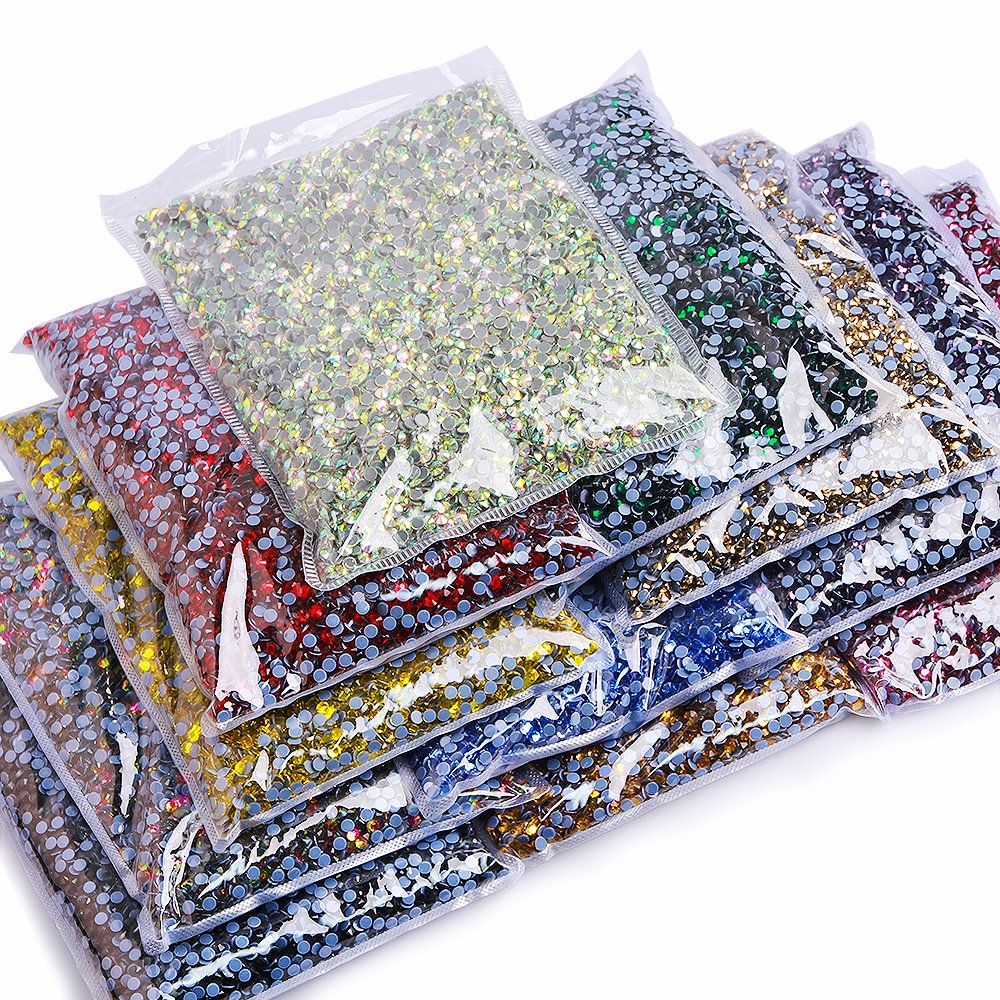
The final stage of QC happens in the packing department. Most B2B orders are measured by weight rather than hand-counted, as a single order might involve millions of stones. However, the density of glass can vary slightly between colors.
Weight-to-Count Calibration: A responsible manufacturer will calibrate their digital scales for every specific color and size before packing. They will count 100 stones, weigh them, and then calculate the total weight required for the ordered “gross” amount (1 gross = 144 stones). Furthermore, the packaging must be moisture-proof and shock-absorbent to prevent the stones from rubbing against each other during international transit, which can cause surface scratches.
9. Why Guangzhou Manufacturers Lead the Way in QC
Guangzhou has long been the epicenter of the global rhinestone trade. The proximity to raw material suppliers and the concentration of technical expertise allow factories here to implement “Total Quality Management” (TQM). Unlike smaller regional workshops, major Guangzhou manufacturers invest in European-standard testing equipment and maintain in-house laboratories to conduct the tests mentioned above.
For the B2B buyer, sourcing from this region offers the advantage of established QC benchmarks. Most factories are familiar with the strict requirements of Western brands and can provide certifications like OEKO-TEX Standard 100, ensuring the products are safe for end-consumers.
10. The B2B Buyer’s QC Checklist
When evaluating a new wholesale partner for hotfix rhinestones, we recommend asking for the following documentation:
- Technical Data Sheet (TDS): Outlining the glass type, glue melting point, and recommended application pressure.
- Wash Test Report: Documenting the retention rate after 20+ cycles.
- Compliance Certificates: REACH, RoHS, or OEKO-TEX (especially for the children’s apparel market).
- Pre-Shipment Inspection (PSI) Samples: A small sample from the actual bulk lot before the final balance is paid.
Conclusion: The True Value of Quality
In the world of bulk rhinestone manufacturing, price is often what you see, but quality is what you get. For B2B buyers, understanding the intricacies of quality control—from the symmetry of a machine-cut facet to the chemical stability of a hotfix adhesive—is the key to a successful and sustainable supply chain.
By partnering with a manufacturer that prioritizes these QC metrics, you ensure that your products remain as brilliant as the day they were created, fostering trust with your customers and protecting your brand’s bottom line. In the long run, the most expensive rhinestone is the one that fails; the most profitable one is the one that stays perfectly in place, shining brilliantly, batch after batch.
Related reading: