
Luxury Hotfix Rhinestones for Gulf Fashion Bulk Supply for Abayas Kaftans and Galabiyas in the UAE and Saudi Arabia
Across the Arabian Gulf, luxury fashion is defined by regal elegance, intricate artisanal detailing, and fluid drapes. In the haute couture ateliers of Dubai’s Design District (d3), historical tailoring workshops in Sharjah, and prestigious modest wear fashion houses throughout Riyadh, Jeddah, and Khobar, black and deep jewel-toned textiles serve as the canvas for contemporary luxury. Abayas, kaftans, jalabiyas, and evening capes demand embellishments that convey genuine opulence. Yet, for luxury apparel houses, couture ateliers, and textile wholesalers across the United Arab Emirates and Saudi Arabia, sourcing reliable crystal embellishments presents persistent technical hurdles.
In luxury modest wear, an abaya is an investment piece worn during high-profile family weddings, royal state receptions, private salon gatherings, and sacred religious celebrations including Ramadan and Eid al-Fitr. The failure of decorative elements is disastrous for brand reputation. Every production manager and atelier director in the region has confronted the routine failures of generic trims: crystals that lose their luster against pitch-black Korean Nida fabric, stones that turn dull or yellow under intense desert daylight, and adhesive backings that peel away when exposed to scorching outdoor heat or air-conditioned environments.
Sourcing through local traders in wholesale districts like Deira in Dubai often leaves fashion businesses paying markups of 200% to 300% for inconsistent stock lots. At Guangzhou Yiben E-Commerce Co., Ltd., we bring 12 years of precision hotfix manufacturing experience directly to Gulf fashion brands and overseas garment manufacturers. By pairing high-grade K9 optical glass crystals with German-engineered heat-activated grey adhesive, we deliver direct factory supply that withstands severe arid climates, protects delicate luxury textiles, and cuts procurement costs significantly. Exploring direct China rhinestone manufacturing provides the technical consistency, custom capabilities, and volume scale required to dominate the demanding GCC luxury fashion sector.
—
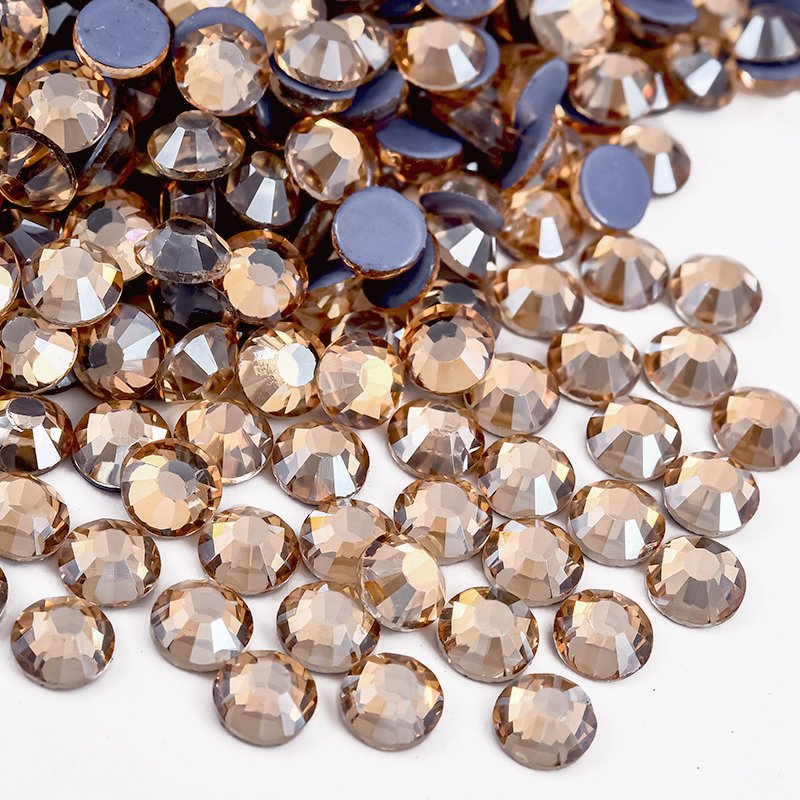
The Sourcing Reality of Gulf Luxury Fashion and Abaya Embellishment
The Demands of Desert Climates and Black Fabric Brilliance
The Arabian Gulf represents one of the most demanding wear environments for embellished textiles anywhere in the world. Between May and October, ambient outdoor temperatures across Dubai, Abu Dhabi, Doha, and Riyadh routinely surpass 45°C to 50°C. Sunlight is relentless, producing intense ultraviolet radiation and rapid surface heating of dark garments. When a client steps from an air-conditioned salon maintained at 20°C into direct 48°C desert heat, garments undergo severe thermal shock.
Black textiles, such as high-grade Korean Nida, Japanese crepe, and premium chiffon, absorb maximum thermal radiation. The surface temperature of a jet-black abaya can spike beyond 60°C within minutes under direct midday sun. Under these conditions, lower-grade hotmelt adhesives soften, lose mechanical grip, and turn sticky. Dust and fine desert sand particles then adhere to the softened glue margins, creating unsightly grey halos around each stone. When the wearer returns indoors, the glue hardens once more, locking in the dirt and leaving the stone prone to snapping off the textile under slight physical abrasion.
Compounding this mechanical challenge is the optical barrier of deep black textiles. Black cloth absorbs up to 95% of ambient light. While an inferior resin stone or low-purity glass gem may appear passably bright against a white test card, it vanishes or looks murky against dense black Nida or dark emerald kaftan silk. Luxury Gulf consumers expect crystalline scintillation that refracts light with surgical precision, whether under bright midday sunshine or the soft ambient chandeliers of private evening banquets.
Why Ordinary Rhinestone Adhesives Fail in 45 Degree GCC Heat
The primary cause of stone detachment on abayas and kaftans is the widespread use of generic ethylene-vinyl acetate (EVA) based hotfix adhesives. Standard commercial rhinestones traded through intermediaries often feature cheap, clear, or milky white glue backings. These adhesives are engineered for low-temperature application on casual cotton t-shirts, possessing a glass transition temperature and softening threshold starting as low as 40°C to 45°C.
When an abaya decorated with standard EVA-backed stones is worn outdoors in Gulf summer climates, the bond fails through chemical creep. The polymer chains slide against one another under minimal shear stress. Once the garment is sent for laundering or dry cleaning, the degraded adhesive dissolves or crystallizes, leading to catastrophic shedding across cuffs, necklines, and hem borders. For a boutique charging 1,500 to 4,000 AED per bespoke abaya, stone shedding generates costly customer returns and irreversible damage to brand prestige.
Furthermore, thermal cycling creates microscopic condensation beneath the stone. When moving repeatedly between extreme outdoor heat and dry indoor refrigeration, ambient humidity trapped in the fabric weave condenses at the interface between the textile fiber and the glue bed. Inferior adhesives suffer hydrolytic degradation under repeated condensation cycles, causing the adhesive to separate from the glass backing foil or from the textile itself.
—
Optical Brilliance on Dark Fabrics with K9 Precision Crystal Cuts
The Refractive Advantage of K9 Optical Glass Over Standard Resins
To overcome the light-absorption barrier of black fabrics, embellishments must possess an exceptionally high refractive index. At our Guangzhou manufacturing facility, we produce our premium hotfix line exclusively from 100% K9 optical crystal glass.
K9 glass is an optical borosilicate crown glass renowned for high clarity, minimal bubble inclusions, and exceptional dispersion characteristics. Possessing a refractive index of approximately 1.9 and a Mohs hardness rating of 6.0 to 6.5, K9 crystals outclass both standard soda-lime glass (refractive index ~1.5) and molded acrylic or resin substitutes.
| Material Type | Refractive Index | Mohs Hardness | Visual Performance on Pitch-Black Nida Cloth |
|---|---|---|---|
| Molded Acrylic / Resin | 1.48 – 1.50 | 2.0 – 2.5 | Dull, foggy, scratches easily |
| Commercial Soda-Lime | 1.51 – 1.53 | 5.0 – 5.5 | Moderate, flat sparkle |
| Middle Grade DMC Glass | 1.58 – 1.62 | 5.5 – 6.0 | Clear, limited fire |
| Yiben K9 Optical Crystal | ~1.90 | 6.0 – 6.5 | Intense diamond fire |
The difference is immediately visible on finished garments. When light enters a K9 crystal, the internal facet angles reflect the illumination back out through the table rather than allowing it to be absorbed into the dark backing fabric. Even in subtle lighting, garments embellished with K9 stones display a sharp, fiery rainbow scintillation that elevates the perceived value of the collection.
SS10 to SS20 Sizing and 14 Facet Architecture for Heavy Drape Abayas
In Middle Eastern modest fashion, stone sizing must balance dramatic visual impact with fabric drape. Premium abayas and kaftans rely on sweeping, fluid silhouettes. Applying stones that are too heavy or bulky can weigh down delicate necklines, cause puckering along sleeve cuffs, or distort the natural hang of fine crepe.
Through 12 years of direct collaborations with Middle Eastern designers, we have standardized the optimal sizing combinations: – SS6 and SS10 (2.0 mm to 2.9 mm): Ideal for dense, intricate pavé fills, geometric Islamic lattice patterns, micro-border trims, and delicate embroidery line tracing. – SS16 (3.8 mm to 4.0 mm): The undisputed workhorse size for abaya sleeve borders, bodice accents, and kaftan neck panels. It delivers brilliant visibility without overburdening the drape. – SS20 (4.6 mm to 4.8 mm): Utilized for high-impact focal points, scattered galaxy patterns, trailing hem borders, and bridal jalabiya panels. – SS30 (6.3 mm to 6.5 mm): Reserved for statement centerpieces on formal evening capes and wedding abayas.
Our K9 crystal line features a precision 12 to 14 facet multi-angle cut. By cutting microscopic planar facets across the crown and table, each crystal functions as a multi-directional prism. When applied along flowing sleeve edges or sweeping hemlines, the stones ignite with movement, creating dynamic shimmer that commands attention at every step.
Specialized Gulf Colorways and Vacuum Magnetron Sputtering Coatings
Color selection in Gulf couture requires sophisticated nuance beyond standard clear crystals. Dark background fabrics demand vacuum-deposited optical coatings that maintain high reflectivity without altering base hues.
At our Guangzhou factory, our vacuum magnetron sputtering chambers produce specialized finishes developed specifically for regional preferences: – Deep Jet Black and Jet Hematite: High-sheen metallic gunmetal coatings that blend seamlessly into black Nida cloth while reflecting mirror-like flashes under spotlighting. – Golden Shadow and Champagne AB: Warm, regal champagne hues that harmonize with traditional gold embroidery (Zari work) and authentic metallic braidings without the brassy, yellow appearance of cheap acrylic stones. – Crystal Transmission and Silver Night: Subtle smoky silver coatings that create an understated, modern monochromatic aesthetic popular in minimalist Dubai luxury collections. – Rich Jewel Tones (Emerald, Sapphire, Burgundy, Violet): Saturated body-colored glass formulations that retain deep coloration under sunlight without fading over time.
—
Extreme Heat Resistance with German Industrial Hotmelt Grey Glue
Why Glue Formulation Dictates Retention Under Intense Arabian Sunlight
Sparkle is meaningless if the stone detaches during wear. To solve the extreme heat degradation common to the GCC climate, we coat all our premium hotfix crystals with an imported German-engineered industrial hotmelt grey adhesive.
This proprietary adhesive is a high-temperature polyamide-based formulation specifically synthesized for harsh climate durability. It exhibits an activation melting point between 150°C and 170°C, with an operational press temperature of 160°C. Crucially, its thermal degradation threshold exceeds 200°C, and its glass transition point remains completely stable up to 85°C.
| Property / Metric | Standard White EVA | German Industrial Grey Glue |
|---|---|---|
| Primary Polymer Base | Ethylene-Vinyl Acetate (EVA) | Modified Polyamide Hotmelt |
| Adhesive Melting Range | 110°C – 130°C | 150°C – 170°C |
| Softening Point (Vicat) | 42°C – 48°C (Fails in GCC sun) | 85°C – 92°C (Desert stable) |
| Glue Color After Pressing | Cloudy white or yellowing | Crisp, clean neutral grey |
| Tensile Peel Strength | 1.2 – 1.8 N/mm | 4.2 – 5.5 N/mm (Ultra hold) |
| Washing Durability | Degrades after 5–10 washes | ISO 6330 50 washes (<2% loss) |
| Resistance to Sweating/Oils | Porous, prone to loosening | Hydrophobic, non-porous seal |
| Shear Adhesion Failure Temp | 52°C | 118°C (Extreme heat proof) |
Under the blazing Arabian sun, our German grey glue remains solid, rigid, and completely bonded to the fabric weave. It does not soften, bleed into adjacent fibers, or capture airborne desert dust. When the garment is washed, the adhesive resists water penetration and surfactant degradation, ensuring stones stay permanently locked in position throughout the garment’s operational lifespan.
Mechanical Bond Retention Testing on Nida Crepe and Chiffon Textiles
Achieving long-term adhesion on Gulf textiles requires deep mechanical anchorage into synthetic microfibers. Premium abayas rarely use open-weave cottons; they utilize dense, smooth polyester microfibers, silk-viscose crepes, or ultra-sheer chiffons.
When heated to its 160°C activation point under controlled pneumatic pressure, our German grey adhesive transforms into a low-viscosity liquid. It flows around individual textile filaments, creating thousands of microscopic mechanical anchors before cross-linking into a resilient elastomer upon cooling.
In standardized laboratory wash testing complying with ISO 6330 protocols, garments decorated with our K9 grey-glue hotfix stones undergo 50 consecutive industrial laundering cycles at 40°C. Stone detachment rates remain consistently below 2%. For design houses concerned with garment durability, our companion guide on ISO 6330 wash durability and glue retention details the full laboratory protocols, shear testing benchmarks, and glue cross-linking chemistry.
—
Recommended Heat Application Settings for Delicate Abaya Fabrics
Temperature Pressure and Dwell Time Matrix for Premium Polyester Blends
Embellishing delicate abaya textiles requires an exact balance of temperature, dwell time, and mechanical pressure. Applying too much heat or prolonged pressure scorches synthetic fibers, creating permanent glossy imprints or fiber melting. Conversely, insufficient heat fails to melt the polyamide adhesive fully, causing stones to pop off during initial wear.
To assist production managers and atelier staff, we provide our tested heat transfer matrix specifically calibrated for popular Middle Eastern fabrics:
| Fabric Type | Temperature | Dwell Time | Pressure | Application Method |
|---|---|---|---|---|
| Korean Nida (Poly) | 155°C–160°C | 10–12 sec | 3.0–3.5 bar | Reverse press / Top pad |
| Japanese Crepe | 160°C–165°C | 12–14 sec | 3.5–4.0 bar | Direct with Teflon sheet |
| Chiffon / Georgette | 150°C–155°C | 8–10 sec | 2.0–2.5 bar | Lower temp, light press |
| Silk Velvet / Nada | 155°C–160°C | 12–15 sec | 2.5–3.0 bar | Reverse press with foam |
| Linen / Cotton Mix | 165°C–170°C | 14–16 sec | 4.0–4.5 bar | Direct press, firm hold |
Preventing Fabric Scorching and Gloss Marks with Silicone Protection Pads
When applying hotfix transfers or loose stones to dark, high-luster fabrics like Nada, Lexus, or premium Malaki crepe, improper pressing techniques can leave shiny circular marks around the stones. These marks are caused by the metal heat platen compressing and melting the surface microfibers.
To eliminate pressing marks in production, our technicians recommend two essential shop-floor protocols:
1. The Reverse Press Method: Place the fabric face down on the lower platen, positioning the transfer paper beneath the garment. Press directly against the reverse side of the textile. Because heat travels through the fabric weave to activate the glue, the delicate front fibers are never exposed to direct platen friction or heat glaze. 2. High-Elastic Silicone Pad Utilization: When pressing from the face side, insert a 2 mm to 3 mm food-grade, high-temperature silicone rubber pad between the transfer sheet and the upper heating element. The silicone pad distributes pressure evenly across both the raised crystal crowns and the flat fabric bed, eliminating pressure concentration points that cause surface shine.
Always allow the transfer film to cool completely before peeling (cold peel protocol). Peeling carrier paper while the adhesive is molten can stretch the glue bond, creating thin hair-like adhesive strings and loosening edge stones.
Shop Floor Troubleshooting Guide for Common Application Faults
When issues arise on the atelier production line, production supervisors can diagnose root causes using this diagnostic checklist: – Crystals detach with clean glue left on fabric: The temperature was too high or dwell time was excessive, causing thermal degradation of the adhesive bonding layer to the crystal glass backing. Reduce platen temperature by 5°C to 10°C. – Crystals detach with glue remaining firmly attached to crystal: Heat failed to penetrate the fabric substrate, or pressure was inadequate to force the molten glue into the fiber weave. Increase pressure by 0.5 bar or lengthen press time by 2 to 3 seconds. – Glue overflows beyond the stone perimeter: Excessive pneumatic pressure or over-extended pressing time. Lower mechanical pressure to 2.5–3.0 bar. – Fabric displays permanent glossy imprint around stones: Platen heat is glazing polyester microfibers. Immediately switch to the reverse pressing method or introduce a 3 mm silicone buffer mat.
—
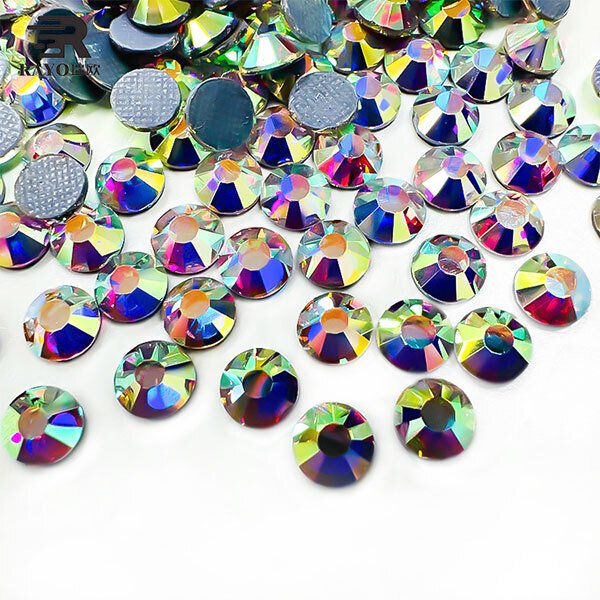
Landed Cost Comparison Direct Factory Supply Versus Local Deira Wholesalers
Deira Wholesale Markups versus Guangzhou Direct Sourcing
Design houses and apparel manufacturers across the UAE and Saudi Arabia traditionally purchase embellishments from regional trading districts like the Naif Souk and Deira textile markets in Dubai, or Batha market in Riyadh. While these markets provide immediate over-the-counter availability for emergency single-packet needs, sourcing production quantities through traders imposes massive cost inefficiencies.
Local traders operate with substantial commercial overheads, including showroom rent, local warehousing, import duties, and multi-tier distributor margins. By the time a packet of stones reaches an atelier workbench, its cost has inflated by 200% to 300%. Furthermore, local distributors frequently mix crystal grades within the same shipment, combining top-grade stones with cheap dead-stock lots to maximize trading margins.
By establishing a direct factory sourcing channel with Guangzhou Yiben, design houses bypass all intermediary layers. We supply freshly manufactured, single-batch stones inspected under strict optical tolerances, with express door-to-door delivery across the GCC.
| Procurement Metric | Dubai Deira Local Wholesaler | Guangzhou Yiben Factory Direct |
|---|---|---|
| Unit Price per Gross | $4.80 USD | $1.95 USD (K9 Optical Grade) |
| Subtotal (100 Gross) | $480.00 USD | $195.00 USD |
| Express Air Freight (DHL) | Included in local markup | $42.00 USD (3–4 Day Courier) |
| Customs Duty & UAE VAT (5%) | Hidden in retail markup | $11.85 USD |
| Local Pickup / Courier | $15.00 USD | $0.00 USD (Doorstep Delivery) |
| Total Landed Cost | $495.00 USD | $248.85 USD |
| Net Savings per 100 Gross | Baseline | $246.15 USD (49.7% Direct Savings) |
| Annual Savings (2,000 Gross) | Baseline | $4,923.00 USD Clean Profit |
For mid-sized abaya manufacturing facilities processing between 1,000 and 5,000 gross per month, switching to factory-direct supply yields annual material savings exceeding $25,000 to $60,000 USD. These capital reserves can be immediately reinvested into brand marketing, premium base textiles, or production automation.
—
Procurement Logistics and Express Air Delivery Across the GCC
Express Transit Schedules from Guangzhou Factory to Dubai and Riyadh
A frequent concern among Gulf fashion businesses considering overseas sourcing is shipping turnaround. Modest fashion trends move quickly, and production schedules for seasonal collections cannot tolerate month-long maritime delays.
Hotfix rhinestones are compact, dense, and high in value per kilogram, making international air express courier the standard delivery mode. Our logistics facility in Guangzhou is positioned adjacent to Baiyun International Airport (CAN), with direct air transport connections to Dubai International (DXB) and King Khalid International in Riyadh (RUH).
| Destination City | Primary Courier | Flight Transit | Total Door-to-Door |
|---|---|---|---|
| Dubai / Sharjah (UAE) | DHL / FedEx Air | Direct CAN-DXB | 3 to 5 Business Days |
| Abu Dhabi (UAE) | DHL Express | Via DXB / AUH | 3 to 5 Business Days |
| Riyadh (Saudi Arabia) | FedEx Priority | Direct CAN-RUH | 4 to 6 Business Days |
| Jeddah (Saudi Arabia) | DHL Express | Via RUH / JED | 4 to 6 Business Days |
| Doha (Qatar) | DHL / Qatar Cargo | Direct CAN-DOH | 4 to 5 Business Days |
| Manama / Kuwait City | FedEx Express | Regional Hub | 4 to 6 Business Days |
Because stock colors are kept constantly on hand in our central facility, orders received for standard catalog stones are packed and dispatched the same day payment clears. Production runs for custom motifs or special dye lots ship within 7 to 15 days, allowing atelier managers to plan collections with complete confidence.
Customs Clearance and Commercial Invoicing for UAE and Saudi Importers
Navigating customs clearance in the GCC is straightforward when documentation is executed accurately. Every shipment leaving our Guangzhou warehouse is accompanied by export documentation tailored for Gulf customs compliance: – Harmonized System (HS) Tariff Code: Declared accurately under `7018.10.00` (Glass beads, imitation pearls, imitation precious stones, and similar glass smallwares). – Commercial Invoicing and Packing Lists: Clearly itemizing gross counts, net/gross weights, country of origin (China), and precise HS codes to expedite instant port clearance. – Value Added Tax (VAT) Processing: Consignments arriving in the UAE clear customs under standard 5% VAT. Shipments entering Saudi Arabia are processed according to Zakat, Tax and Customs Authority (ZATCA) standards under 15% VAT.
For commercial accounts utilizing DHL or FedEx corporate accounts, import duties and VAT are cleared electronically, with packages delivered directly to your studio or warehouse without paperwork delays at the airport terminal.
—
Order Specifications Turnaround Times and Custom Motif Production for Ramadan
Navigating the Pre-Ramadan Production Surge
In the Gulf fashion calendar, the pre-Ramadan and Eid production cycle represents up to 60% of annual retail revenue. Between Shawwal and Shaban, ateliers operate at peak capacity, producing thousands of embellished abayas, festive jalabiyas, and evening kaftans.
During this frantic period, local Gulf distributors routinely run out of popular crystal sizes and shades, forcing designers to accept inferior substitutes or delay customer deliveries. Establishing a direct manufacturing partnership months ahead of the season protects your supply chain:
| Timeline Phase | Target Milestone | Action Items |
|---|---|---|
| 4 Months Prior (Jumada I) | Color Matching & Sample Approval | Request physical sample cards; confirm stone cuts & colors |
| 3 Months Prior (Jumada II) | Custom Motif Sampling & Tooling | Submit vector artwork for necklines & sleeves; test strike-offs |
| 2.5 Months Prior (Rajab) | Bulk Production Run Execution | Issue PO for bulk gross cartons; factory begins machine-set motifs |
| 2 Months Prior (Early Shaban) | Express Air Dispatch & Receipt | Shipments clear GCC customs; materials arrive at atelier benches |
| 1 Month Prior (Late Shaban) | Garment Assembly & Quality Control | Full garment production underway; zero stock-out risks |
Precision Custom Hotfix Motifs and Multi-Stone Transfers
Manually placing individual stones on intricate abaya necklines, sleeve cuffs, and back yokes is labor-intensive and error-prone. To accelerate atelier production, we engineer custom hotfix rhinestone motifs and continuous rhinestone trimming sheets.
Designers provide their unique design artwork in vector format (AI, PDF, or DXF). Our design division transforms the graphics into precision CNC-drilled template templates within 24 to 48 hours. We combine multiple crystal sizes (e.g., SS10, SS16, and SS20) and intersperse crystal stones with pearl cabochons, metallic dome studs, or custom-shaped baguettes.
The stones are vacuum-arranged onto heat-resistant, transparent Mylar transfer tape. Atelier press operators apply the entire neckline or sleeve motif in a single 12-second press cycle, reducing embellishment labor time by up to 85% while guaranteeing 100% design symmetry across every garment in the production run.
—
Frequently Asked Questions from Middle East Fashion Designers and Sourcing Agents
How do K9 hotfix crystals compare to Austrian and Czech brand crystals on black abayas?
Austrian and Czech crystal brands are renowned for optical precision, but their retail pricing is prohibitive for commercial apparel manufacturing, often costing 4 to 6 times more than factory-direct alternatives. Our K9 optical glass crystals deliver an identical refractive index (~1.9) and 14-facet precision geometry. When applied to dark abaya textiles, the visual fire and brilliance are indistinguishable to the human eye, providing couture visual elegance at a fraction of the component cost.
What minimum order quantity is required for custom colors or direct factory orders?
For catalog stock colors and standard sizes (SS6 to SS30), our minimum order quantity is just 2 packets per color and size (each packet contains 10 gross, or 1,440 stones, establishing a low barrier of 20 gross). For custom Pantone color matching or specialized vacuum coating finishes, the MOQ is typically 50 to 100 gross depending on stone diameter.
Will German grey adhesive damage delicate silk chiffon or thin organza fabrics?
When applied according to our recommended temperature and pressure settings (150°C to 155°C, 8 to 10 seconds, 2.0 to 2.5 bar pressure), our German grey adhesive does not scorch or bleed through fine silk chiffon, organza, or tulle. The adhesive melts cleanly into the fibers without lateral overflow, maintaining the sheer transparency and soft touch of the textile.
Can you match specific traditional Middle Eastern colorways like Jet Hematite and Golden Shadow?
Yes. Our standard factory inventory encompasses over 400 distinct shades, including classic Gulf colorways such as Deep Jet Black, Metallic Hematite, Golden Shadow, Champagne AB, Light Peach, Rose Gold, and Emerald Green. We maintain rigorous vacuum-sputtering tolerance controls across repeat manufacturing batches, ensuring that stones ordered today match the exact hue of stones reordered six months later.
How are sample cards and strike-offs dispatched to the UAE and Saudi Arabia?
We dispatch comprehensive physical color sample cards containing actual K9 crystal stones across our entire size and color spectrum via DHL Express. Sample cards generally arrive at your studio in Dubai, Abu Dhabi, or Riyadh within 3 to 4 business days, allowing you to inspect stone facet quality, test glue adhesion on your specific fabrics, and verify color refraction under your studio lighting before committing to volume production orders.
—
Explore Our Sourcing Guides and Factory Direct Support for the Gulf Region
Navigating international supply chains requires reliable technical data and transparent factory communication. To assist your production and design teams in mastering hotfix embellishments, consult our technical resources:
– Global Sourcing Guide for Hotfix Rhinestones: Master international logistics, HS codes, volume container planning, and direct China factory procurement strategies. – Industrial Washing and Hotfix Adhesive Standards: Comprehensive testing protocols for ISO 6330 wash durability, heat press temperature curves, and shear resistance. – Extreme Heat Adhesive Durability for Desert Climates: Discover why specialized modified polyamide adhesives outperform generic glues under intense sun and thermal cycling *(Gulf Series Spoke 3.1)*. – Continuous Rhinestone Trimming and Crystal Mesh by the Yard: Production guidelines for high-volume abaya cuffs, collar bandings, and flexible crystal fabrics *(Gulf Series Spoke 3.2)*.
Contact Guangzhou Yiben today via WhatsApp at `+86 13692450325` or email `rhinestonewholesale8@gmail.com` to request your complimentary K9 crystal sample card, submit vector artwork for custom Ramadan motif quotations, or discuss volume wholesale supply directly with our engineering team.

Need a size or color recommendation for your next order? Send us your fabric type, design, and target price — we reply within one business day. WhatsApp +86 13692450325 · rhinestonewholesale8@gmail.com