
How Do You Choose and Place Rhinestones on Prom Dresses and Evening Gowns
Quick answer K9 optical crystal hotfix stones are the default for prom dresses and evening gowns. They carry a refractive index around 1.9 with 12 to 14 facets and a Mohs hardness of 6-6.5, which is what throws fire under a stage rig or a camera flash. Match the stone to the panel instead of picking one size for the whole gown. SS16 and SS20 build the focal areas, SS6 to SS10 carry the gradients and outlines, and the base fabric decides how the stone is fixed. Everything below is written for the studios, ateliers and costume workrooms that build the gown.
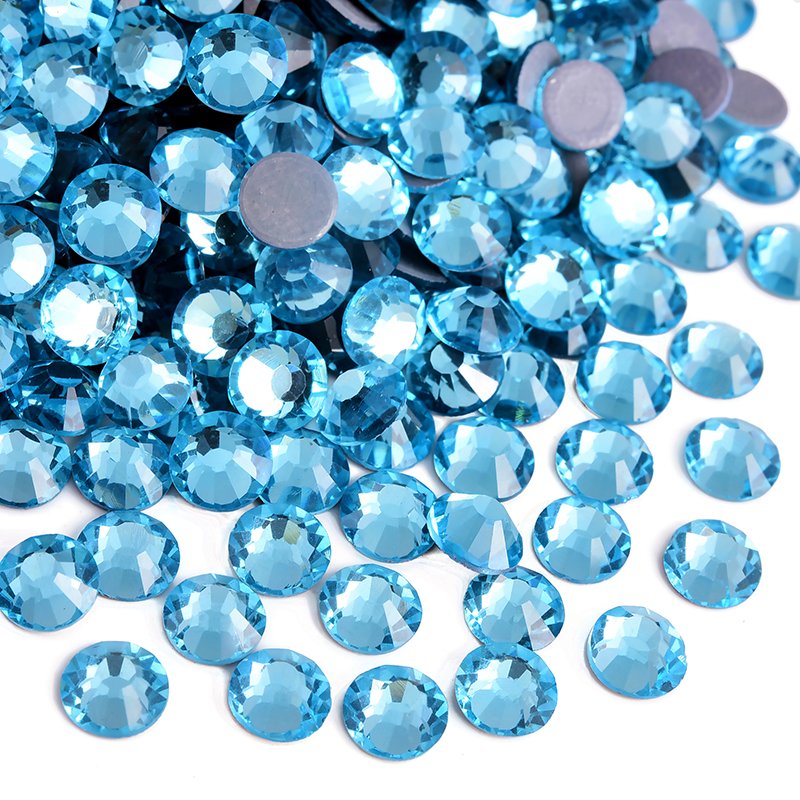
What rhinestones work best for prom dresses and evening gowns
K9 optical crystal is the baseline everyone in the trade measures against. A K9 stone is cut with 12 to 14 facets on a glass body with a refractive index near 1.9, and that pairing is what makes a stone read as moving light instead of a flat dot of colour. Acrylic and resin imitations sit around 1.49, so they lose their fire the moment the room light changes.
Two numbers decide how a gown looks from row ten. The first is facet count. Standard K9 carries 12 to 14 facets; pressed imitations often carry eight or fewer, and each facet you remove is a surface that no longer bounces light back at the audience. The second is hardness. K9 sits at Mohs 6-6.5 while acrylic sits at 2-3, and that gap matters on a garment that gets steamed, hung in a bag, loaded into a van, worn for a night and packed away again. Soft stones haze and scratch over a single season of bookings.
Size is the third variable, and it works as a hierarchy rather than a single choice. SS16 (4.0 mm) and SS20 (4.8 mm) carry the main visual weight. SS10 (2.8 mm) and smaller handle gradients, outlines and scatter. SS30 (6.4 mm) is a focal tool, not a coverage tool, and it belongs where a cluster or a single centred stone has to register from the back of a hall. We hold SS6 (2.0 mm) through SS30 (6.4 mm) as stock so a single bodice can mix four sizes without a special order.
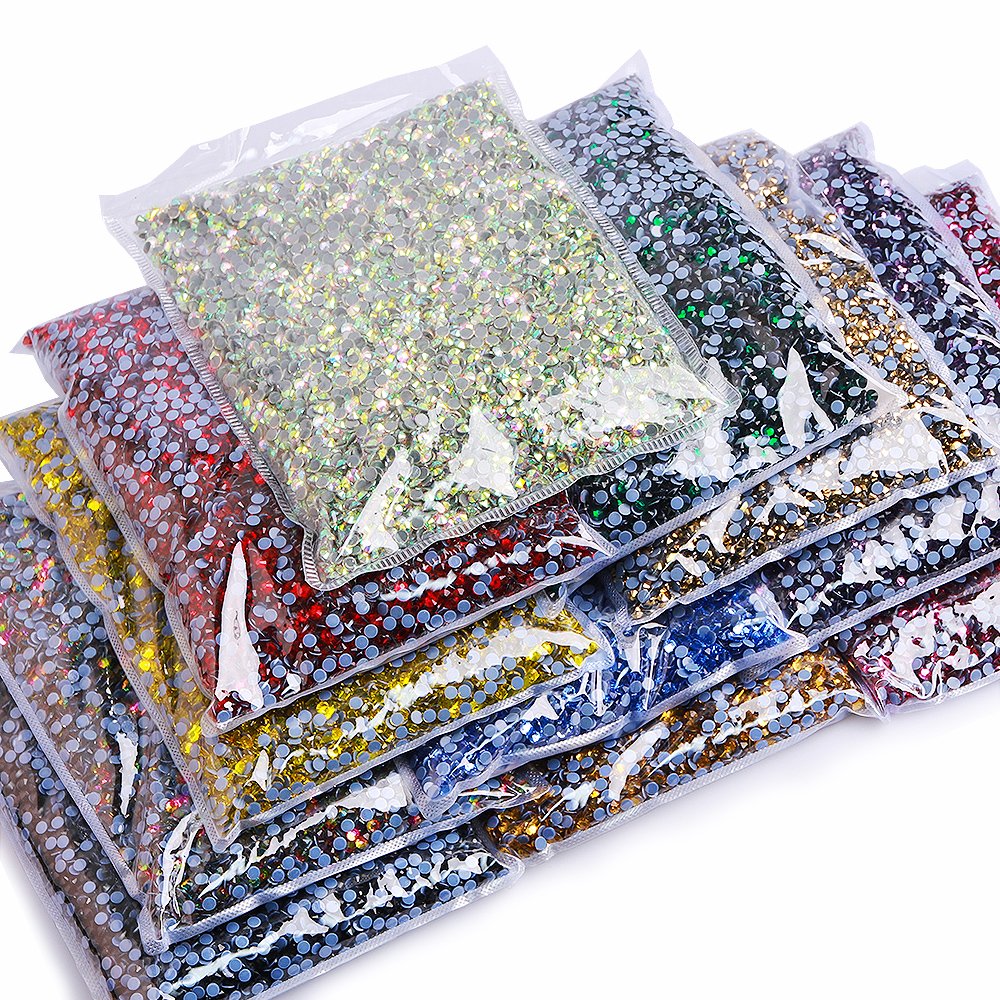
Colour range matters just as much for gown work, because collections move faster than most factories like. We keep more than 400 stock colours and match Pantone references when a designer needs an exact tone across many pieces. If you are sourcing for a full production line rather than a single dress, the buying side of this conversation lives on our page for wholesale rhinestones for pageant and prom gowns. This article stays on the making side, from the first fabric cut to the wash cycle.
Which fabric types can take hotfix rhinestones and which cannot
Hotfix works on any fabric that survives a short press at the adhesive’s working temperature without glazing, scorching or shifting. The German grey adhesive we pre-coat our stones with melts in a 150-170°C window and is worked at roughly 160°C, so the real question is how much heat your base will take. Cotton, stable woven blends and fused bodice panels are easy. Silk, chiffon, tulle and open mesh need a barrier, a lower setting, or a completely different fixing route.
| Fabric | Press setting | Risk | How to handle it |
|---|---|---|---|
| Cotton | 165°C, 40PSI, 15 seconds | Low, the fibre tolerates the full window | Good baseline for testing a new stone batch |
| Spandex, elastane or Lycra | 150°C, 30PSI, 12 seconds | Higher heat glazes or burns the fibre | Keep the dwell short and never re-press the same spot twice |
| Silk | 140°C, 20PSI, 10 seconds with a heat barrier sheet | Direct contact scorches the face | Always use a barrier and expect lower wash durability |
| Polyester satin | No single safe setting, test each dye lot | Heat can leave shiny press marks | Test on an inner facing first and use a barrier |
| Chiffon | Do not press directly, sandwich between layers | The fabric shifts and wrinkles under the platen | Fix to a stable backing or choose sew-on |
| Tulle and open mesh | Low heat with a barrier, or sew-on | The mesh points melt before the glue activates | Keep heavy stones off the open grid |
Silk is where most first attempts go wrong. The stone will bond at 140°C with a barrier sheet, but the face of the fabric is unforgiving and a single hot spot leaves a permanent sheen. Treat that lower setting as a ceiling rather than a target, and accept that a silk gown will not reach the same wash count as a cotton panel.
Spandex has the opposite problem. At 150°C the fibre is comfortable, but the fabric moves independently of the stone, so a stone that is only marginally stuck will pop the first time the garment stretches over a shoulder. Adhesion on stretch fabric has to be complete, not partial. The mechanics behind both cases are covered in our guide to how to apply hotfix rhinestones, and the temperature windows themselves are broken down in the article on rhinestone heat transfer temperature.
Where should you place rhinestones on a prom dress or gown
Placement follows weight and movement, not symmetry. Load the bodice where the panel is stabilised and the eye lands first. Lighten the shoulder line and straps where the garment flexes and carries load. Run the density down the skirt as a gradient so the sparkle builds toward the hem instead of stopping at a hard line halfway down the dress.
| Zone | Stone size | Density | Fixing note |
|---|---|---|---|
| Bodice and front panel | SS16 to SS20 | High, focal | Hotfix on a fused or lined panel so the face stays flat |
| Neckline edge | SS10 to SS16 | Medium, outline | Small stones hold the line, avoid SS30 on a thin edge |
| Straps | SS6 to SS10 | Light | Load-bearing and flexible, keep the weight down |
| Side seams and waist | SS10 to SS16 | Medium, gradient | Account for seam bulk, place after the seam is pressed open |
| Hem and train | SS16 to SS20 | Gradient, denser near the floor | More abrasion and floor contact, secure well |
| Skirt scatter | SS6 to SS10 | Light scatter | Reads as sparkle at distance and costs the least per square foot |
Straps are the panel that designers underestimate. A strap stretches every time the gown is put on, and it is often the first place a heavy stone pulls free. Cap the weight there. A small SS30 placed at the top of a strap as a deliberate focal point is fine, but a column of them along a thin strap is a repair waiting to happen.
The hem and train take the opposite kind of punishment. They touch the floor, the stair edge and the car door, so abrasion rather than stretching is the failure mode. Denser placement near the floor looks richest, but every stone in that band should have a complete bond and, on very heavy gowns, the option of a sew-on anchor. If you need the size-to-zone mapping in one place, our SS6 to SS30 size reference collects the whole scale.
Should you use hotfix, glue-on flatback or sew-on stones
Match the route to the base and the wash cycle, in that order. Hotfix for flat heat-tolerant panels, glue-on flatback for hard or heat-sensitive bases where no press is available, and sew-on for heavy stones or fabric that cannot take heat at all. Choosing by habit rather than by base is the single most common reason a gown sheds stones in the dressing room.
| Route | Best for | Avoid when | Durability |
|---|---|---|---|
| Hotfix with grey glue | Flat, heat-tolerant panels such as cotton, fused bodice, tested blends | Silk face fabric, chiffon, tulle, beaded or heat-sensitive bases | Up to 50 machine washes with under 2% loss on a tested base |
| Glue-on flatback | Hard or non-porous surfaces, no press available, sample and temporary work | Garments that will be washed often | Not built for repeated laundering, the glue line fails first |
| Sew-on | Heavy stones, delicate or heat-sensitive fabric, straps and closures | High-volume flat panels where speed is the priority | Highest, as long as the thread and stitch count hold |
Hotfix is the default for a reason. It is fast, it is consistent across thousands of stones, and with the German grey adhesive it survives a full wash test. The route only breaks down when the fabric cannot take the press, and no amount of extra time at the iron will fix a base that scorches at the working temperature.
Glue-on is the right answer when the base is rigid, non-porous or simply not heat-safe, and when a designer is mocking up a layout before committing to production. Two boundaries matter here. Apply the adhesive to the back of the stone and the base, never to the face. And treat glue-on as a fixed-wear solution rather than a washable one, because a hand-applied glue joint does not hold like a thermal bond and will give way after repeated cleaning. For samples and photo shoots that is fine. For a gown heading into a rental fleet it is not.
Sew-on is the heavy-duty option. It suits large SS30 stones, dense clusters and any fabric that refuses heat entirely. The reliability comes down to the stitch, and the standard method is to pass the thread through each hole two or three times before knotting, which spreads the load and stops a single cut thread from releasing the stone. It is slower than hotfix, so reserve it for the stones that genuinely need it.
How many rhinestones are needed to decorate a prom dress
Estimate by area, not by instinct. Full coverage runs about 576 SS16 stones per square foot, or about 400 SS20 stones over the same area, and you build the total from the square footage you actually cover plus a scrap allowance. A partial bodice treatment and a fully stoned skirt can differ by ten thousand stones on the same dress, so sketch the coverage map first and measure it.
| Application | Size | Stone count |
|---|---|---|
| Full coverage, 1 square foot | SS16 (4.0 mm) | About 576 |
| Full coverage, 1 square foot | SS20 (4.8 mm) | About 400 |
| Gown bodice or hem, partial | SS16 and SS20 mix | 2,000 to 5,000 |
| Performance costume, full body | SS6 to SS16 mix | 15,000 to 30,000 |
A worked example makes the numbers usable. A structured bodice of about half a square foot, fully covered in SS16, lands near 288 stones. Add an outlined neckline, a gradient down the side seams and a dense hem band and the same gown climbs past 3,000. Now imagine a competition costume where the entire garment is covered in a mixed SS6 to SS16 scatter. That piece sits comfortably inside the 15,000 to 30,000 range, and the small stones are doing most of that count.
Two practical notes. First, add five to ten percent for breakage, test pieces and the stones that end up on the floor. Second, remember that size carries weight. A fully covered SS30 panel is heavy, and on a lightweight bodice it can pull the fabric out of shape, so keep the large stones where the gown can support them.
Can a rhinestone prom dress be washed or dry cleaned
Yes, within limits set by the fabric and the adhesive. A gown pressed with K9 stones and German grey glue survives the ISO 6330 standard wash test with under 2% stone loss across 50 machine cycles. That figure assumes cotton or a tested blend at a cool setting. The same stones on silk or lightweight satin will not reach fifty cycles, and ironing directly over the stones will break the bond no matter what the fabric is.
| Cleaning method | Works for | Limit |
|---|---|---|
| Hand wash, cold, inside out | Most hotfix gowns | Keep the water cool and never scrub across the stones |
| Dry clean | Silk, beaded and structured bodices | Tell the cleaner which panels are stoned |
| Machine wash, gentle cycle | Cotton and tested blends | Sustained only with K9 plus grey glue, 50 cycles at under 2% loss |
| Direct ironing over the stones | Nothing | Scorches the glue and the fabric face |
| Tumble drying | Nothing | Heat and tumbling pull stones loose |
Dry cleaning is usually the safer route for a finished gown, especially if it has beading, boning or a silk face, because the solvent process avoids the water and heat combination that stresses the bond most. The one thing a dry cleaner needs to know is where the stones sit, so the pressing operator keeps the iron off those panels. Our washing rhinestone garments guide covers the cycle settings in more detail.
For studios producing repeatedly, the more useful habit is to wash a test swatch before the gown is assembled. Press a few stones onto the exact fabric and run the cycle it will realistically face. That one test tells you whether the piece is a machine-wash job, a hand-wash job or a dry-clean-only job, and it takes less time than the first repair.
Why do rhinestones fall off a gown and how do you prevent it
Most failures trace back to four causes, and they are usually visible before the gown leaves the bench. The fabric was not prepped, the pressure was too low, the base was contaminated, or the stones were coated with cheap yellow glue that melts below 130°C. Rank the cause before you change anything, because adding more heat to a contaminated panel makes the problem worse.
| Rank | Cause | What you see | Fix |
|---|---|---|---|
| 1 | Fabric not pre-shrunk or still holding sizing | Stones lift after the first wash | Pre-wash or steam the panel and remove the sizing |
| 2 | Too little pressure at the press | Stones sit on top and flick off | Raise pressure inside the fabric’s safe window |
| 3 | Contaminated or coated surface | Patches where the glue peels | Wipe the base clean and avoid silicone fabric sprays |
| 4 | Cheap yellow adhesive | Stones drop in heat or direct sun | Yellow glue melts below 130°C, specify grey glue at 150-170°C |
The first two causes are the ones we see most from studios that are new to production. Fabric fresh off the roll often carries a sizing or finish that sits between the glue and the fibre, so the bond forms against the coating instead of the cloth. A short pre-wash or a pass of steam removes it. Pressure is the other half of the equation, and an under-pressed stone looks identical to a properly set one until the garment is worn.
The adhesive itself is worth specifying rather than assuming. Economy yellow glue softens below 130°C, which means a hot car, a sunny window or a steamer can release it without any washing at all. Our stones are pre-coated with the German grey adhesive, which melts in the 150-170°C window and is worked around 160°C, giving the bond a thermal margin. If your failure traces to the glue rather than the technique, the full diagnosis and the industrial wash test behind it are set out in the article on preventing rhinestone peeling under ISO 6330 washing.
How do you keep the colour consistent across one gown or a whole collection
Buy the whole gown, or the whole collection, from one production batch, and keep a physical reference on the bench. Colour drift across a stoned gown shows up as a visible seam where one panel meets another, and on a staged photograph it shows up first. Preventing it is far cheaper than repairing it. We keep more than 400 stock colours and match Pantone references on custom runs, which is what lets a studio hold one exact tone across a bodice and a train that are pressed weeks apart.
The mechanism is simple. Every dye and coating lot has a tolerance, and a small tolerance is invisible on two stones side by side but obvious where a densely covered panel meets a lighter one. When you order the whole project from a single batch and keep a labelled swatch bag, a later reorder can be matched against that physical reference rather than against memory or a screen.
Two habits reduce the risk further. Group the panels that will touch, such as a bodice and its centre front, into the same pressing session so they come from the same stones. And when a designer asks for a tone that is not in the range, treat the Pantone match as the specification from the start, so the reference exists before the first stone is pressed.
What is the next step if you are fitting out a new collection
The fastest way to move from a sketch to a production plan is to send us the base fabric and a coverage map. Tell us the panels, the sizes you have in mind and the wash cycle the gown has to survive, and we will confirm which fixing route suits each area before you commit to a layout.
From there the sequence is simple. We send a swatch set so you can press a test piece on your own fabric. Once the layout and the colour are locked, stock colours ship the same day payment clears, and custom runs ship in 7 to 15 days depending on order quantity. Our minimum for stock colours is two packs per colour and size, which keeps a first run small enough to trial without tying up much capital.
Send your fabric swatch, your colour list and your quantity to rhinestonewholesale8@gmail.com or message us on WhatsApp at +86 13692450325. We reply with a 12-hour quote and free samples, and we will tell you plainly if a panel on your sketch is one where we would recommend sew-on instead of hotfix.
Need a size or color recommendation for your next order? Send us your fabric type, design, and target price — we reply within one business day. WhatsApp +86 13692450325 · rhinestonewholesale8@gmail.com