
Rhinestone Border Trim Wholesale, How to Pick by Backing, Width and Fixing Method
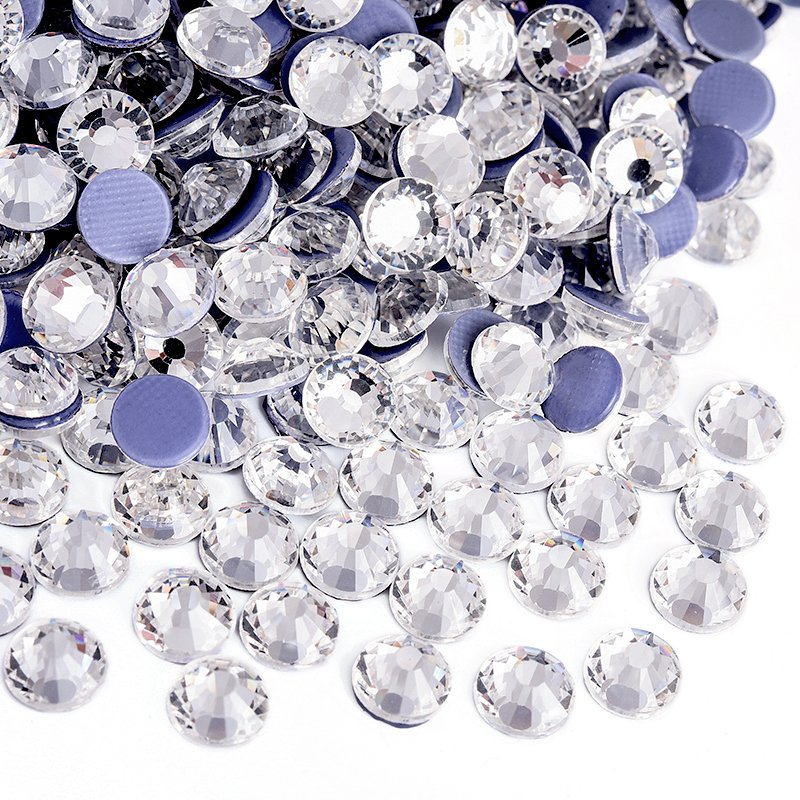
Quick answer A rhinestone border is a continuous strip of crystal stones already set onto a flexible backing, sold by the yard or the meter so you can run it along a hem, waistband, sleeve, strap or bag edge instead of placing stones one at a time. The backing decides almost everything — plastic base, net elastic, grosgrain ribbon, and tube or cord each bend, fix and wash differently. Our borders use K9 optical crystal (refractive index near 1.9, 12 to 14 facets, Mohs 6 to 6.5) set with a German imported heat-activated grey glue that melts between 150 and 170 °C and holds through 50 ISO 6330 wash cycles with under 2% stone loss. Stones run SS6 to SS30, finished widths land between roughly 8 mm and 2 cm, and the factory holds more than 400 colours with Pantone matching.
A border is the fastest way to put sparkle on a straight edge. It also hides its own problems well, which is the catch. Two strips that look identical in a photo can behave like different products once one is sewn onto jersey and the other is pressed onto a rigid bag panel. So this guide is written the way a buyer needs it. What the backing is, what a width actually means, which fixing method survives a wash cycle, how the price moves, and where the honest limits are.
What Is a Rhinestone Border and Which Backing Types Exist
A rhinestone border is a pre-set strip of crystal stones bonded to a flexible carrier, sold by length so the stones arrive already lined up and spaced. The carrier, not the crystal, is what separates one border from another. Four backing types cover nearly everything on the market.
The plastic base is the workhorse of straight edging. A clear plastic strip holds a single row of stones at a fixed spacing, so the line stays dead straight and the stones sit proud of the fabric. It is the go-to for bag edges, home decor, picture frames and any run where the fabric itself does not stretch. The trade-off is drape. A plastic base is the least forgiving on a soft curve, and it will not follow a stretchy cuff.
Net elastic is the opposite. Stones are set on an elastic mesh, so the strip stretches with the garment and springs back without tearing the film between stones. Dancewear, swimwear, leg openings, cuffs and anything that has to move with the body belong here. If you have ever watched a rigid trim pop off the back of a stretch leotard after one performance, that is the reason net elastic exists.
Grosgrain ribbon gives you a woven base that sews exactly like a normal ribbon. It holds a clean straight line, folds well around a curved neckline, and takes a needle without complaint. Sashes, uniform trim, headbands and waistbands are the natural fit. Because the base is textile, grosgrain is also the easiest of the four to sew by hand in a studio without special equipment.
Tube and cord sit at the decorative end. Stones are wrapped around a small cord or tube, which turns the strip into something closer to a beaded string — laces, hoodie strings, corset lacing, purse straps, bag handles. It curves freely, works on rounded shapes, and reads as jewellery rather than trim.
| Backing | How it behaves | Best on | Typical fixing | Watch out for |
|---|---|---|---|---|
| Plastic base | Stiff, holds a straight line, stones sit proud | Bags, decor, frames, rigid edging | Hotfix or glue | Poor drape on soft curves |
| Net elastic | Stretches and recovers with the fabric | Dancewear, swimwear, cuffs | Sew on or hotfix | Must be cut between stones, then sealed |
| Grosgrain ribbon | Woven, sews like ordinary ribbon | Sashes, waistbands, headbands | Sew on | Cut ends can fray if left raw |
| Tube or cord | Curves freely, reads as beading | Laces, strings, straps, handles | Knot and stitch the ends | Not for high-heat pressing |
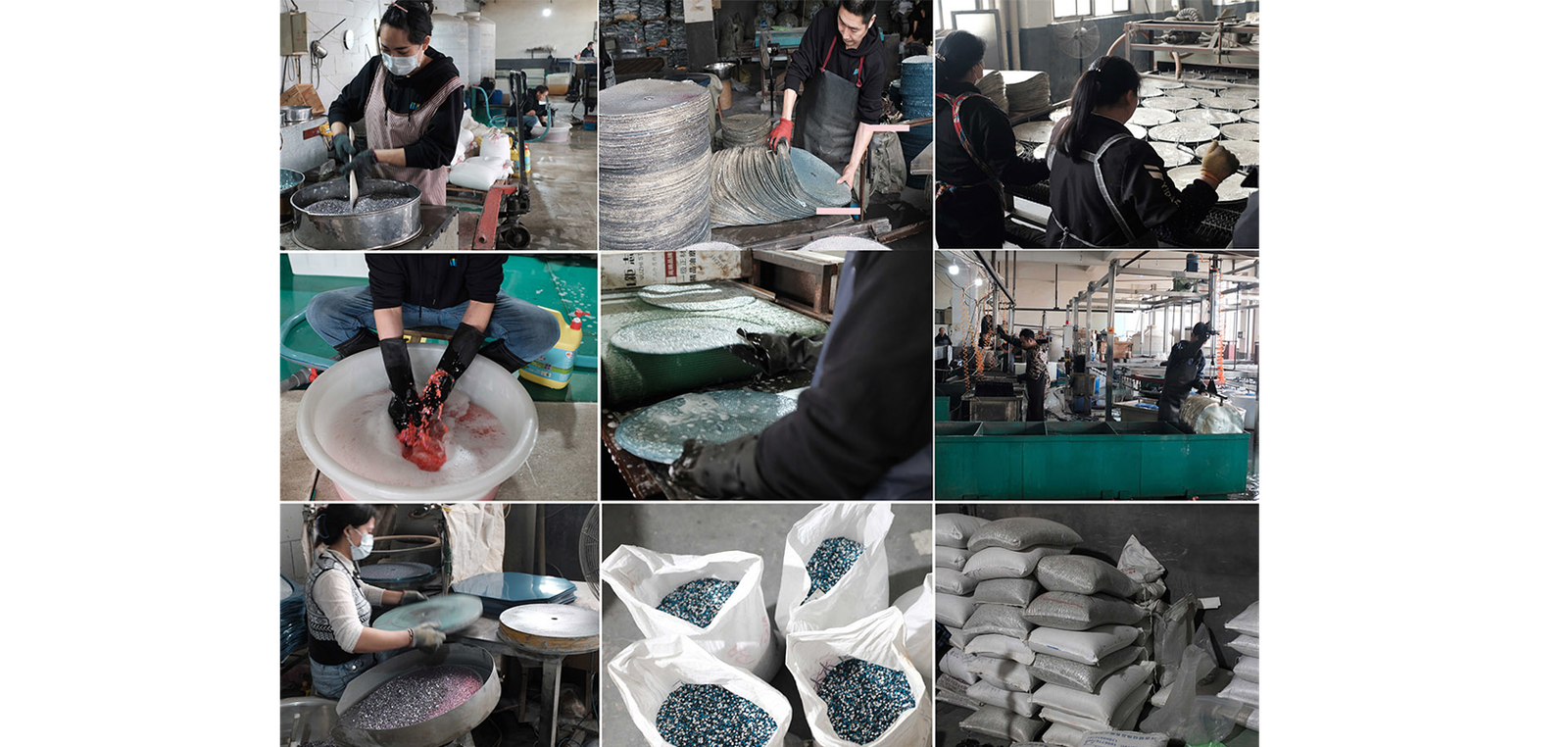
Behind every one of these strips is the same production line that supplies our loose stone range, run out of Guangzhou’s Baiyun district after 12 years of cutting crystal and beaded trim. If you want the wider picture of how the stones themselves are made before choosing a border, our Guangzhou hotfix rhinestone manufacturer with 12 years of glass crystal production page walks through the factory, the sizing, and the export side.
Send us a photo of the garment or bag you want to edge and our team will match a backing to it within 12 hours, with a free sample strip so you can press or sew it before you commit to bulk. WhatsApp is the quickest way to reach us at wa.me/8613692450325.
What Sizes and Widths Do Rhinestone Borders Come In
Stone size and finished width are two different numbers, and buyers mix them up constantly. The SS number tells you the diameter of each stone. The finished width tells you how wide the whole strip is once the stones sit on the backing. A two-row border of SS16 is not the same product as a single row of SS16, even though both are “SS16”.
The SS scale is a naming standard rather than a millimetre value, so here is the conversion for the sizes actually run. SS6 is about 2.0 mm, SS10 about 2.8 mm, SS12 about 3.2 mm, SS16 about 4.0 mm, SS20 about 4.8 mm, and SS30 about 6.4 mm. The whole range from SS6 up to SS30 is available, and smaller stones let you build a finer line while larger stones fill a width faster and read from further away. Our rhinestone size guide covers the full scale if you want more depth on any single size.
| Stone size | Diameter | Typical border use | Feel |
|---|---|---|---|
| SS6 | about 2.0 mm | Fine single-row accent, delicate lingerie trim | Subtle, glitter from close up |
| SS10 | about 2.8 mm | Standard single-row edging for garments and bags | Balanced sparkle, easy to sew |
| SS12 | about 3.2 mm | Slightly bolder single row, popular on dancewear | Noticeable line at arm’s length |
| SS16 | about 4.0 mm | Two-row work, waistbands, sashes | Strong line, reads across a room |
| SS20 | about 4.8 mm | Bold edging, statement hems and sleeve cuffs | Jewellery-like, heavier |
| SS30 | about 6.4 mm | Wide decorative bands, accessory and decor trim | Bold, best kept to straight runs |
Finished width then comes from the stone size multiplied by the row count, plus the visible backing. Single-row borders start around 8 mm and the widest bands reach roughly 2 cm on the ranges produced. Multi-row strips are quoted by both the row count and the width, because the same width can be built from different stone mixes.
For estimating a paved area rather than a line, the useful reference is that one square foot of solid coverage takes about 576 stones at SS16 or about 400 stones at SS20. A running border is a different calculation, because it depends on row count and how tightly the stones are set per meter — the exact stone count per meter is quoted alongside your sample so you can plan consumption against your run length without guessing.
Should You Sew, Hotfix or Use a Self-Adhesive Border
Pick the fixing method that matches both the fabric and the wear the piece will see. Sew-on is the most forgiving and the most permanent on textiles, hotfix is the fastest on flat heat-safe panels, and self-adhesive is for pieces that will not be washed hard.
Sew-on borders — grosgrain, net elastic and tube — are stitched through the backing or around the cord. You keep full control over tension, you can reposition before the final knot, and the strip survives washing as long as the thread does. The cost is labour: a hand-sewn border on a gown is a studio job, not a five-minute fix.
Hotfix borders carry a heat-activated adhesive on the underside. A press or an iron melts the glue into the fabric, and when the parameters are right the bond is stronger than most sewing for the same size stone. Our hotfix line uses a German imported grey glue that melts between 150 and 170 °C with a working temperature of 160 °C, and on stable fabrics it survives 50 ISO 6330 wash cycles with under 2% stone loss.
Self-adhesive borders are peel-and-stick. They are genuinely useful for costume pieces, photo shoots, temporary styling and paper or decor work, and they are the wrong choice for anything that will be machine washed repeatedly. Treat them as a one-event solution.
| Method | How it bonds | Best fabrics | Wash life | Tools |
|---|---|---|---|---|
| Sew on | Strong or fine thread through the backing | All textiles, including stretch and delicate | Lasts as long as the thread and fabric | Needle, thread, machine optional |
| Hotfix | Heat melts a pre-coated adhesive into the fibre | Cotton, polyester blends, spandex, denim | Up to 50 ISO 6330 washes on stable fabric | Heat press or iron |
| Self-adhesive | Pressure-sensitive peel-and-stick film | Anywhere, best on flat and rigid | Not built for repeated washing | None |
A good rule for mixed orders is to standardise on one method across a collection. If your bag line is hotfix and your dancewear is sewn net elastic, that is logical. If the same garment uses both with no plan, the wash behaviour becomes unpredictable for your customer.
How Is a Rhinestone Border Priced and Sold
Borders are sold by length, not by the pack. You will see quotes in yards or meters depending on the market, and the price per yard moves with four variables rather than one.
The four are stone density, row count, finished width, and stone size. A tight single row of SS20 costs more per yard than a single row of SS10, because each stone uses more crystal. A two-row border costs more than a single row of the same stone, because there is roughly double the material. A wide band built from multiple rows sits at the top of the range. Density matters too — stones set closer together use more material per meter than a spaced design.
Volume then reshapes the price again. Wholesale pricing is tiered by quantity, so the effective rate at a few hundred yards is lower than at a few yards, and the quote normally steps down across size bands. Because those bands are set per order and per specification, they are confirmed on the quote rather than published as a single number that would mislead a buyer working at a different volume.
For the arithmetic side — how to convert a garment’s edge length into yards, and how to compare a per-yard quote against a per-meter one — our companion piece on rhinestone trim by the yard walks through the calculation step by step. Use it alongside your sample so you are comparing like with like.
What Can You Use a Rhinestone Border On
A border belongs anywhere you want a continuous line of sparkle that follows an existing edge. The applications are broad, but the right backing changes with the surface, so match from the table rather than from the photo.
| Application | Suggested backing | Suggested width and size | Fixing | Note |
|---|---|---|---|---|
| Dress and gown hemline | Grosgrain ribbon | Single row, SS12 to SS16 | Sew on | Weight hangs well on a flowing skirt |
| Waistline and belt | Grosgrain or plastic base | Single or two row, SS16 to SS20 | Sew on or hotfix | Two row reads as a designed waistband |
| Sleeve and cuff | Net elastic on knit, grosgrain on woven | Single row, SS10 to SS16 | Sew on | Use elastic on anything that stretches |
| Neckline | Grosgrain ribbon | Single row, SS6 to SS12 | Sew on | Small stones sit flat on a curved edge |
| Wedding dress detailing | Grosgrain or tube | Single row, SS10 to SS16 | Sew on | Keep the line clean and consistent |
| Dance and stage costume | Net elastic | Single or two row, SS10 to SS16 | Sew on | Must stretch with the body |
| Swimwear | Net elastic | Single row, SS10 to SS12 | Sew on | Lighter stones resist pulling on thin fabric |
| Shoes and sneakers | Plastic base or tube | Single row, SS10 to SS16 | Hotfix or glue | Curved areas favour tube and cord |
| Bags and straps | Plastic base or tube | Single or two row, SS16 to SS20 | Hotfix or glue | Rigid backing holds a firm edge |
| Home decor and frames | Plastic base | Single row, SS20 to SS30 | Glue | No washing, so bond life is easy |
If you are placing a bulk border order against a cut sheet or a tech pack, send us the edge lengths and the application and our team returns a per-yard quote plus a free sample strip within 12 hours, so your pattern team can test the width before the production run. Reach us on WhatsApp at wa.me/8613692450325 or by email at rhinestonewholesale8@gmail.com.
What Is the MOQ and Delivery Time for Wholesale Borders
Our minimum on the stock stone line is one colour and one size from 2 packs, which keeps a first trial small. On assembled borders the minimum follows the specification — a narrow single row is easier to run in small quantity than a wide multi-row band — so the exact border minimum is confirmed on the quote rather than a blanket number that would not hold across every design.
Delivery time is fixed, not estimated. Stock colours ship the same day payment clears. Custom borders — a new backing, a private colour match, a wider band, your own packaging — ship in 7 to 15 days depending on order quantity, because a wide multi-row band takes longer to run than a narrow single row in the same colour. Either way the window is confirmed on the proforma invoice along with the shipping method.
Two things are worth pinning down before you order. First, the HS code for glass decorative trim is 7018.10, which is the code your customs broker will need, and the duty your market applies depends on your country’s current tariff schedule — the correct code and documents come with the shipment so your broker can clear it without a surprise. Second, freight choice changes the calendar more than production does. Air gets a small border order to your door quickly, while sea freight cuts the cost per unit on volume and adds transit time. Our comparison of sea versus air freight for wholesale rhinestone orders sets out how to decide between them.
For custom work the factory runs OEM and ODM, including private labels, so a border can ship with your own branding on the packaging. Confirm the artwork and the packaging spec early, because those two items, not the crystals, are usually what extends a custom timeline.
Will the Rhinestones Survive Washing
On stable fabric with the right parameters, yes. Our K9 crystal set with the German grey glue holds through 50 machine wash cycles under the ISO 6330 standard with under 2% stone loss. The same test on cheap acrylic stones with low-grade yellow glue shows more than 30% loss after only 5 cycles, which is the gap between a border that survives a season and one that survives a photo.
The mechanism is simple. Heat-activated glue that melts between 150 and 170 °C and cures at a working temperature of 160 °C forms a bond that locks into the fibre. A low-temperature glue that softens below 130 °C lets go the first time the garment sits in a hot car or goes through a warm cycle.
How you wash matters as much as how you pressed. Turn the garment inside out, use cold water, skip the dryer, and keep harsh bleach away from the glue line. Stone loss almost always starts at the bond, not in the crystal, so the wash routine protects the adhesive.
Here is the honest limit. On silk expect roughly 20 to 30 machine washes rather than 50, because the fibre itself is delicate and we lower the press temperature to protect it. On anything with heavy movement or a thin, stretchy weave, choose a net elastic backing and sew it, then treat the wash count as a guideline rather than a promise. Our guide to washing rhinestone garments covers the cycle settings in detail, and the short version for any single fabric starts with that same cold-water, no-dryer routine.
How Do You Apply a Rhinestone Border at Home
For a hotfix border, heat and pressure do the work, and the temperature has to match the fabric rather than the stones. Too cool and the glue never fully melts; too hot and you damage the fibre. Work on a hard, flat surface, not an ironing board with give in it, and use a press where you can control pressure.
| Fabric | Temperature | Pressure | Time | Extra step |
|---|---|---|---|---|
| Cotton | 165 °C | 40 PSI | 15 seconds | None |
| Spandex and other stretch knits | 150 °C | 30 PSI | 12 seconds | Lower heat protects the fibre |
| Silk | 140 °C | 20 PSI | 10 seconds | Add a heat-protection paper over the strip |
Lay the border flat, place the heat-protection paper over it if the fabric calls for one, and press in sections rather than trying to do a full hem in one go. Move along the strip with a small overlap so no stretch of glue is missed. Let the piece cool completely before you handle it, because the bond is still soft while warm.
If you are working without a press, an iron can work on a small run but it is hard to control pressure evenly, and uneven pressure is the usual reason part of a border lifts later. Our heat press machine review explains what to look for in a press if borders are going to be a regular part of your production.
Can You Use a Rhinestone Border on Any Fabric
Most fabrics take a border, but not all of them with the same method or the same expected life. The three parameters in the table above are the deciding factor, and a quick test on an offcut saves a ruined garment.
Cotton and cotton blends are the easiest and take the full 165 °C press with the strongest resulting bond. Polyester blends sit close behind. Stretch knits and spandex need the temperature dropped to 150 °C so the fibre does not scorch, and they hold up far better with a net elastic backing than with a rigid plastic base, because the strip has to move with the cloth.
Silk and other delicate fibres are the edge case. The press drops to 140 °C with 20 PSI for 10 seconds with heat-protection paper laid over the strip, and buyers are told plainly that the wash life is shorter than on cotton. Delicate fabric and heavy crystal do not mix well at high stone counts, so keep the design to a single row.
Two more limits worth stating before you order. Heavy, large stones look bold but carry real weight, so a full-pave border in SS20 or SS30 is a poor fit for a child’s garment where comfort and safety come first — keep those pieces to a light single row in smaller stones. And any fabric with a slick or coated surface, like a waterproof shell, needs a bond test before production, because the coating can resist adhesive regardless of how good the glue is.
Can You Cut a Rhinestone Border to Length
Yes, and the cut is where a lot of borders quietly fail. You can cut any of these strips to length, but how you cut decides whether the end frays, sheds stones, or holds.
For a plastic-base or hotfix strip, cut cleanly between two stones with sharp snips rather than through the middle of a stone. Cutting through a stone cracks it and leaves a ragged edge that will not press flat. Cut in a straight line so the new end matches the original.
For a net elastic border, cut between stones and then seal the exposed mesh so it cannot run. A tiny dab of clear fabric glue or a quick pass with a lighter held well away from the stones will stop the edge from unravelling — the same idea as sealing any mesh edge. Do not cut so close to a stone that the mesh has nothing to grip.
For a grosgrain border, the woven base is the part that frays, so seal the cut ribbon end with a fray-check liquid or fold it under by a few millimetres and stitch it down. For tube and cord, cut and then knot the end or melt the cord tip, which keeps the stones from sliding off.
Whichever backing you use, cut a little longer than the measured edge. A few extra centimetres lets you tuck the start under a seam or a fold, so the finished border reads as continuous rather than as a strip that begins in the middle of nowhere.
What Is the Ordering Process from Inquiry to Delivery
The process is short and the same for a two-yard sample and a two-hundred-yard production run. Knowing the steps in advance removes most of the uncertainty buyers feel about ordering trim from a distance.
You send the application, the edge length, the stone size and the colour, and any reference photo. The factory confirms the backing, the row count, the width and the fixing method, then quotes per yard or per meter with the quantity tiers. A free sample strip is cut and sent for you to press or sew against your own fabric. Once you approve, a proforma invoice follows with the specification, the delivery window — stock colours ship the same day payment clears, custom runs in 7 to 15 days depending on quantity — the HS code and the shipping method.
Production then runs against the approved sample, followed by a quality check before packing. Shipping goes by air or sea depending on your deadline and volume, with tracking and export documents handed over, and after-sales support stays open for any query on application or bond. Because the approved sample is the reference for production, and we retain a sample from your batch, a reorder has something concrete to match rather than a memory.
How Colour Stays Consistent Across Reorders
Colour drift is the complaint buyers raise most often about trim, and it is almost always a batch problem rather than a crystal problem. Two dye lots of the same named colour can sit a shade apart if nothing in the process controls them.
We handle it at three points. Stones are sorted by colour after coating so a named colour matches its reference before it is set onto a strip. Every batch runs through a quality check against the approved sample, so a shift is caught before packing rather than after the container arrives. And a retention sample is kept from each batch, which is what lets a reorder be matched months later against the exact run you first approved.
That matters more for borders than for loose stones, because a border is a long unbroken line. A faint shade change is invisible in a pile of stones and obvious along a hem. If a collection will run across several production batches, tell us up front so the colour can be planned as one lot. The standard colour range follows a fixed naming system, and Pantone matching covers anything outside it.
Explore the Rhinestone Trim Series
This is the pillar page for our rhinestone trim cluster, and it sits alongside two focused pieces that go deeper on the parts buyers ask about most. Read them next depending on which decision is blocking your order.
– Rhinestone trim by the yard — how to convert edge lengths into yards and meters, and how to compare a per-yard quote against a per-meter one without being misled by the unit. – Rhinestone tape — the three tape formats explained, what each one is actually for, and how to buy the right one for your application.
If you are still deciding on the stones rather than the trim, the wider wholesale rhinestone supplier hub covers sizing, colours, glue and export in one place.
Frequently asked questions
What is a rhinestone border used for? A border is used to run a continuous line of sparkle along an existing edge — hems, waistlines, sleeves, necklines, straps, bag edges and home decor. It saves placing stones individually, because the stones arrive already lined up on a backing. Choose the backing by the surface, since stretch fabric needs net elastic while rigid edges suit a plastic base.
How wide are rhinestone borders? Finished width depends on the stone size and the row count, not on the SS number alone. Our single-row borders start around 8 mm and the widest bands reach roughly 2 cm. A two-row SS16 strip is wider and heavier than a single row of the same stone, so always confirm both the size and the row count when you order.
Can rhinestone borders be washed? Yes, on stable fabric with a proper press. Our K9 crystal with German grey glue holds through 50 ISO 6330 wash cycles with under 2% stone loss, while cheap acrylic with yellow glue loses more than 30% after 5 cycles. Wash inside out in cold water and skip the dryer to protect the glue line.
What is the minimum order for wholesale rhinestone borders? Our stock stone minimum is one colour and one size from 2 packs, which keeps a trial small. Assembled borders depend on width and row count, so the exact border minimum is confirmed on the quote. OEM and ODM with private labelling are also available for buyers who need their own branding on the packaging.
Do rhinestone borders come in custom colours? More than 400 colours are held in stock, with Pantone matching for anything outside the standard range. Send the Pantone reference or a physical swatch and the stones are matched to it. For collections that will run across several batches, tell us in advance so the colour can be planned as a single lot.
Can I cut a rhinestone border without it fraying? Yes, if you cut between stones rather than through them. Seal a net elastic edge with a dab of clear glue, seal or fold a grosgrain ribbon end, and knot or melt a cord end. Cutting straight and leaving a few extra centimetres to tuck under a seam gives the cleanest finished result.
Are rhinestone borders sew-on or hotfix? Both formats exist, and the right one follows the fabric. Sew-on suits grosgrain, net elastic and tube backings, and it is the safer choice on delicate or highly stretchy fabric. Hotfix suits flat heat-safe panels and bonds strongly under a press at the fabric’s correct temperature, which is 165 °C for cotton and 150 °C for spandex.
How long does delivery take? Stock colours ship the same day payment clears. Custom borders ship in 7 to 15 days depending on order quantity, because a wide multi-row band takes longer to run than a narrow single row. The confirmed window goes on the proforma invoice. Air freight is faster and sea freight is cheaper per unit.
For a 12-hour quote and a free sample strip, message us on WhatsApp at wa.me/8613692450325, call or message +86 13692450325, or email rhinestonewholesale8@gmail.com.
Need a size or color recommendation for your next order? Send us your fabric type, design, and target price — we reply within one business day. WhatsApp +86 13692450325 · rhinestonewholesale8@gmail.com