
Rhinestone Trim by the Yard, Per-Yard Pricing and How Many Yards You Need
Quick answer Rhinestone trim by the yard is sold on length, not on a set stone count, so you pay for the yards you order, and the rate per yard moves with stone size, row count, trim width, and how tightly the stones are set. One yard is 0.9144 m, or about 91.4 cm. To size an order, measure the edge you are decorating, add roughly 10% for turning ends and waste, then multiply by the number of rows you want. Rolls commonly ship at 5 or 10 yards.
Most buyers open a trim listing, see a per-yard figure, and stall. Is that number a meter or a yard? How many rolls is 12 yards? Will it arrive as one strip or as a stack of offcuts? Those three questions decide whether a wholesale order lands on cost or comes in short, and the pages that rank for this search leave all three unanswered. So this page does the arithmetic for you: how a per-yard price is built, how to convert yards to meters, how many yards a neckline or a skirt hem actually eats, and how to cut the trim without watching it fall apart.
If your width, stone size, colour, and yardage are already set, send the list and you get a per-yard quote plus a free sample back within 12 hours. Reach us on WhatsApp at +86 13692450325 or by email at rhinestonewholesale8@gmail.com.
How Rhinestone Trim Is Priced by the Yard
A per-yard price covers one yard of finished trim with the stones and the base already assembled, not a fixed number of stones. That single line explains most quotes. A stone-heavy yard costs more than a sparse one even when both measure the same length, because the money is in how much crystal and how much setting work sit inside that yard.
Wholesale trimming is quoted by the yard because buyers cut from a roll and think in length — 20 yards of hemline here, 8 yards of neckline there. A supplier in another country may quote by the meter instead, which is the same strip measured two ways. A yard is a fixed 36 inches, so 10 yards and 9.144 meters describe an identical amount of trim. Retail sellers sometimes split the same roll into single full-yard increments and charge more for the convenience of a one-yard cut. For anything past a couple of garments, the by-the-yard route is cheaper and more flexible, since you order the exact length a job needs instead of buying fixed packs and hoping.
Everything on this line comes out of our Baiyun District factory in Guangzhou, where the crystal is cut and the trim assembled under one roof. That is why the Guangzhou hotfix rhinestone manufacturer behind 12 years of production matters for a by-the-yard order: the stones and the base are matched in the same building rather than bought from two different suppliers and hoped into alignment. The base type you choose changes the per-yard rate as well, and every base option is set out in our rhinestone border trim guide, so you can pick the strip that fits your garment before you ask for a price.
What Drives the Price Per Yard
Four things move the number more than anything else, and they are the four you should name when you ask for a quote.
| What changes | How it moves the per-yard price | What to tell us when you ask |
|---|---|---|
| Stone size, SS6 to SS30 | Larger stones use more crystal per stone and take longer to set, so SS20 and SS30 yards price above SS6 yards | The SS number, or the finished look you want |
| Number of rows | A double or triple row roughly doubles or triples the stones packed into the same yard | Single, double, or triple row |
| Trim width | Wider trim carries more stones and more base material per running yard | Finished width in mm or cm |
| Stone density | A tightly set yard costs more than a spaced-out yard of the same width | Dense, medium, or spaced |
| Backing and material | Net elastic, ribbon, tube, and plastic base carry different costs and behave differently in finishing | How the trim will be attached |
| Finish and colour | AB and special finishes cost more than a plain crystal tint, and custom Pantone shades run in smaller batches | A stock colour, or a Pantone reference |
Stone material sits behind all of it. The stones we use are cut from K9 optical crystal glass: a refractive index near 1.9, 12 to 14 facets, and a Mohs hardness of 6 to 6.5. Acrylic look-alikes sit near 1.49 and scratch far more easily, so they read flat next to a crystal yard under the same light. Two trims priced per yard can photograph the same and behave nothing alike once they are on a finished dress that is handled, folded, and worn.
Volume changes the rate as well. The more yards you take in one colour and spec, the better the per-yard figure, because setup and stone handling are spread across a longer run instead of a short one. That is the whole logic behind tiered yard pricing, and it is why wholesale buyers consolidate colours into a single order rather than reordering every week.
Want the per-yard rate on your own spec? Send the width, SS size, colour, and yardage to rhinestonewholesale8@gmail.com or wa.me/8613692450325, and a quote with a free sample comes back within 12 hours.
How Many Yards of Rhinestone Trim Do I Need
Measure the edge you are trimming, add 10% for turning ends and waste, then multiply by the number of rows. That is the working rule. A crew neckline usually needs under a yard, a straight midi hem around two yards, and a full wedding skirt hem four to six yards for a single row.
Rhinestone trim is not a returnable short order, so the small allowance earns its keep. Measure the finished circumference, not the flat width of the pattern piece, because a neckline that measures 30 cm across the front can run 60 cm once it is sewn into a curve. Add the 10%, round up to the nearest half yard, and order that.
| Placement | Typical finished run | With the 10% allowance | Yards to order, one row | Yards to order, two rows |
|---|---|---|---|---|
| Crew neckline | 55–65 cm | about 0.7 m | 0.7–0.8 yd | 1.4–1.6 yd |
| Waistline or belt | 75–95 cm | about 1.0 m | 0.9–1.1 yd | 1.8–2.2 yd |
| Sleeve cuffs, pair | 2 × 22–28 cm | about 0.55 m | 0.5–0.7 yd | 1.0–1.3 yd |
| Straight midi hemline | 130–170 cm | about 1.7 m | 1.6–2.1 yd | 3.2–4.2 yd |
| Full wedding skirt hem | 300–500 cm | about 4.4 m | 3.6–6.0 yd | 7.2–12 yd |
For a garment with several trimmed edges, add the rows together before rounding, then buy once. A dress with a neckline, two cuffs, and a hem in a single row lands near four yards, not three; the extra half yard you dislike paying for is cheaper than a second shipment.
Yard to Meter and Inch Conversion for Trim Orders
When one supplier quotes per meter and another per yard, convert before you compare, or the cheaper-looking figure can be the dearer one. One yard is 0.9144 m, or 91.44 cm, or 36 inches. One meter is 1.0936 yard, so a meter always buys you slightly more trim than a yard.
| Yards | Meters | Centimetres | Inches |
|---|---|---|---|
| 1 | 0.9144 | 91.44 | 36 |
| 2 | 1.8288 | 182.88 | 72 |
| 3 | 2.7432 | 274.32 | 108 |
| 5 | 4.572 | 457.2 | 180 |
| 10 | 9.144 | 914.4 | 360 |
| 20 | 18.288 | 1828.8 | 720 |
| 50 | 45.72 | 4572 | 1800 |
Read the other way and 10 meters is 10.936 yards — just under 11. If a European mill quotes you 10 meters and a Chinese factory quotes 10 yards, the mill is selling you 9.36% more trim for the same headline length, which is exactly the kind of gap a per-yard comparison is meant to expose. Keep one unit across a project and convert the quotes, not the orders.
What Length Does a Roll or Card of Rhinestone Trim Hold
Rolls and cards are the two standard forms this trim ships in, and the length on each is a fixed trade convention rather than a per-order decision. As an industry standard, rolls and cards of rhinestone trim commonly carry 5 yards or 10 yards. A roll is the wholesale form, wound on a spool for cutting from; a card is a flat winding used more for retail display and short runs. When you order 30 yards in one colour, that is normally three 10-yard rolls, not one 30-yard reel.
That leads to the question suppliers rarely answer in writing. Does a multi-yard order arrive as one continuous length, or as joined pieces? In this trade the rule is that a full roll is a single continuous strip with no joins, and when you buy several yards of the same colour and the same spec, most factories cut from one continuous run to give you as few cut points as possible. That is the practice here.
Honesty matters more than the promise, though. Continuous length can only be guaranteed when the colour, the size, and the production batch are all the same. If a 40-yard order mixes two colours, or a single row with a double row, the trim has to be produced on separate runs and will arrive in segments, however carefully it is packed. Plan multi-colour orders knowing that the strip changes at the colour change, and keep each colour’s yardage whole.
Can You Cut Rhinestone Trim to Length Without It Unraveling
Yes, but the cut itself decides whether the end stays neat. Cut through the gap between two stones, never through a stone or its setting, and seal the raw end on cord or tube trims so it cannot fray open.
Here is where most guides stop at “easy to cut” and leave you with a frayed end two weeks later. The practice that holds up is more specific. Lay the trim flat and find a stone-free interval, then cut dead centre in that gap with sharp, straight scissors — a blunt blade that lands on a stone chips the setting and starts a run. On a woven or net-backed trim, add a dab of clear fabric glue or a careful touch of heat to the cut end so the threads stop travelling. On a cord or tube trim, a brief pass of heat near the end melts the fibre and fuses it closed.
Leave a little more than the mark. Cut one full stone-interval past your finish line, because you lose a few millimetres turning the end under and sewing it down, and a trim cut exactly to length ends up short on the last corner.
One boundary worth stating plainly. A cut sealed by hand at the stone gap is enough for a garment that is worn and spot-cleaned, and for most costume and eveningwear work. It is not the same as a factory heat-cut edge, and a hand-sealed end is not the thing to rely on for a piece that goes through a machine wash cycle every week for years. If a long-wearing, machine-washed item needs sealed trim ends, ask for factory-cut and sealed lengths when you place the order rather than cutting them in your own workshop.
What Sizes and Widths of Rhinestone Trim Can You Order
Trim runs in the SS6 to SS30 stone range, with the finished strip width marked in mm or cm alongside the SS number, so the same design can be ordered narrow for a neckline or wide for a hem. The full chart of every size, how each SS number converts to millimetres, and how size changes the look of a trim is on the rhinestone border trim sizing and width chart — worth a look before you lock a width, because width is one of the four factors that sets your per-yard rate. If you only need the stone-by-stone conversion, the SS6 to SS30 size guide has it.
Do Backing and Material Types Change What You Order
They change both the handling and the per-yard rate. A trim can sit on a plastic base, a net elastic, a tube or cord, or a grosgrain ribbon, and each base flexes, seals, and attaches differently. The full comparison of base types, and which one suits a hem versus a shoe versus a corset, lives on the pillar page linked above, so only the one-line version stays here: the base decides how the trim moves on the garment, not just what it costs.
How Do You Attach Rhinestone Trim to a Garment
The three routes are sew-on, hotfix, and glue, and the choice follows the base you picked. A hotfix-backed trim presses on with our German grey hot-melt adhesive, which melts between 150 and 170 °C and works at 160 °C, at 165 °C and 40 PSI for cotton, 150 °C and 30 PSI for spandex, or 140 °C and 20 PSI for silk. Because the attach method belongs with the wider border guide, the step-by-step for each route sits on the pillar page rather than here.
MOQ and Delivery Time for Rhinestone Trim
| Item | Detail |
|---|---|
| Minimum order | Single colour, single size, from 2 packs |
| Stock colours | Over 400 colours held in stock, plus Pantone matching for custom shades |
| Custom work | OEM and ODM with private labelling available |
| HS code | 7018.10 for glass beads and imitation jewellery, for customs paperwork |
| Lead time | Stock colours ship the same day payment clears · custom runs ship in 7 to 15 days depending on order quantity |
Because trim price follows the specification and lead time follows the order — stock colours ship the same day payment clears, custom runs ship in 7 to 15 days depending on quantity — both are best confirmed together on the same quote. What is fixed is the minimum: a single colour in a single size starts at 2 packs, which suits a studio testing a colour before a season. For freight planning, whether a trim order travels by sea or by air changes the landed cost as much as the trim itself, and the guide to sea versus air freight for wholesale rhinestone orders works through that split.
What Can Rhinestone Trim Be Used On
Trim earns its place wherever an edge wants a line of light — a neckline, a waistline, a hemline, a sleeve cuff, the bodice seam of an evening gown, a wedding dress skirt, a shoe strap, or a bag handle. The same yardage math applies to all of them: measure the run, add 10%, and count the rows. Home decor uses the same trim on cushion edges, curtain tiebacks, and lampshade rims, where length is measured flat instead of in the round.
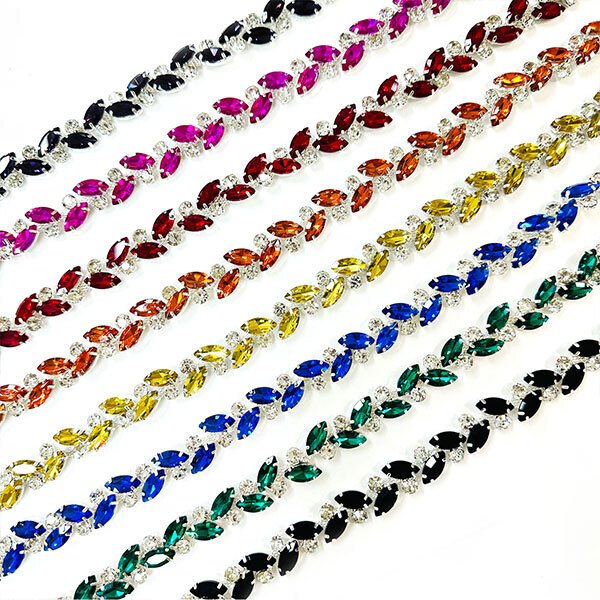
For multi-colour work, a mixed-toned chain trim lets one continuous length carry several colours without a visible join, which sidesteps the segment problem that a two-colour roll order always hits. The multicolor marquise chain rhinestone trim is built for exactly that use, and it is worth seeing beside a single-colour yard if your design leans colourful. And if the finished piece will be washed rather than dry-cleaned, read the guide to washing rhinestone garments before you commit the whole order.
Where to Go Next
This page has done the per-yard math: how a price is built, how many yards an edge takes, how to convert between yards and meters, and how to cut a length cleanly. Three deeper reads carry you the rest of the way.
– Rhinestone Border Trim Guide — base types, size and width charts, fixing methods, MOQ, and care, the full picture behind every by-the-yard question here. – Rhinestone Size Guide SS6 to SS30 — every size in millimetres with coverage counts. – Global Shipping for Wholesale Rhinestone Orders, Sea vs Air Freight — how to move a trim order without losing the margin. – Multicolor Marquise Cut Rhinestone Chain Trim — one length, several colours, no visible join.
Ready to price your own spec? Send the width, SS size, colour, and yardage to wa.me/8613692450325 or rhinestonewholesale8@gmail.com, and a per-yard quote with a free sample comes back within 12 hours.
Frequently asked questions
How is rhinestone trim priced by the yard? You pay for one yard of finished trim with the stones and base included, not a fixed stone count. The rate per yard rises with larger SS sizes, more rows, wider trim, and denser stone setting. Buying more yards in one colour and spec lowers the per-yard rate, so consolidating an order pays off.
How many yards of rhinestone trim do I need for a hemline? Measure the finished hem circumference, add 10% for turning ends and waste, and multiply by the number of rows. A straight midi hem runs about 1.6 to 2.1 yards in a single row; a full wedding skirt hem takes 3.6 to 6 yards. Round up to the nearest half yard and order once.
Does rhinestone trim come in one continuous length? A full roll is one continuous strip with no joins, and same-colour, same-spec orders are usually cut from a single run. Continuous length can only be guaranteed when colour, size, and batch all match. A multi-colour or mixed-spec order is produced on separate runs and will arrive in segments.
Can I cut rhinestone trim without it unraveling? Yes. Cut in the gap between two stones, never through a stone or setting, using sharp scissors. Seal the raw end on net or woven trims with a dab of clear fabric glue, and melt the tip of a cord trim with brief heat. A hand-sealed end suits spot-cleaned garments, not weekly machine washing.
What is the minimum order for rhinestone trim? The minimum is a single colour in a single size, from 2 packs. That lets a studio test a colour before committing to a full season. OEM and ODM with private labelling are available, and over 400 stock colours are held alongside Pantone matching for custom shades.
How do I convert yards to meters for a trim order? One yard is 0.9144 m, or 91.44 cm, or 36 inches, and one meter is 1.0936 yard. So 10 meters is 10.936 yards, meaning a meter quote buys slightly more trim than a yard quote. Convert every quote to one unit before comparing prices.
Is rhinestone trim sold by the yard or by the meter? Wholesale trims are usually quoted by the yard, since buyers cut from a roll and order by length. Some mills and retail sellers quote by the meter or in single full-yard increments instead. Both describe the same strip, so convert to a single unit before you compare two quotes.

Need a size or color recommendation for your next order? Send us your fabric type, design, and target price — we reply within one business day. WhatsApp +86 13692450325 · rhinestonewholesale8@gmail.com