
Partnering with a China Rhinestone Manufacturer – What to Verify Before You Sign
Introduction: The Growing Demand for High-Quality Rhinestones
In the competitive landscape of the global fashion, apparel, and accessories industry, the brilliance of a rhinestone is more than just an aesthetic choice—it’s a mark of quality and a differentiator for brands. For businesses operating at a B2B level, whether you’re a garment manufacturer, a distributor of craft supplies, or a private-label fashion house, sourcing the right components is the foundation of your success. China, particularly Guangzhou, has long stood as the global powerhouse for rhinestone production. However, for many international buyers, navigating the vast network of suppliers in the “World’s Factory” can be daunting. Is that “manufacturer” you’re talking to actually a factory, or a trading company taking a significant cut? How can you ensure the consistency of hotfix glue across a million-piece order? This guide is designed to peel back the layers of the China rhinestone market, providing you with a roadmap to identify, vet, and build a lasting partnership with a genuine hotfix rhinestone manufacturer like Yiben in Guangzhou. Our Guangzhou hotfix rhinestones manufacturer page documents exactly what a capable partner looks like.
Section 1: The Landscape of China’s Rhinestone Industry
China accounts for the vast majority of the world’s rhinestone production, ranging from economical resin stones to high-precision machine-cut glass crystals. Within China, several hubs specialize in different grades of production. However, for hotfix rhinestones—the cornerstone of the global garment decoration industry—Guangzhou and its surrounding districts (like Panyu) represent the pinnacle of quality and technological advancement.
Guangzhou: The Epicenter of High-End Hotfix Rhinestones
Guangzhou isn’t just a trading hub; it’s a manufacturing powerhouse. While other regions might focus on mass-produced, lower-grade stones, Guangzhou factories have historically invested in the precision machinery required for high-index glass and advanced adhesive technologies. The proximity to the world’s largest fabric and garment markets gives Guangzhou manufacturers an edge in understanding fashion trends and the technical requirements of modern textile applications.
Why Source From China Directly?
The primary driver for B2B buyers is, of course, the cost-to-quality ratio. By sourcing directly from a China rhinestone manufacturer, businesses can achieve a significant reduction in Unit Cost (CPU). But it’s not just about the price. Direct manufacturer access provides:
- Customization Capabilities: The ability to develop unique colors, sizes, and even shapes that aren’t available in standard catalogs.
- Production Priority: During peak seasons, being a direct partner with a factory ensures your orders aren’t bumped by a trading company’s larger clients.
- Technical Accountability: If a batch of hotfix glue fails, you speak directly to the chemists and production managers responsible for the formula.
Section 2: The Critical Choice: Trading Company vs. Source Factory
One of the most significant challenges for international B2B buyers is identifying whether they are dealing with a trading company (middleman) or a true source factory. In the rhinestone industry, this distinction can mean a 20-40% difference in price and a world of difference in technical support.
What is a Trading Company?
A trading company typically does not own its own manufacturing facilities. Instead, they source products from various small and medium-sized factories across China. They often have slicker websites and better English-speaking sales staff, but they lack direct control over the production line. For a B2B buyer, this creates a “black box” where you don’t know who is actually making your product.
The “Source Factory” Advantage (The Yiben Model)
A source factory, such as Yiben in Guangzhou, owns its machinery, manages its workforce, and controls the entire supply chain—from raw glass material to the final application of the hotfix adhesive. Here’s why the source factory model wins for B2B:
- Transparent Pricing: No hidden markups. You pay for the material, the labor, and the factory’s margin.
- Quality Consistency: Trading companies may switch factories to save costs, leading to inconsistencies between batches. A source factory uses the same molds, machines, and raw materials every time.
- Faster Lead Times: By cutting out the middleman’s communication lag, orders go straight into the production queue.
How to Spot a Real Manufacturer
- Check the Business License: Look for “Manufacturing” or “Production” in the business scope (经营范围) of their Chinese business license. Trading companies will often only list “Sales” or “Import/Export.”
- Ask for a Live Video Tour: A real manufacturer like Yiben will have no problem showing you their floor in real-time. If they hesitate or show you a showroom only, be suspicious.
- Review the Product Catalog: Trading companies often have “too many” products across unrelated categories. A focused manufacturer will specialize in a specific niche, such as hotfix rhinestones and related heat-transfer products.
Section 3: Understanding Rhinestone Quality: Machine Cut vs. Hand Cut
Not all rhinestones are created equal. The method of production dictates the brilliance, the symmetry, and the overall value of the stone.
Machine-Cut Rhinestones: The Gold Standard
Modern B2B requirements for high-end fashion demand machine-cut stones. These are produced using high-precision automated grinding and polishing machines. The facets are perfectly symmetrical, leading to a higher refractive index (more sparkle). In a B2B context, machine-cut stones are essential for automated stone-setting machines, as their uniform size prevents jams.
Hand-Cut/Molded Stones: The Budget Alternative
Lower-grade stones may be molded or hand-polished. While cheaper, they lack the sharp edges and flat backs required for high-quality hotfix application. These stones often have “seams” and inconsistent heights, which can lead to uneven pressure during the heat-transfer process, causing the stones to fall off later.
The Yiben Quality Benchmark
At a leading factory like Yiben, the focus is on 12-facet or 16-facet machine-cut glass. By utilizing advanced German or Japanese-inspired grinding technology, the stones achieve a brilliance that rivals premium European brands at a fraction of the cost. This is the quality level required for B2B distributors who need to compete in the mid-to-high-end market.
Section 4: The Core of the Partnership: Factory Audits and Vetting
Before committing to a high-volume B2B order, a thorough audit is non-negotiable. This process ensures the factory can meet your standards and scale with your business.
Production Capacity: Can They Scale?
In the world of wholesale, capacity is king. You need to know that your partner can handle a sudden 10-million-piece order without compromising quality. A professional Guangzhou manufacturer should have:
- Multiple automated production lines.
- Specialized departments for sorting and grading (Size consistency is critical!).
- A dedicated QC (Quality Control) team at every stage.
Social and Environmental Compliance
Global brands now require their suppliers to meet specific ethical standards. When vetting a China rhinestone manufacturer, look for:
- ISO 9001: For quality management systems.
- OEKO-TEX Standard 100: Critical for hotfix rhinestones used in apparel, ensuring the stones and glue are free from harmful substances.
- SGS/Intertek Reports: Verification of lead content and adhesive strength.
The On-Site vs. Remote Audit
If you cannot visit Guangzhou in person, hire a third-party inspection service. They can verify the factory’s physical address, the number of employees, and the condition of the machinery. However, for a long-term B2B partnership, many buyers find that a single visit to the Yiben facility in Guangzhou pays for itself by solidifying the relationship and clarifying technical expectations.
Section 5: The Manufacturing Process: From Raw Material to Sparkle
Understanding how a rhinestone is made allows B2B buyers to better communicate their technical requirements. A true factory like Yiben maintains control over several key stages:
1. Raw Material Selection
The journey begins with high-index glass. The lead content and chemical composition of the glass determine the clarity and “fire” of the stone. Premium manufacturers use specialized “crystal glass” that minimizes impurities.
2. Precision Cutting and Grinding
The raw glass is fed into automated machines that cut the facets. The more facets a stone has, the more light it reflects. 12-facet and 16-facet cuts are the current industry standards for high-end wholesale.
3. Foiling and Backing
A vacuum-plating process applies a silver or aluminum foil to the back of the stone. This foil acts as a mirror, reflecting light back through the facets. The quality of this foiling is vital; low-quality foiling will oxidize and turn black over time.
4. Hotfix Adhesive Application
This is perhaps the most critical step for B2B apparel manufacturers. The hotfix glue (often a grey or clear German-style glue) is applied to the foiled back. It must have a consistent melting point and a strong bond that survives multiple wash cycles. A manufacturer like Yiben tests every batch for washability and shear strength.
Section 6: Customization and OEM/ODM Services
In a saturated market, differentiation is key. Partnering with a manufacturer allows you to go beyond the standard SS10 and SS16 Clear Crystal stones.
Color Matching and Development
Factories can produce stones in thousands of colors and finishes, including the popular AB (Aurora Borealis) coating, neon hues, and metallic finishes. If you have a specific brand color, a source manufacturer can provide color-matching services to create a proprietary stone for your line.
Custom Shapes and Packaging
While round chatons are the standard, B2B buyers often require hearts, stars, baguettes, or custom shapes for unique designs. Furthermore, a manufacturer can provide private-label packaging, ensuring that when the rhinestones arrive at your warehouse, they are ready for retail or distribution under your own brand.
Section 7: Logistics, Supply Chain, and Bulk Order Management
Guangzhou’s location is a strategic advantage for logistics. As a major port city, it offers multiple shipping options to global markets.
Managing Lead Times
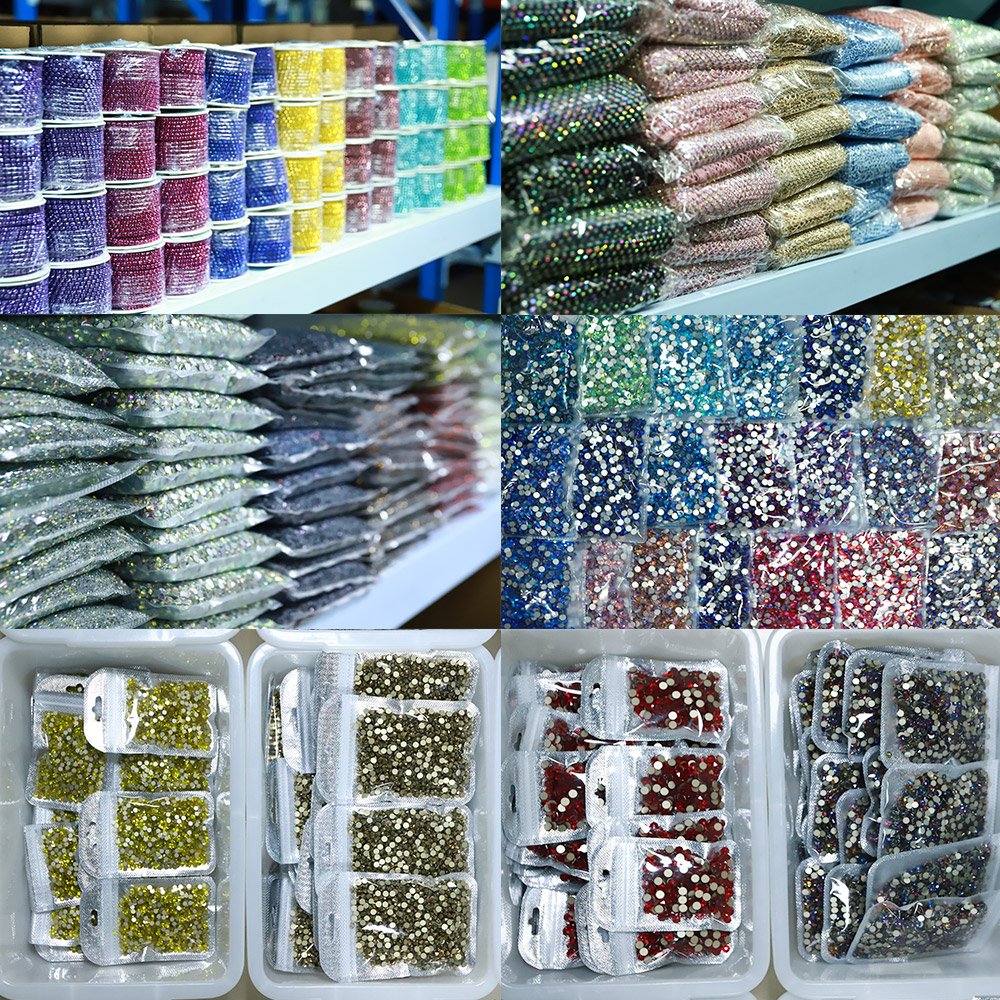
Standard production for bulk rhinestone orders typically takes 7-15 days, depending on the complexity and volume. However, a reliable manufacturer should maintain a massive “Ready-to-Ship” inventory of standard sizes and colors to support urgent B2B needs.
Shipping and Customs
Whether you prefer Air Express (DHL/FedEx/UPS) for speed or Sea Freight for cost-efficiency, your manufacturer should be well-versed in international trade terms (FOB, CIF, DAP). Proper documentation—including Certificates of Origin and detailed Packing Lists—is essential to avoid delays at customs.
Quality Assurance During Transit
Bulk rhinestones are heavy. A professional factory uses reinforced packaging (inner plastic bags, sturdy boxes, and often wooden pallets) to ensure the stones don’t chip or the hotfix glue doesn’t become contaminated by moisture during their journey across the ocean.
Section 8: Technological Innovations in Rhinestone Manufacturing
The rhinestone industry is not static. A leading Guangzhou manufacturer like Yiben is constantly innovating to meet the evolving demands of the global market. These innovations are critical for B2B buyers who need to stay ahead of the curve in terms of both aesthetics and functionality.
Advanced Coating Technologies
Beyond the standard AB (Aurora Borealis) coating, new vacuum-deposition techniques allow for multi-chromatic finishes that change color depending on the light angle. These “chameleon” stones are increasingly popular in high-end footwear and evening wear. A true source factory invests in the high-cost vacuum chambers required to apply these coatings uniformly across millions of stones.
Eco-Friendly and Low-Lead Solutions
With tightening regulations like California Prop 65 and the EU’s REACH, the chemical composition of both the glass and the adhesive has become a primary concern. Leading factories are shifting towards “eco-friendly” hotfix glues that are free from phthalates and other harmful volatile organic compounds (VOCs). This is a significant selling point for brands targeting conscious consumers.
Precision Sorting and Grading Automation
In the past, sorting SS10 from SS12 was often a manual or semi-manual process prone to human error. Today, top-tier manufacturers use optical sorting machines equipped with high-speed cameras. These machines can identify and discard stones with even minor chips or foiling defects at a rate of thousands per minute. For the B2B buyer, this means “zero-defect” batches that don’t jam automated application machinery.
Section 9: Common Pitfalls in B2B Rhinestone Sourcing (And How to Avoid Them)
Sourcing from China offers immense rewards, but there are common traps that inexperienced buyers often fall into. Understanding these can save your business thousands of dollars and months of delay.
The “Bait and Switch” Quality Trap
A common issue when dealing with unvetted suppliers or low-tier trading companies is receiving a high-quality sample, followed by a lower-quality bulk shipment. The bulk stones might have thinner foiling or weaker glue. How to avoid: Specify the exact grade of glass and the brand/origin of the glue in your contract. Insist on a pre-shipment inspection (PSI) by a third party to verify that the bulk order matches the approved sample.
Underestimating Shipping Weights and Costs
Rhinestones are made of glass, and glass is heavy. A bulk order of 500 bags of SS16 stones can weigh hundreds of kilograms. Many B2B buyers forget to factor in the landed cost (Price + Shipping + Duties). How to avoid: Ask for a detailed “Shipping Quote” at the same time as your product quote. A professional factory like Yiben will have negotiated volume rates with carriers like DHL or specialized sea-freight forwarders, which they can pass on to you.
Miscommunication of Sizing Systems
The “SS” (Stone Size) system is the industry standard, but slight variations exist between manufacturers. An “SS10” from one factory might be 2.7mm, while another’s is 2.9mm. This 0.2mm difference can ruin a pre-cut heat-transfer template. How to avoid: Always request the specific millimeter (mm) range for every size ordered. Better yet, provide your own templates to the factory for testing.
Section 10: Building Long-Term B2B Trust
The first order is a transaction; the tenth order is a partnership. Building trust with a Chinese manufacturer requires clear communication and mutual respect.
Clear Communication and Technical Specs
Don’t just ask for “red rhinestones.” Provide specific color codes (like “Siam” or “Light Siam”), size measurements in millimeters, and your specific wash-test requirements. The more precise you are, the less room there is for error.
Payment Terms and Risk Management
For initial orders, the standard is often a 30% deposit and 70% balance before shipping. As trust grows, many B2B manufacturers are open to more flexible terms. Utilizing secure payment methods or trade assurance can mitigate risk during the early stages of the partnership.
The Role of Visit and Reciprocity
Inviting your manufacturer’s representative to see your finished products or visiting the Guangzhou factory annually strengthens the bond. When a factory feels like they are part of your brand’s growth, they are more likely to go the extra mile during tight deadlines or material shortages.
Conclusion: The Strategic Advantage of a Direct Partnership
Choosing to partner with a genuine China rhinestone manufacturer in Guangzhou is more than just a cost-saving measure; it is a strategic business decision that impacts your product quality, brand reputation, and bottom line. By moving past the trading companies and engaging directly with a high-capacity, technically proficient factory like Yiben, you gain control over your supply chain that is impossible to achieve otherwise.
The journey to finding the perfect partner requires due diligence—vetting their machinery, auditing their quality systems, and testing their hotfix adhesive—but the result is a reliable, scalable source for the brilliance your brand deserves. In the world of B2B wholesale, sparkle is a science, and your manufacturer is your most important scientist. Establish that foundation today, and watch your business shine on the global stage.
Frequently Asked Questions for B2B Rhinestone Sourcing
1. What is the MOQ (Minimum Order Quantity) for direct factory orders?
While it varies, most Guangzhou manufacturers have an MOQ of 10-50 bags per color/size for stocked items, and higher for custom colors.
2. How do I know if the hotfix glue is “washable”?
Ask for a “Wash Test Report.” A quality manufacturer will have tested their stones at 40°C and 60°C for multiple cycles to ensure the bond remains intact.
3. Can I get samples before placing a bulk order?
Absolutely. Any reputable manufacturer like Yiben will provide sample cards or small quantities of stones for you to test on your specific fabrics before committing to a wholesale purchase.
4. What is the difference between “Lead-Free” and standard glass?
Lead-free rhinestones meet strict CPSIA and REACH regulations for children’s wear. If you are selling in the US or EU markets, ensure you specify your lead-content requirements.
Get a free sample pack and factory pricing – WhatsApp us at +86 13692450325 or request a quote to check stock, bulk pricing, and lead time. We are a 12-year Guangzhou hotfix rhinestone factory serving garment makers and wholesalers worldwide.
Related reading: