
What Do SS6 to SS30 Mean, a Complete Guide to Rhinestone Sizes
If you have ever ventured into the world of apparel decoration, dancewear design, or high-end craft projects, you have likely encountered a peculiar measurement system: “SS.” Whether you are scrolling through a B2B catalog from a Guangzhou manufacturer like Yiben E-Commerce or browsing a local craft store, labels like SS6, SS16, or SS30 are everywhere. But what does it actually mean? Is an SS20 twice as big as an SS10? And why don’t we just use millimeters?
Understanding rhinestone sizing is the foundational skill for any designer, wholesaler, or DIY enthusiast. Choosing the wrong size can lead to a design that looks cluttered, a costume that feels too heavy, or a logo that is unreadable. In this comprehensive guide, we will decode the Stone Size (SS) system, provide a definitive conversion chart, and offer an expert buyer’s guide to help you choose the perfect hotfix crystals for your next masterpiece.
What is “Stone Size” (SS)? A Historical Perspective
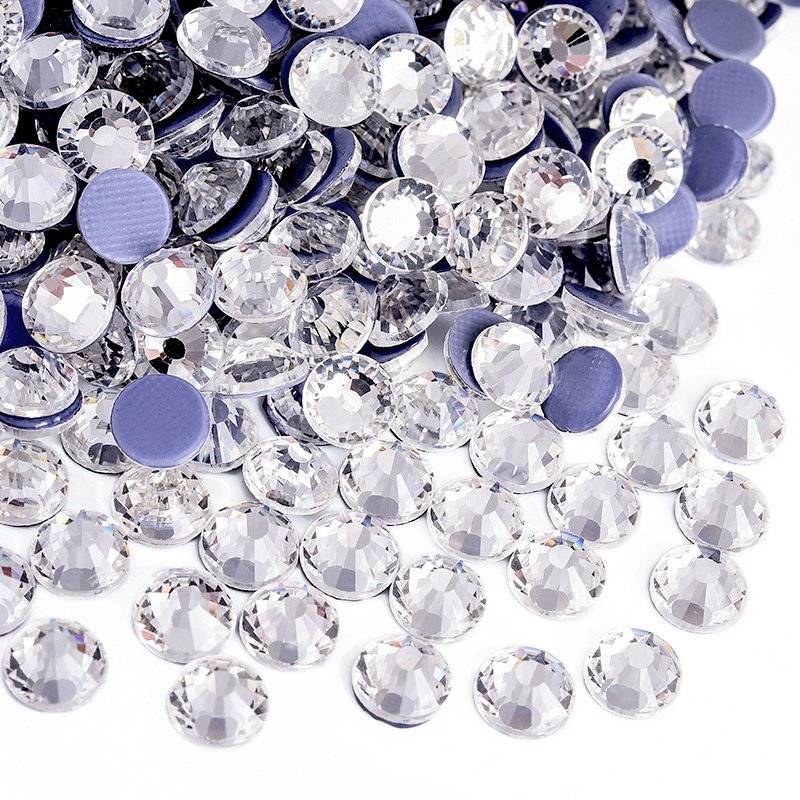
The “SS” abbreviation stands for “Stone Size.” It is a specialized measurement system that originated in the jewelry and gemstone industry centuries ago. While most of the modern world has transitioned to the metric system (millimeters), the rhinestone industry—particularly for flatback and hotfix crystals—has clung to the SS system for its brevity and industry-wide standardization.
Historically, SS measurements were used to categorize round stones. Unlike a simple diameter measurement, SS refers to a specific range of sizes. Because rhinestones are manufactured in massive quantities through glass-cutting or molding processes, there is always a slight “tolerance” or variance. For example, an SS16 stone isn’t exactly one single measurement; it is a stone that falls within the range of 3.8mm to 4.0mm.
For B2B buyers and manufacturers, using SS is more efficient. If a garment factory needs 10,000 gross of stones for a production run, ordering “SS16” ensures that every stone will fit into a specific preset template or transfer sheet designed for that size range. It simplifies communication between the designer in New York and the manufacturer in Guangzhou.
SS vs. PP: Clearing Up the Confusion
Before we dive into the specific sizes, it is vital to mention “PP.” If you are looking at very tiny stones, usually smaller than SS4, you might see them labeled as PP (Pearl Plate). PP is an even more precise measurement system used primarily for jewelry-grade chatons (pointed-back stones) and micro-rhinestones.
While SS covers the broad range of sizes used in apparel and accessories, PP is used for the “micro-details.” As a general rule of thumb, PP measurements are smaller and more granular. For the purpose of this guide and most hotfix applications, we will focus exclusively on the SS system, as it is the standard for heat-transfer and glue-on applications.
The Definitive Rhinestone Size Chart: SS to Millimeters
When planning a design, you need to know how much physical space a stone will occupy. Below is the industry-standard conversion chart for the most common rhinestone sizes used in B2B manufacturing and high-end fashion.
A Deep Dive into Small Sizes: SS4 to SS12
The smaller end of the spectrum is all about precision and texture. When you use small stones, you aren’t just adding sparkle; you are creating a “pavé” effect—a French term meaning “paved,” like a cobblestone street made of diamonds.
SS6 (Approx. 2.0mm)
SS6 is the smallest size commonly used for hotfix applications on fabric. It is incredibly popular in the nail art industry because of its tiny footprint. In B2B apparel manufacturing, SS6 is used to outline complex logos or to fill in very small gaps where larger stones won’t fit. Because they are so small, they require a steady hand or a specialized vacuum pickup tool for application.
SS10 (Approx. 2.8mm)
SS10 is the “sweet spot” for high-density fills. If you want a logo to look like a solid sheet of crystal from a distance, SS10 is often the preferred choice. It provides enough surface area to show off the facets of the glass while remaining small enough to follow tight curves in a design. It is the go-to size for custom rhinestone transfers on t-shirts and hoodies.
The “Workhorse” Sizes: SS16 and SS20
If you were to walk into a professional costume shop for a Broadway show or a competitive ballroom dance studio, you would find that SS16 and SS20 make up about 80% of their inventory. These are the industry standard for a reason.
SS16 (Approx. 4.0mm)
SS16 is widely considered the most versatile rhinestone size in existence. At 4mm, it is large enough to be easily handled by hand or with tweezers, but small enough to be used in large quantities without making a garment excessively heavy. It is the perfect size for “scattering”—a technique where stones are applied randomly across a fabric to create a shimmering effect. Most mass-produced retail apparel uses SS16 for its cost-to-sparkle ratio.
SS20 (Approx. 4.7mm)
When you need to be seen from the back of a theater or a stadium, SS16 might be too subtle. That is where SS20 comes in. This size is the gold standard for dancewear, cheerleading uniforms, and pageant gowns. Its larger surface area allows for more light refraction, meaning it catches the stage lights much more aggressively. For B2B buyers supplying the performance arts industry, SS20 is usually the top-selling SKU.
The Large Statement Sizes: SS30 to SS48
Sizes like SS30 and above move away from “shimmer” and toward “impact.” These are not typically used for entire logos; instead, they serve as focal points or “buttons” in a design.
SS30 (Approx. 6.4mm)
SS30 is roughly the size of a pencil eraser. It is often used as a “center stone” in floral patterns or at the peaks of a tiara-style design on a bodice. In the world of Western wear (Rodeo shirts and belts), SS30 is a staple. It provides a rugged, bold look that stands up well to thicker fabrics like denim and leather.
SS34 and SS40
These sizes are massive. They are heavy and require significant adhesive strength. In B2B contexts, they are frequently used in home decor (upholstered headboards), footwear (heels of luxury shoes), and large-scale stage backdrops. Because of their weight, we generally recommend using glue-on (E6000 or similar) rather than hotfix for these sizes, although high-quality hotfix glue can still work on very porous fabrics.
The Technical Side: Why Size Matters for Hotfix Application
When dealing with Hotfix (heat-applied) rhinestones, the size of the stone dictates the physics of the application. As a professional manufacturer, we often see beginners making the mistake of using the same heat settings for every size. This is a recipe for disaster.
Buyer’s Guide: How to Choose the Right Size for Your Project
Choosing the right size is a balance of aesthetics, weight, and budget. Here is our expert checklist for making the right choice.
1. Consider the Viewing Distance
How far away is the audience? For nail art (viewing distance: 1 foot), SS3 to SS6 is perfect. For a cocktail dress (viewing distance: 5-10 feet), SS10 and SS16 are ideal. For a stage performer (viewing distance: 30+ feet), you need at least SS20, often mixed with SS30, to ensure the sparkle isn’t lost.
2. Consider the Fabric Weight
Delicate fabrics like silk, chiffon, or thin mesh cannot support the weight of large SS30 stones. They will sag and potentially tear the fabric. For lightweight materials, stick to SS6 through SS16. For heavy denim, canvas, or leather, larger stones (SS20+) look more proportional and the fabric can handle the weight.
3. Complexity of the Design
If your design has sharp angles or intricate curves, you need smaller stones. Think of rhinestones like “pixels” in an image. The smaller the pixels (the stones), the higher the resolution of your design. Large stones are great for bold, geometric patterns but struggle with fine script lettering.
4. The “Mixed Size” Secret
The most professional-looking designs rarely use just one size. By mixing SS12, SS16, and SS20 together, you create a “multi-dimensional” sparkle. This technique, often used by high-end brands, mimics the natural variation found in starlight or crushed diamonds. It also allows you to fill gaps more effectively, ensuring no “dead spots” in your design.

Manufacturing Quality: Facets and Material
Size isn’t the only thing that matters; the number of facets (the flat surfaces cut into the glass) changes how large a stone *looks*. For example, a high-quality SS16 stone with 14 or 16 facets will often appear “bigger” and more brilliant than an SS20 with only 8 facets.
At Yiben E-Commerce, we emphasize that “A-grade” Chinese glass or lead-free crystal options provide different refractive indices. When you are buying in bulk (wholesale), always ask for the facet count. A stone with a “Xirius” style cut (star-shaped facets) will offer a different visual diameter than a standard “Xilion” cut, even if the SS measurement is the same.
The Impact of Color and Finish on Size Perception
One of the most fascinating aspects of working with rhinestones is how color can trick the eye. Even if you have two stones of the same size—say, both are SS20—they may not appear identical in your design if they have different finishes. As a manufacturer, we often have to explain this phenomenon to clients who are puzzled by why their “Jet Black” stones look smaller than their “Crystal AB” stones.
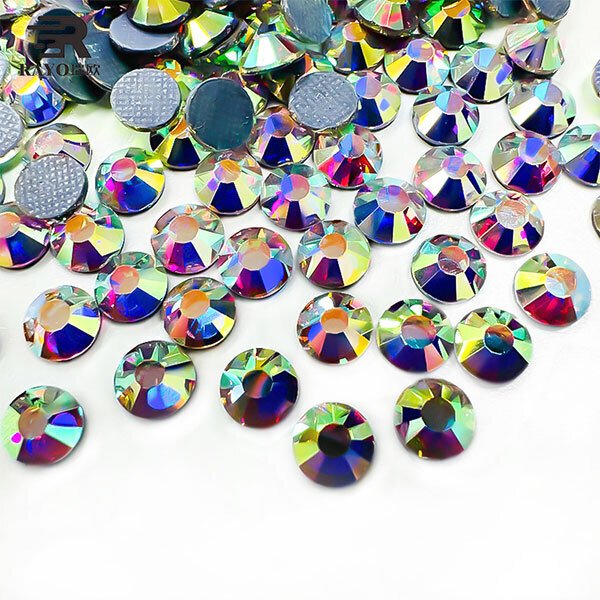
1. Crystal AB and High-the distributor Finishes: Stones with an Aurora Borealis (AB) coating or high-lead content tend to look slightly larger. This is because the coating reflects light in multiple directions, creating a “halo” effect around the stone. This optical illusion makes the stone appear to take up more space on the fabric than its physical diameter would suggest.
2. Opaque and Matte Colors: Colors like Jet Black, Hematite, or Matte finish stones tend to look smaller. These stones absorb light rather than reflecting it. Without the sparkle to “bleed” over the edges, the eye sees the exact, sharp boundary of the stone. When designing with opaque colors, we often recommend going up one size (e.g., using SS20 instead of SS16) to achieve the same visual impact.
3. Neon and Fluorescent Stones: Neon stones have a similar effect to AB stones. Their vibrancy makes them pop against almost any background, often making them the dominant feature of a multi-size design.
B2B Logistics: How Size Affects Weight and Shipping
For our wholesale clients, understanding rhinestone size is not just a design choice—it is a logistical one. When you are ordering hundreds or thousands of “Gross” (the standard unit of measurement, equal to 144 stones), the difference between SS10 and SS30 is massive in terms of weight.
Weight is a critical factor in B2B shipping costs, especially for air freight from Guangzhou. Here is a rough breakdown of how weight scales with size:
When planning a large-scale production, always calculate the total weight of the stones to avoid surprises in your shipping invoice. For most apparel logos, using SS10 or SS12 provides the best balance of visual density and shipping efficiency.
Regional Sizing Variations: Swarovski, Preciosa, and Chinese Glass
While the SS system is global, there are slight variations in “tolerance” between different manufacturers. This is a common point of confusion for buyers switching from European brands to Chinese wholesale sources.
Austrian/Czech Standards: Brands like Swarovski and Preciosa have incredibly tight tolerances. Their SS16 will almost always be exactly 3.9mm. Their manufacturing process is highly controlled, ensuring every stone is identical.
Chinese Glass Standards (Yiben E-Commerce): High-quality Chinese manufacturers have closed the gap significantly. However, because we cater to a massive range of price points, you might find more variation in “B-grade” glass. Our “A-grade” stones follow the same 0.2mm tolerance window as European brands. When buying wholesale, always specify the “tolerance window” if your application involves laser-cut templates where the fit must be perfect.
The “Gross” System: Quantity vs. Size
In the rhinestone industry, we don’t sell by the “dozen” or the “hundred.” We sell by the Gross.
When you are sizing your design, you need to calculate your “Stone Consumption.” For example, if you are filling a 4×4 inch square with SS16 stones, you will need approximately 1,100 stones (roughly 8 Gross). However, if you use SS10 stones for the same square, you would need nearly 2,500 stones (roughly 17 Gross). Smaller stones mean more work and more quantity, while larger stones cover more area quickly but with less “resolution.”
Frequently Asked Questions (FAQ) About Rhinestone Sizes
Q: Can I use different sizes together in a heat press?A: It is risky. Because larger stones are taller, the top plate of the heat press will hit the large stones first, potentially leaving the smaller stones without enough pressure to bond. If you must use mixed sizes, we recommend using a silicon pad to distribute pressure or applying them in two separate stages.
Q: What size is best for a logo on a baseball cap?A: SS10 or SS12 is usually best. Caps have curved surfaces and rigid panels; larger stones like SS20 struggle to adhere to the sharp curve of a cap crown and are more likely to pop off over time.
Q: Does the size of the stone affect the “Lead-Free” status?A: No. Lead-free crystal is a matter of the glass composition (the “recipe”), not the size. However, larger stones contain more physical material, so they are more heavily regulated in certain jurisdictions like California (Prop 65) or for children’s toys (CPSIA). Always ensure your supplier provides certifications for the specific material used.
Measuring Your Own Stones: Pro Tips
If you have a bag of loose rhinestones and aren’t sure what size they are, don’t guess. Use these methods for accuracy:
Conclusion: Mastering the SS System
The transition from a beginner to a pro in the rhinestone world happens when you stop thinking in “small, medium, and large” and start thinking in “SS6, SS16, and SS30.” Understanding the nuances of these measurements allows you to communicate effectively with manufacturers, budget your projects accurately, and—most importantly—create stunning, professional-grade designs.
Whether you are designing a single dance costume or ordering thousands of gross for a global apparel line, the Stone Size system is your universal language. By mastering the conversion from SS to millimeters and understanding the best use cases for each size, you ensure that every crystal you apply adds the perfect touch of brilliance to your work.
Remember: there is no “best” size—only the “right” size for your specific fabric, design, and audience. Happy designing!
Need a size or color recommendation for your next order? Send us your fabric type, design, and target price — we reply within one business day. WhatsApp +86 13692450325 · rhinestonewholesale8@gmail.com