
Automated Rhinestone Brushing Machines vs Manual Application, a Factory Review
In the high-volume world of garment decoration and wholesale rhinestone motifs, the efficiency of your “brushing” process – the act of getting hotfix rhinestones into the holes of a template – determines your entire profit margin. For decades, the industry standard has been manual flocking: using a sponge and a steady hand to sweep stones over a sticky flock template. However, as labor costs rise and lead times shrink, the rise of the Automated Rhinestone Brushing Machine has sparked a major debate among factory owners.
Is the multi-thousand-dollar investment in automation worth it? Or does the flexibility and low entry cost of manual flocking still hold the crown for B2B manufacturers? In this comprehensive review, we break down the upfront costs, maintenance requirements, daily output, and long-term ROI of both methods to help you decide which setup fits your factory size.
The Contenders: An Overview
1. Manual Flocking (The Traditional Method)
Manual flocking involves creating a template using “sticky flock” material (typically a rubbery, adhesive-backed fabric). This flock is cut using a plotter or laser cutter. Once the template is mounted on a board, a worker pours a pile of hotfix rhinestones over it and uses a specialized sponge or soft brush to move the stones in a circular motion. The stones fall into the holes right-side up due to their weight and geometry. Finally, transfer tape (hotfix tape) is applied to lift the design.
2. Automated Rhinestone Brushing Machines
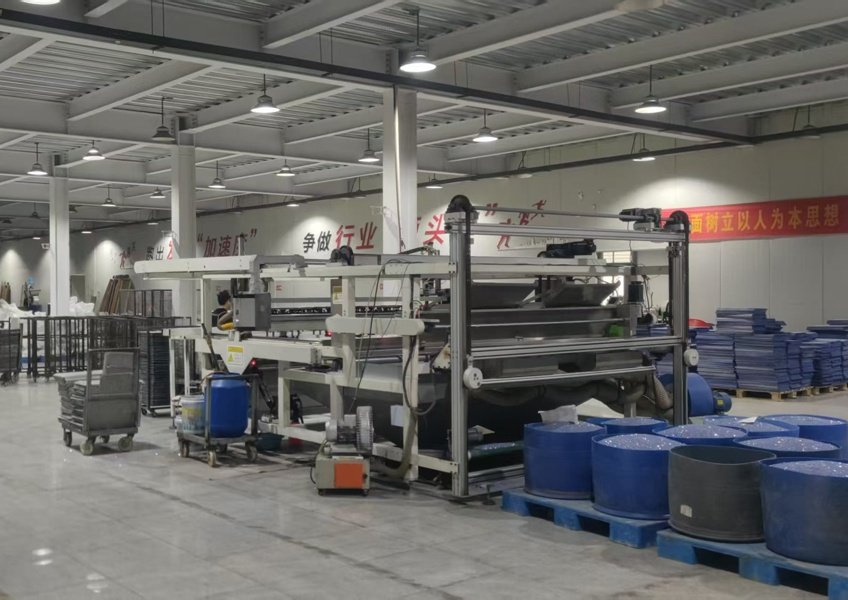
These machines, often referred to as “Automatic Rhinestone Brushing Systems,” replace the human hand with mechanical circular brushes. The template (often a more durable PVC or metal plate, though flock is still used in some setups) is placed on a rotating or reciprocating bed. High-speed brushes sweep across the surface, filling thousands of holes per minute. Most modern machines include vacuum systems for dust control and sensors to ensure 99% fill accuracy.
Deep Dive: Upfront Cost & Initial Investment
Manual Flocking: The Low-Barrier Entry
For a B2B startup or a small-scale workshop, manual flocking is almost unbeatable in terms of entry price. Your primary investments are:
Total setup cost typically stays under $3,000. This allows a factory to test new designs and enter the market with minimal financial risk.
Automated Brushing: The Capital Expenditure (CapEx)
An automated brushing machine is a serious piece of industrial equipment. Prices vary based on the number of “heads” (colors) and the size of the brushing area:
The upfront cost is significantly higher, requiring a clear volume projection to justify the “break-even” point.
Daily Output & Production Speed: The “Real World” Numbers
In B2B manufacturing, “Speed is Currency.” Let’s look at how many transfers a typical operator can produce in an 8-hour shift.
The Manual Bottleneck
A skilled manual operator can brush a standard A4-sized motif (approx. 500-800 stones) in about 45 to 90 seconds. However, this doesn’t include the time spent applying transfer tape and clearing the board. On average, a worker can produce 30 to 45 transfers per hour for moderate complexity designs.
The problem? Fatigue. Manual brushing is physically demanding on the wrists and back. Output at 4:00 PM is rarely as high as output at 9:00 AM. Scaling production requires hiring more people, which increases your overhead and management complexity.
The Automated Advantage
An automated machine doesn’t get tired. A single-head machine can often process 80 to 120 transfers per hour. Multi-head machines allow for even faster throughput or the simultaneous production of different colors without manual stone-swapping.
For a factory running two shifts, an automated machine can easily out-produce 4-5 manual workers, significantly lowering the “cost per piece.”
Maintenance & Reliability: What Happens When Things Break?
Manual Systems: Fail-Safe
There is very little that can go wrong with a sponge and a board. If your plotter breaks, you can replace it quickly. If your worker is sick, you can (in theory) step in. The “maintenance” here is mostly managing the cleanliness of the sticky flock, which loses its “grip” over hundreds of uses as it accumulates stone dust.
Automated Machines: Technical Oversight
Automated machines introduce mechanical complexity. Key maintenance areas include:
If a machine goes down, production stops unless you have a backup or a technician on call. This is why B2B buyers often choose reputable brands with local support over cheaper, unbranded imports.
Quality Comparison: Precision vs. Versatility
Manual Brushing for Complex Motifs
Manual brushing shines when dealing with “mixed sizes” (SS6, SS10, and SS16 in one design) or very intricate patterns. A human can feel when a stone isn’t sitting correctly and adjust the sponge angle. For high-end, low-volume couture work, manual remains the gold standard for quality control.
Automation for Standardized High-Volume
For standard wholesale motifs (think sports logos, “bling” t-shirts for retail chains), automation wins. The fill rate is exceptionally high for SS10 and SS16 stones. However, very small stones (SS4 or SS6) can sometimes be trickier for machines, requiring finer brush adjustments and slower speeds to avoid “flicking” stones out of the holes.
The B2B Verdict: Which One Should You Choose?
There is no one-size-fits-all answer, but after analyzing hundreds of factory setups, we recommend the following based on your production tier:
Tier 1: The Small Studio / Custom Shop
Daily Volume: 1 – 100 transfers. Recommendation: Manual Flocking. The flexibility to switch between dozens of designs per day without setting up a machine is your greatest asset. Your investment should be in a high-quality Graphtec or Roland plotter rather than a brushing machine.
Tier 2: The Growing Manufacturer
Daily Volume: 200 – 800 transfers. Recommendation: Hybrid Approach. Invest in one single-color automated brushing machine for your “bread and butter” high-volume designs. Keep manual stations for custom orders and multi-size/multi-color complex motifs. This allows you to scale without exploding your labor costs.
Tier 3: The Industrial Enterprise
Daily Volume: 1,000+ transfers. Recommendation: Fully Automated. At this level, labor is your biggest expense and your biggest liability. A fleet of 2-4 multi-head automated brushing machines will provide the consistency and speed required to fulfill massive wholesale orders. The ROI on a $20,000 machine is often realized within 6-10 months of high-capacity operation.
Summary Table: At a Glance
Final Thoughts from the Manufacturer’s Floor
As a B2B rhinestone supplier, we see the output of both methods every day. The most successful factories we work with are those that recognize when they have outgrown the “sponge.” If you find your workers struggling to keep up with orders, or if your “reject rate” due to poorly brushed transfers is climbing, it is time to look at automation.
Manual flocking isn’t dying – it’s just specializing. It is becoming the “artisan” side of the business, while automated brushing takes over the heavy lifting of the global garment supply chain. Evaluate your order volume, your local labor costs, and your long-term growth goals before making the leap. Whichever path you choose, the quality of your hotfix rhinestones remains the most important factor in the final product’s brilliance and durability.
Detailed Analysis: The Hidden Costs of Manual Production
When B2B owners calculate the cost of manual production, they often only look at the hourly wage of the operator. However, the hidden costs are what truly eat into the margins. First, consider material waste. In manual brushing, stones are often scattered or lost on the floor during the sweeping process. Over a year of producing thousands of motifs, a 2% waste rate on premium lead-free rhinestones can add up to thousands of dollars in lost revenue.
Second is the ergonomic impact. Carpal tunnel syndrome and repetitive strain injuries are common in the rhinestone industry. A factory that relies solely on manual labor faces higher turnover rates and potential workers’ compensation issues. Automation mitigates this by transforming the role of the worker from a “manual laborer” to a “machine technician,” a role that is generally more sustainable and requires less physical exertion.
Thirdly, there is the space requirement. To match the output of one automated machine, you might need four manual stations. In cities where industrial rent is high, the “footprint per unit of output” becomes a critical KPI. An automated machine occupies roughly 2 square meters but produces the work of a 10-square-meter manual department.
The Technical Evolution of Brushing Templates
To understand the performance of automated machines, one must understand the shift in template technology. In manual flocking, Sticky Flock is favored because its fuzzy texture helps “catch” the rhinestones and hold them in place while the transfer tape is applied. However, sticky flock is soft. Under the heavy, high-speed rotation of an industrial brushing machine, sticky flock would tear or lose its shape within hours.
Therefore, automated systems typically use Rigid Templates. These are made from materials like acrylic, PVC, or even thin sheets of aluminum. PVC Templates: These are the most common for automation. They are cut using high-precision CNC or laser machines. They offer a smooth surface that allows the brushes to glide easily while the holes remain sharp and defined for thousands of cycles. Aluminum Templates: Used for “permanent” designs that a factory might run for years (like a standard star or heart shape). These are virtually indestructible but have a higher initial cost. The transition from flock to rigid templates is one of the biggest learning curves for factories moving to automation. It requires a different set of design parameters in your CAD software, as the tolerances for hole size must be much tighter to prevent stones from flipping upside down.
Optimizing Your Machine for Maximum ROI
If you decide to invest in an automated rhinestone brushing machine, “plug and play” is rarely the reality. To achieve the 2000+ word depth of understanding required for B2B excellence, we must discuss optimization. The difference between a machine that runs at 80% efficiency and one that runs at 99% often comes down to three factors: Brush Pressure, Rotation Speed, and Stone Quality.
1. Brush Pressure: If the pressure is too light, the stones won’t be “pushed” into the holes, leading to empty spots. If it is too heavy, the brushes will actually “flick” the stones back out of the holes after they have landed. Expert operators use a “feather-touch” setting that just barely kisses the surface of the template.
2. Rotation Speed: Faster isn’t always better. For larger stones like SS20, a slower rotation allows the heavy stones to settle. For SS6, a faster, vibrating motion is often needed to overcome the lightness of the stone.
3. Stone Quality (The B2B Secret): This is where many factories fail. Automated machines are incredibly sensitive to “size tolerance.” If you buy cheap, low-grade rhinestones where the sizes vary (e.g., some SS10s are slightly larger than others), the machine will jam or fail to fill holes. High-quality, machine-cut rhinestones with consistent dimensions are mandatory for automated brushing. You may pay 5% more for the stones, but you will save 20% in production time.
Environmental Considerations and Factory Safety
In a modern B2B environment, sustainability and safety are no longer optional. Manual flocking, while low-tech, creates a significant amount of “flock dust” – tiny fibers that can be inhaled. Automated machines are almost always enclosed and equipped with vacuum extraction systems. This keeps the factory air cleaner and protects the health of your staff. Furthermore, the reduction in transfer tape waste (due to fewer “missed” stones that require manual fixing) contributes to a lower environmental footprint for the factory.
The Role of Software in Modern Rhinestone Production
Whether you go manual or automated, the “Brain” of your operation is your design software. Modern B2B software like Sierra Hotfix, WinPCSIGN, or specialized plugins for CorelDRAW have changed the game. These programs can now automatically calculate the most efficient “path” for a brushing machine or optimize a flock template to minimize material waste. For the automated user, the software can even predict how many stones of each color will be used, allowing for precise inventory management – a critical component of wholesale profitability.
Case Study: The “Mid-Size” Struggle
Consider “Factory X,” a motif manufacturer in Vietnam. They started with 10 manual workers. As they landed a contract with a major US retailer, they faced a choice: hire 20 more workers or buy 2 automated machines. By choosing automation, they were able to maintain their existing footprint, avoid the complexities of managing a 30-person staff, and – most importantly – they could guarantee a 48-hour turnaround on bulk orders. Their manual workers weren’t fired; they were promoted to QC (Quality Control) and design roles, creating a more professional and efficient production line. This is the typical evolution of a successful B2B rhinestone enterprise.
Conclusion: Investing in the Future
The “Review: Automated Rhinestone Brushing Machines vs. Manual Flocking” debate isn’t about which technology is “better” in a vacuum. It is about which technology matches your business stage. Manual flocking is the foundation of the industry, providing the soul and the custom flexibility that high-end fashion demands. Automated brushing is the engine of the industry, providing the scale, speed, and consistency that global commerce requires.
For any serious B2B player looking to dominate their local or international market, the path usually begins with a sponge and ends with a machine. By understanding the costs, the maintenance, and the technical requirements of both, you can make an informed decision that ensures your rhinestone motifs shine brighter than the competition – both in terms of quality and profit.
Need a size or color recommendation for your next order? Send us your fabric type, design, and target price — we reply within one business day. WhatsApp +86 13692450325 · rhinestonewholesale8@gmail.com