
Wholesale Rhinestones for Pageant and Prom Gowns with Factory-Direct Size Color and Lead Time Control
Quick answer Wholesale rhinestones for pageant and prom gowns are almost always K9 optical crystal hotfix stones, and we supply them factory-direct from Guangzhou in 400+ stock colours with Pantone custom matching. Sizes run SS6 (2.0mm) to SS30 (6.4mm). Our MOQ is 2 bags per colour and size, about 1440 pcs per SS16 bag. Stock colours ship the same day payment clears, and custom runs ship in 7 to 15 days depending on order quantity. Every batch carries German grey glue with a 160°C working temperature and ISO 6330 wash durability under 2% stone loss across 50 machine washes. Send your gown bill of quantities to WhatsApp +86 13692450325 or rhinestonewholesale8@gmail.com and we return a quote within 12 hours with free samples.
If you run a gown line, the stone is the easy part to buy and the hard part to buy well. Pageant and prom production throws up the same four problems every season. The size mix inside one garment has to sit right. The colour has to hold from the bodice to the hem and from this order to the next. The quantity has to be counted, not guessed, so the quote and the bill of materials agree. And the lead time has to line up with a drop date that a designer cannot move. This page walks through all four, in the order a gown maker actually meets them, and ends with the quote path.
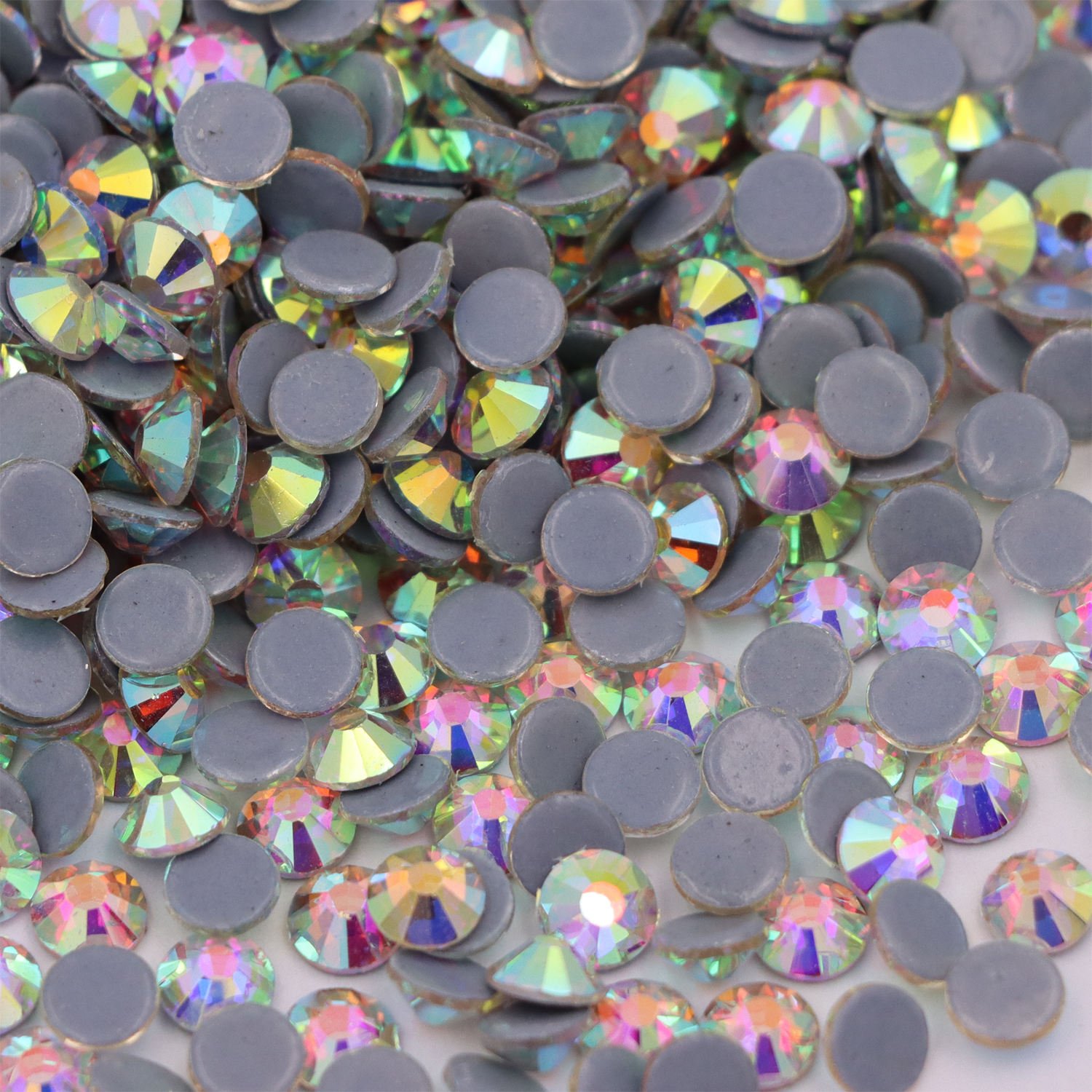
What Rhinestones Are Used for Pageant and Prom Gowns?
Pageant and prom gowns are built with K9 optical crystal hotfix rhinestones. K9 refracts light at roughly 1.9, carries 12 to 14 machine-cut facets, and holds a Mohs hardness of 6 to 6.5, which is why it throws a bright, deep flash under stage lighting without the cost of a branded crystal. Acrylic and resin stones are visible alternatives, and they behave very differently on a finished gown.
The reason K9 dominates gown work is optical, not cosmetic. Light entering a stone with a higher refractive index bends harder inside the glass, so more of it comes back out through the top facets as visible fire rather than passing through as a dull haze. On a bodice packed with hundreds of stones, that difference compounds. A paved panel in K9 reads as a solid sheet of light from the back of a hall. The same panel in acrylic reads flat once the viewer is more than a few paces away.
| Stone material | Refractive index | Facets | Mohs hardness | How it reads on a gown |
|---|---|---|---|---|
| K9 optical crystal | ~1.9 | 12 to 14 | 6 to 6.5 | Deep, high-contrast fire that holds at distance |
| Resin | ~1.55 | Fewer than K9 | Softer than glass | A softer, lighter glow for accent fills |
| Acrylic (PMMA) | ~1.49 | 8 or fewer | 2 to 3 | A flat plastic look that scratches early |
Cost drives the choice for many lines, and that is a fair trade. Acrylic and resin cost less and weigh less, so they suit a mass-market prom run where the retail ceiling is tight and the stone is decorative rather than defining. K9 is the pick when the garment itself sells on sparkle, which is the whole premise of a competition pageant gown.
We work in K9, and we say so plainly. If your client contract names a specific branded crystal and the gown has to carry that label, we are not the right source and we will tell you so on the first call. What we control is the optical grade of the K9 we cut, the precision of the facets, and the glue we pre-coat onto every stone. Those three things decide how the gown looks on stage and how long it stays that way.
Which Pageant and Prom Looks Drive the Most Rhinestone Volume?
Four buying patterns repeat across the year for a gown maker. Pageant competition gowns lead on density, prom and evening gowns lead on volume, competition dance and skating costumes sit close behind, and bridal and quinceañera work fills the calendar between seasons. Pageant and prom are the two lines worth a standing wholesale account, because they come back every season with a fresh theme.
The distinction matters for stocking. A pageant house rebuilds its stone inventory each season around a new colour story, so it buys a wide colour range in narrow sizes, mostly SS10 to SS16 for the pavé and SS20 to SS30 for focal work. A prom manufacturer tends to buy a smaller palette in large volume, because a prom line repeats a handful of colourways across hundreds of units. Same stone, two very different order shapes.
| Buyer segment | Typical draw | Stone density | Repeat cadence |
|---|---|---|---|
| Pageant competition gowns | Paved bodice, sleeves, train | Very high | Seasonal, new theme each year |
| Prom and evening gowns | Bodice, straps, hem band | Medium to high | Seasonal, high unit volume |
| Competition dance and skating | Full costume | High | Per season |
| Bridal and quinceañera | Accent plus bodice | Medium | Year-round |
Where this guidance breaks down is on prom. Prom is a mass-market segment with a hard cost ceiling, and a fully paved SS20 bodice is usually the wrong call on a dress that has to retail at a modest price. The stone cost alone would push the garment out of its market. For prom we recommend a bodice focal cluster plus a defined hem run, and we will say so during quoting rather than let a buyer over-spec a garment that then cannot sell.
What Sizes Should a Gown Maker Order for a Full Pageant Gown?
A full pageant gown is built from three or four sizes used on purpose, not one size repeated. Typical allocation is SS10 (2.8mm) and SS16 (4.0mm) for dense bodice pavé, SS20 (4.8mm) for highlight runs and focal lines, and SS30 (6.4mm) for single focal points such as a belt stone or a centre point on a sleeve.
The logic behind the mix is contrast. If every stone is the same size, the eye reads a uniform sheet with no place to rest. Grading the sizes gives the gown a visual structure: fine stone for the fields, mid stone for the running lines, and a few large stones to catch the eye at the points that matter. This is why a pageant gown looks designed and a hobby-grade garment looks sprinkled.
| Size | Diameter | Where gown makers use it |
|---|---|---|
| SS6 | 2.0mm | Tight fills, mesh bases, narrow trim lines |
| SS10 | 2.8mm | Dense bodice pavé |
| SS16 | 4.0mm | Bodice pavé, hem runs |
| SS20 | 4.8mm | Highlight lines, focal accents |
| SS30 | 6.4mm | Single focal points, large accent stones |
Ordering, not designing, is where most size mistakes happen. A gown maker who buys only SS16 will build a dense but flat garment. A maker who buys only SS20 and SS30 will build something heavy that eats fabric drape. If you are unsure how a size behaves on your chosen base, our reference on rhinestone sizes from SS6 to SS30 maps each size to its common gown applications.
There is a real boundary here that we will not talk around. SS30 is a heavy stone, and a bodice paved entirely in SS30 on lightweight chiffon or fine tulle will distort the drape and pull at the fabric under its own weight. For a fine-fabric gown, keep the large stones to a few focal points and hold the main fields in SS10 and SS16. Large stones belong on structured boning and heavier bases, not on a floating sheer panel.
How Many Rhinestones Do You Need for One Gown?
Count gown volume by surface area, not by guesswork. Full pavé covers about 576 SS16 stones per square foot, or about 400 SS20 stones per square foot. A gown with a paved bodice and a partial hem run usually lands between 2,000 and 5,000 stones, while a fully paved stage costume runs 15,000 to 30,000 stones across a mix of SS6 to SS16.
The method is simple once you break the garment into zones. Measure each zone you plan to pave, convert it to square feet, and multiply by the stone count for your chosen size. A bodice panel measured at 1.5 square feet, paved fully in SS16, needs roughly 1.5 times 576, or about 864 stones. Add the sleeves, the hem run and the train separately, then total the zones. That total is your bill of quantities, and it is also the number your quote should be built on.
| Coverage target | Basis | Stones needed |
|---|---|---|
| Full pavé, one square foot | SS16 | About 576 |
| Full pavé, one square foot | SS20 | About 400 |
| Gown bodice plus partial hem | SS16 and SS20 mix | About 2,000 to 5,000 |
| Full stage costume, head to hem | SS6 to SS16 mix | About 15,000 to 30,000 |
Two practical notes. First, these counts assume near-touching placement, which is what full pavé means. A scattered or sparse design uses far fewer stones, sometimes a fraction of the figure, so decide the density before you order. Second, always round up a little for handling losses during pressing and pickup. Stones drop, stones get pressed badly, and a reorder to cover a shortfall costs more in freight than the stones saved.
If you would rather not build the estimate yourself, send us your zone measurements and we will run the numbers for you as part of the quote. This is the single most common request we get from new gown accounts, and it takes us no time at all once we know the zones and the target sizes.
Which Colors Work for Pageant Gowns and How Do You Keep the Color Consistent?
Colour consistency comes from lot control, not from luck. We retain a physical swatch from every production batch, so a reorder months later is matched back to the original run instead of drifting to a new one. For the palette itself, pageant and prom gowns lean on Crystal and Crystal AB for the main pavé, with one accent colour reserved for focal stones.
A gown rarely uses one colour. It uses a base that reads as light and a single accent that reads as intent. Crystal and Crystal AB work as base colours because they take on the tone of the fabric beneath them and stay visible over any gown colour. The accent colour, chosen to match the gown or to oppose it deliberately, is what makes the design feel intentional. Keeping the accent confined to the focal lines is what stops the garment from looking noisy.
| Gown zone | Common colour choice | Why |
|---|---|---|
| Main bodice pavé | Crystal or Crystal AB | Reads as light, works over any base fabric colour |
| Focal stones | One accent colour | Creates a single deliberate highlight |
| Trim and hem lines | Silver or gold tones | Defines edges and hem bands |
| Train and overskirt | Crystal for continuity | Extends the base look without adding a second accent |
We hold 400+ stock colours and match Pantone for custom lines. The consistency mechanism is the part competitors tend to skip. When a gown, a headpiece and a sash are ordered separately, or reordered in a later season, they can arrive from different production runs with a visible tonal shift. A gown maker who assembles the full look from mixed lots ends up with a bodice that flashes slightly greener than the headpiece set beside it. We avoid this by retaining a swatch from the first run of your account and matching every later order back to it. Our complete hotfix rhinestone colour reference shows how the stock palette is organised.
Here is the honest limit on matching. Pantone custom gives a colour matched to the closest achievable tone for that finish, not a guaranteed identical reading on a spectrophotometer. That tolerance is tighter on solid colours than on effect finishes. Crystal AB in particular reads differently over ivory than over pure white, because the coating is semi-transparent and the fabric beneath it acts as a reflector. If an exact match is critical, approve a physical sample against your own fabric before you release a full run.
Which Stone Type Fits a Gown a Headpiece and a Sash?
Match the fixing method to the base and to the load, not to habit. Hotfix suits pressable fabric that carries no heavy point load. Glue-on flatback suits hard and metal bases such as crown frames. Sew-on is the answer where a stone is heavy or the base cannot take heat at all. A full pageant look usually needs more than one of the three.
| Fixing method | Best on | Avoid on | Typical gown parts |
|---|---|---|---|
| Hotfix | Cotton, spandex, mesh, satin blends | Metal, cured beads, heat-sensitive bases | Bodice pavé, hem runs, sleeves, tulle overlays |
| Glue-on flatback | Metal crown frames, plastic, cured resin bases | Fabrics that need a pressed, flat finish | Headpieces, crown stones, hard decorative points |
| Sew-on | Heavy stones, structured corsetry, unpressable fabric | Fine sheer fabric that a needle would mark | Statement stones, sash centre points, structured panels |
The reason the split exists is the glue. Hotfix stones carry a pre-coated hot-melt adhesive on the back, and that adhesive needs a textile surface to bond to. It melts into the fibre and locks as it cools. Press it against a metal crown frame and there is nothing for it to grip, so it fails. A headpiece on a rigid base should use glue-on or sew-on stones instead, and we will route you to those rather than sell you hotfix that will not hold. For non-hotfix work, our flatback rhinestones wholesale range covers the glue-on and sew-on formats.
A sash is the test case that catches people out. It is soft, it is often lined, and it takes point load where it ties or where it crosses the shoulder. Hotfix can work on the flat span, but any stone sitting on a stress point should be sewn through, because no adhesive holds forever against a sustained pull. Knowing which stones go where is the difference between a look that survives a full competition day and one that sheds stones in the wings.
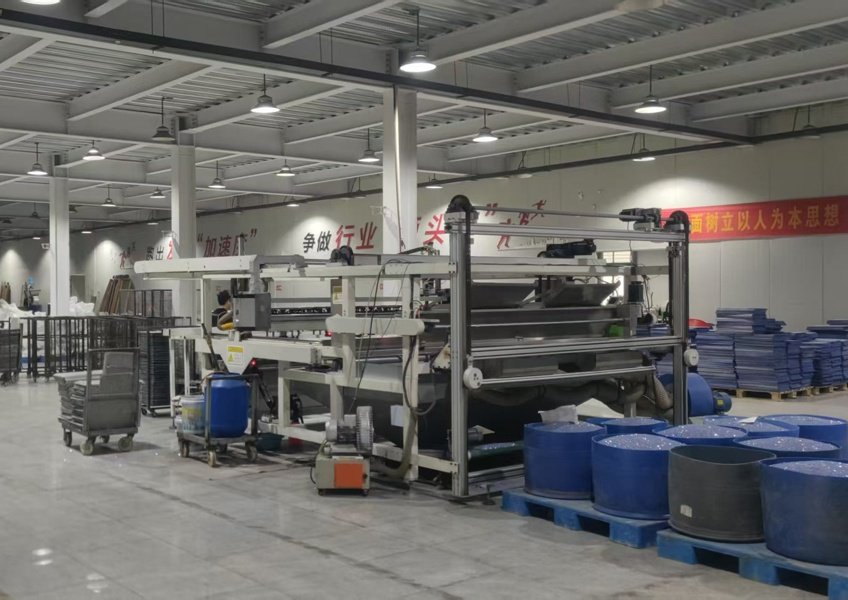
Where Can I Buy Wholesale Rhinestones for Gown Production in Bulk?
There are three real channels: factory direct, B2B marketplaces, and local fabric or trim markets. Factory direct wins on unit price, colour range and reorder consistency, and it is the only channel where the same dye lot can be reserved for a whole season. Marketplaces and local markets each have a place for small or urgent top-ups.
| Channel | Unit price | Colour range | Reorder consistency | Lead time rhythm |
|---|---|---|---|---|
| Factory direct (Guangzhou) | Lowest | 400+ stock plus Pantone custom | Strongest, dye lot retained per account | Stock same day, custom 7 to 15 days |
| B2B marketplace | Mid | Mixed sellers, varies by listing | Weak, lot changes between sellers | Varies by seller |
| Local fabric or trim market | Highest | Limited, shifts with the season | Weak, stock rotates | Same week, at a premium |
The trade-off is real. Factory direct is not the fastest route to a 20-stone sample in a rush; a local supplier or a small-batch wholesaler can beat us on a single test bag, and there is no shame in using one for that. Where factory direct pulls ahead is on repeat production. Price per stone drops, the colour stays put, and the size grades stay available in the quantities a production run needs. For a gown line that ships season after season, that consistency is worth more than the speed of a local pickup. Our notes on low MOQ rhinestone suppliers for small batch explain how to bridge the gap between a test order and a production order.
One caution on marketplaces. A listing photograph is not a specification. Two sellers showing the same image can be shipping stones from different factories with different facet geometry and different glue. If your first order is a marketplace test, treat it as a sample and do not build a season’s purchasing on the result until you have pressed and washed the stones yourself.
What Is the MOQ and Lead Time for a Gown Production Order?
Our MOQ is 2 bags per colour and size, and a bag holds about 1440 pieces at SS16. Stock colours ship the same day payment clears. Custom runs ship in 7 to 15 days depending on order quantity. Quote turnaround is 12 hours, so you can price a gown line quickly.
| Order type | MOQ | Ship timing |
|---|---|---|
| Stock colour, catalogue size | 2 bags per colour and size, about 1440 pcs per bag at SS16 | Same day payment clears |
| Custom colour or custom trim | Quoted per run, project based | 7 to 15 days depending on order quantity |
The low MOQ is deliberate. 2 bags per colour and size lets a gown maker order the exact sizes a garment needs without being forced into a bulk commitment before the design is proven. Build a test garment in the real sizes, press it on the real fabric, wash it the way the client will wash it, and only then scale. Most sourcing risk disappears at that stage, and the MOQ is set low enough that this test is cheap.
Custom runs cannot be compressed below the quoted window. Colour matching and coating take floor time, and we will not shorten a run to hit a date, because a rushed custom batch is exactly where colour drift appears. If your delivery date is fixed, order custom colours early rather than asking for a rush. Stock colours are the opposite case: if you can work within the 400+ stock palette, we ship the same day payment clears and the deadline problem mostly disappears. If you need a formal quotation with freight and lead time built in, send the project details to WhatsApp +86 13692450325 and we will have it back within 12 hours.
Can You Match a Pantone Color and Make Custom Trims or Motifs for a Gown Line?
Yes. We match Pantone colours for custom runs and produce custom trims and motifs under OEM/ODM. For a gown line the real value is continuity: we keep a production swatch from the first run, so a replenishment order months later is matched back to that standard instead of drifting to a new batch.
| Custom request | What we need from you | What you get |
|---|---|---|
| Pantone colour match | Pantone reference, target size, quantity | A matched production run with a retained swatch |
| Custom trim by the yard | Width, base mesh, colour, quantity | Trim matched to your gown colour standard |
| Custom motif or appliqué | Artwork or a physical sample, placement size | A repeatable motif for the whole line |
Reorders are the point of all this. A gown maker who returns next season and orders the same colour has two possible outcomes. Either the new stones match the gowns already in the market, or they do not. When the second run is matched back to the retained swatch, a new gown sits beside last season’s gown without a visible seam. When it is not, the difference shows up in photographs and in customer complaints. Retaining a swatch is a small process with an outsized effect on a gown line’s reputation.
The boundary to plan around is that a Pantone match is a matched tone, not a guarantee of an identical instrument reading, and the tighter the finish, the more a physical sample matters. Approve a sample before a full run on any custom colour, and keep your own swatch on file alongside ours. Two copies of the same standard, one on each side, is the cheapest insurance against a colour dispute later.
How Do You Ship Bulk Rhinestones and What About Duties?
Bulk orders ship by air express or sea freight. Air runs 5 to 7 working days door to door through DHL or FedEx. Sea freight runs 18 to 35 days depending on the destination port. All shipments carry HS code 7018.10. Duties and taxes are assessed by your own customs authority, so we quote the goods and the freight, not your landed tax.
| Method | Transit time | Best for |
|---|---|---|
| Air express (DHL or FedEx) | 5 to 7 working days | Restocks, custom runs, deadline orders |
| Sea freight | 18 to 35 days | Large bulk, cost-first planning |
For a gown house with a fixed drop date, the useful habit is to split the shipment. Send the first tranche of stock colours by air so pressing can begin, and follow with the bulk of the order by sea. That keeps the production floor moving without paying air freight on the whole order. Sea freight is priced by volume, calculated as length by width by height in metres, so consolidating a large order into a smaller number of cartons reduces the cost per stone.
Air is the reliable method and sea is the economical one, and the difference is not small. Air arrives inside a week but costs more per kilo. Sea costs far less per unit but moves in a range rather than a fixed date, and port congestion can push a shipment toward the later end of that range. If your gown line has a hard launch date, plan around the window or ship the first tranche by air rather than betting on a sea shipment arriving on the early side. On duties, we supply the commercial invoice and the HS code, but the tariff and any import tax are set by your country and collected from you, so confirm your own rate with your customs broker.
How Do You Place a First Gown Production Order?
Send a bill of quantities to WhatsApp or email, and we return a quote within 12 hours with free samples. A bill of quantities means sizes, colours and quantities per zone, so we can price the exact stones a garment needs. From there the process is short: sample, approve, produce, and retain a swatch for reorders.
1. Send your bill of quantities, or send your zone measurements and let us build one for you. 2. Approve a physical sample. We ship free samples so you can press and wash in your own workshop first. 3. Confirm the quote and the lead time. Stock colours ship the same day payment clears, custom runs ship in 7 to 15 days. 4. Take delivery by air or sea, and start pressing. 5. Keep your retained swatch on file so next season’s order matches this one.
The quote path is deliberately short because gown makers work to tight calendars. Put your sizes, colours and quantities in front of us and you get a real number, not a range. Reach us on WhatsApp at https://wa.me/8613692450325 or by email at rhinestonewholesale8@gmail.com. Free samples and a 12-hour quote both come standard, and if K9 is not the right material for your line, we will tell you before you order rather than after.
Related Guides for Pageant Headpieces Prom Gowns and Stage Costumes
This page covers the full buying path for gown production. Two companion guides go deeper on the parts of a pageant look that sit outside the gown itself, and both are worth reading before you place a combined order.
– For crown frames, tiaras, headbands and sash work, where the base is often rigid and hotfix will not hold, see our guide to rhinestone headdress and crown supplies. – For the prom and evening gown side, including colour choices for ready-to-wear lines rather than one-off pageant commissions, see rhinestones for prom dresses and evening gowns.
One thing these guides are not. They cover buying stones, not buying finished garments. If your end product is a retail gown or a finished headpiece rather than the raw stone, these pages are written for the maker who assembles the look and not for the shop that sells it. We supply the stones that go into the gown, and the guides assume you are the one pressing or sewing them on.
Frequently Asked Questions About Wholesale Rhinestones for Pageant and Prom Gowns
The questions below come up in almost every first conversation with a gown maker, and the boundary in each answer is deliberate. Tell us your zones, your sizes and your deadline, and we will give you a firm quote rather than a range.
What rhinestones are used for pageant and prom gowns?
Pageant and prom gowns are usually built with K9 optical crystal hotfix rhinestones. K9 refracts light at roughly 1.9, has 12 to 14 machine-cut facets, and holds a Mohs hardness of 6 to 6.5, so it throws a bright, deep flash under stage lighting. Resin and acrylic are cheaper alternatives that read flatter and scratch more easily, and they suit budget lines where the stone is decorative rather than defining. We supply K9, and if a client contract names a specific branded crystal, we are not the right source.
How many rhinestones do I need for one gown?
Count by surface area. Full pavé covers about 576 SS16 stones per square foot, or about 400 SS20 per square foot. A gown with a paved bodice and a partial hem run usually lands between 2,000 and 5,000 stones, while a fully paved stage costume runs 15,000 to 30,000 across SS6 to SS16. Break the garment into zones, measure each, multiply by the count for your size, and round up a little for handling losses.
What sizes should I order for a full pageant gown?
Order three or four sizes on purpose. Use SS10 and SS16 for dense bodice pavé, SS20 for highlight runs and focal lines, and SS30 for single focal points. Averaging the mix keeps the gown looking designed rather than uniformly sprinkled. Keep in mind that SS30 is heavy, so hold large stones to focal points on fine fabric and keep the main fields in SS10 and SS16 to protect the drape.
How do I keep colours consistent across a gown a headpiece and a sash?
Consistency comes from lot control. We retain a physical swatch from every production batch, so a later order is matched back to the original run rather than drifting to a new one. This matters most when a gown, a headpiece and a sash are ordered separately. Pantone custom gives a matched tone rather than a guaranteed identical reading, and Crystal AB reads differently over ivory than over pure white, so approve a physical sample against your own fabric before a full run.
Which fixing method should I use on a gown a headpiece and a sash?
Match the fixing to the base and the load. Hotfix is for pressable fabric such as cotton, spandex, mesh and satin blends, and it is not suitable for metal crown frames because the adhesive needs a textile surface. Use glue-on flatback for rigid and metal bases such as crowns, and sew-on for heavy stones or any stone sitting on a stress point like a sash. A full pageant look often needs more than one method.
What is the MOQ and lead time for a gown production order?
Our MOQ is 2 bags per colour and size, about 1440 pieces per bag at SS16. Stock colours ship the same day payment clears. Custom runs ship in 7 to 15 days depending on order quantity, and custom windows cannot be compressed below that, because colour matching and coating need floor time. Quote turnaround is 12 hours.
Can you match a Pantone colour and keep future reorders consistent?
Yes. We match Pantone colours for custom runs and retain a production swatch from the first run, so a replenishment order months later is matched back to that standard. A Pantone match is a matched tone rather than a guaranteed identical instrument reading, and effect finishes carry a wider tolerance than solid colours, so approve a physical sample before a full run and keep your own swatch on file.
How do you ship bulk rhinestones and what about duties?
Air express through DHL or FedEx runs 5 to 7 working days door to door, and sea freight runs 18 to 35 days depending on the destination port. All shipments carry HS code 7018.10. Many gown houses split the order, sending a first tranche by air and the bulk by sea to keep the floor moving. Duties and taxes are assessed by your own customs authority, so confirm your rate with your customs broker.
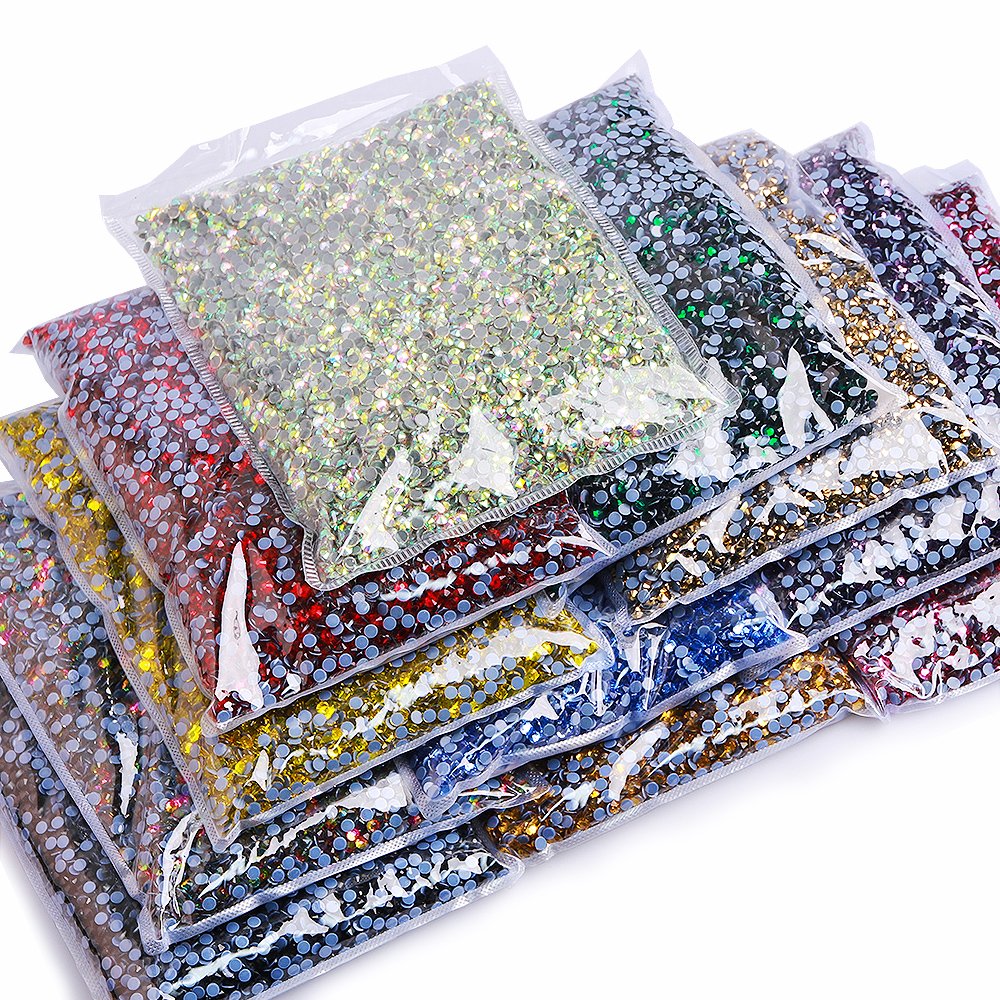
Need a size or color recommendation for your next order? Send us your fabric type, design, and target price — we reply within one business day. WhatsApp +86 13692450325 · rhinestonewholesale8@gmail.com