
Hotfix Rhinestone Colors and How to Use Them in Your Designs
Color is the cheapest decision in a rhinestone order and the one most designers get wrong. You can pick a shade in ten minutes, but after 30,000 SS16 stones are ordered, there is no undo button. The same K9 optical glass reads completely differently by color: clear crystal is clean light, AB is rainbow fire, black diamond is quiet restraint. That gap is physics, not taste. This article breaks down the full Yiben color system — the 31 standard shades, what each one is for, how to pair them with fabric and skin tone, the 2026 trends, and whether you can order a custom color. It is the top-level entry point for the 27 color pages in our colors cluster, and every shade discussed below links to its dedicated page.
Why Color Decides More Than Sparkle
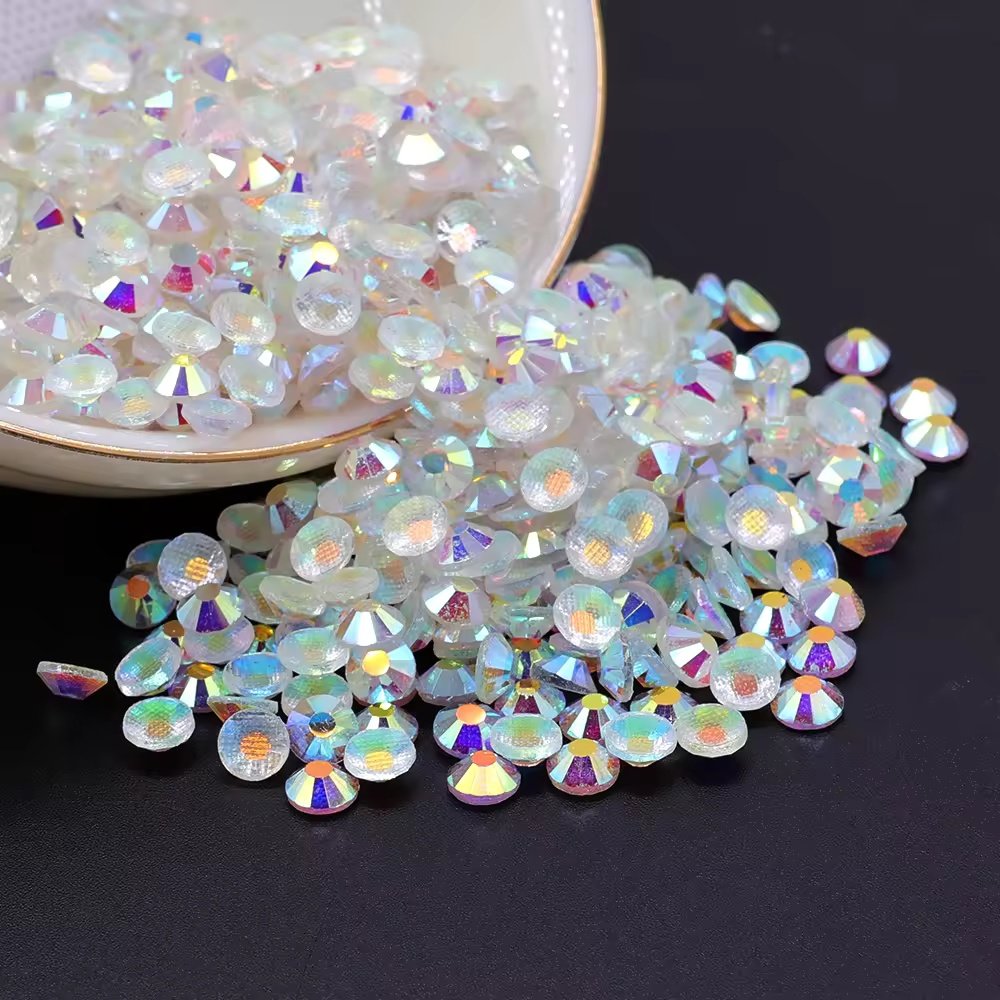
Swap one color and you have a different garment. Color choice is really three decisions stacked together: hue sets the mood, coating sets the personality of the light, and depth sets how well the stone blends with the fabric. Two blues prove the point. Montana behaves like a cold layer of light on dark evening wear, while Sapphire is a loud gemstone blue that demands the design belong to it. Neither is a taste call — it is optical physics. K9 optical glass has a refractive index around 1.9, roughly 1.3 times that of acrylic at about 1.49, which means the base color sits deeper in the stone and burns through with more intensity. Dark colors only get that “baked-in” concentration on real glass, which is one reason cheap acrylic hotfix stones in navy or black look flat no matter how they sparkle.
The 31-Color Hotfix Rhinestone System at a Glance
Yiben’s standard color card is fixed at 31 shades in five families: cool tones, warm tones, neutrals, metals, and AB effects. This system is not an accident. It covers the shades most frequently specified across bridal, stage, and streetwear, and every color has a locked color sample archive — order the same shade in 2022 and again in 2026, and the difference is invisible to the eye.
The quickest way to see the map is a chart:
| Color family | Representative shades | Typical use |
|---|---|---|
| Cool tones | Montana, Sapphire, Peridot | Evening wear, fall-winter, dark fabrics |
| Warm tones | Siam Red, Orange, Gold | Folk, stage, festival |
| Neutrals | Clear Crystal, Black Diamond, Smoken Topaz | All-purpose, menswear, dark bases |
| Metals | Silver, Gold | Mirror finish, red carpet, tech looks |
| AB effects | Crystal AB, Crystal AB HFT | Stage, bridal, ice skating |
Each family has its own logic, so we go through them one at a time.
Cool-Tone Hotfix Rhinestones
Cool tones are the secret weapon for dark fabrics. They do not shout, but under light they outline the silhouette precisely.
Montana is a deep navy that reads as black in daylight and only reveals its blue undertone when light hits it. It performs best on fall coats, menswear, and dark evening gowns — the “present but quiet” color. Sapphire is a pure gemstone blue, a full step more saturated than Montana, and it carries swimwear, stagewear, and any design that needs blue to be unmistakable. Peridot sits between cool and warm, an olive green with a yellow cast that keeps showing up in folk and resort collections. All three depend on glass quality because dark shades amplify cutting detail — the deeper the color, the more the facets matter.
Warm-Tone Hotfix Rhinestones
Warm tones run hot. They are the regulars of red carpets, folk festivals, and fall-winter lines.
Siam Red is a true red with a hint of orange — brighter than wine, warmer than fire-engine. It sells steadily in American-flag designs and festival costumes, and applying it on soft fabrics needs careful temperature control, which we cover in our guide to Siam red hotfix application on soft fabrics. Orange is the loudest of the warm family and a stagewear and cheerleading staple, for a simple reason: it stays visible from hundreds of meters away. Gold is a whole category of its own, and the layering of the metallic finish matters more than most designers expect — the difference is explained in what makes gold hotfix rhinestones different from golden-toned crystal colors. And Smoken Topaz is the underestimated one: its smoky gray cast looks quietly expensive on camel, khaki, and earth tones, and it has become a menswear and premium casual favorite. The smoke is what separates it from the plain yellow topaz family — see the smoken topaz reference for its behavior on different bases.
Neutral and Metallic Hotfix Rhinestones
Neutrals do not make a garment exciting. They make it safe — and at least 60% of any serious order lands in this family.
Clear Crystal is the best-selling shade in the industry, for the simplest of reasons: it behaves like light itself and coexists with any fabric and any print. Black Diamond is a treated black that stays visible on black fabric — that is its entire value, and it carries the details of menswear and dark tailoring that a plain black stone would vanish into; the black diamond hotfix guide explains the finishing behind it. Silver deserves special attention because its vacuum-deposited mirror finish reflects light like an actual mirror — a quality crystal clear cannot reproduce, as laid out in our silver vs crystal-clear comparison. Gold is the other pole of the metals, and its shade range depends heavily on the under-coating process, so request samples before committing.
AB-Coated and Effect Hotfix Rhinestones
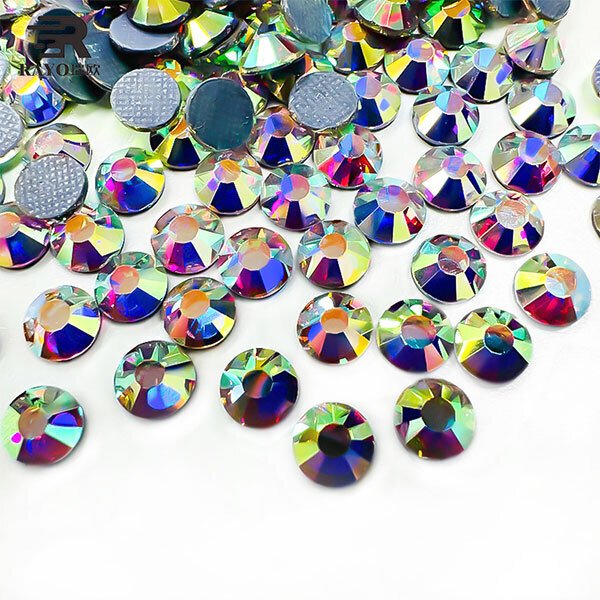
AB — short for Aurora Borealis — works on a different logic. It does not change the base color of the stone; it deposits a thin film on the surface that splits light into a rainbow. That film is applied by vacuum evaporation, not sprayed on, which is exactly why the coating is even and durable. Within Yiben’s Crystal AB line, the HFT (High Fire Technology) coating throws a sharper, denser spectrum than standard AB, and why Crystal AB HFT delivers sharper rainbow fire walks through the difference. AB applications are surprisingly specific: bridal necklines and hemlines need an even rainbow, stage costumes need explosive fire, and ice skating outfits need to survive repeated wear in cold conditions. Those three jobs are covered separately in our AB-on-bridal-gowns and bulk AB sourcing for stage costumes pages.
What Is the Most Popular Rhinestone Color
Clear crystal is the most popular rhinestone color, without close competition. The reason is practical: it is the universal shade that works with every fabric and every design. Crystal AB is the runner-up, because bridal and stagewear — two of the biggest hotfix categories — both default to it.
These are not vibes-based rankings. In Yiben’s order structure, clear crystal and AB together have held the largest share of output for years, and the ratio is stable across brands and regions. The lesson for designers: when a color decision is stuck, clear crystal is the least likely to disappoint. When you need a visual lift, AB is the most cost-effective way to get one. The commercial logic of clear’s dominance is unpacked in why clear crystal remains the best-selling color.
What Color Rhinestones Look Best on Navy Fabric
On navy fabric, Montana, Silver, and Crystal AB are the three safest answers: Montana builds depth in the same color family, Silver creates a cold-light contrast, and Crystal AB adds a rainbow accent.
Which one you choose depends on whether you want the stones to hide or to show. To hide: apply Montana in tone-on-tone, and the stones barely register in daylight while surfacing a cool outline under event lighting — this is the high-end ready-to-wear move. To show: Silver or Crystal AB creates a direct cool-warm contrast, which suits stagewear and evening dresses. One surprise pairing that works well: Siam Red on navy. Red-and-blue collision reads as theatrical when the proportion is restrained, and it outperforms plain black-and-white in visual drama.
How Do I Match Rhinestone Colors to Skin Tones
Skin tone drives the color direction of any design that sits close to the body. Light skin tones suit silver and cool shades, medium tones suit gold and warm shades, and deeper tones pop with gold, copper, red, and black diamond.
This rule reaches its logical extreme in “skin illusion” designs. Light Colorado Topaz is the industry standard there for a reason: its pale yellow cast blends with Asian and Latin skin tones under stage light, producing the effect of fabric glowing against the skin instead of a visible dot of stone. The mechanics of that illusion are detailed in why light colorado topaz is the skin-tone standard. For teams making fitted gowns and dancewear, this is the one shade worth keeping in stock on its own.
Can You Mix Hotfix Rhinestone Colors on the Same Garment
Yes, and professional designs almost always mix. Only three rules matter: stay within two or three shades of the same family, keep the main color above 70% of the coverage, and use AB or metallics only for accents.
The most common mixing failure is equal distribution — three colors at one-third each, which reads as fabric print instead of jewelry. The correct structure gives one color the job of carrying the garment. On a black stage costume, for example: Black Diamond laid down as the base fill, Silver tracing the contours, Crystal AB reserved for the collar and waistline. Three layers, three jobs, and the hierarchy shows up immediately.
Rhinestone Color Combinations That Work
The same logic translates directly onto specific fabrics. These are the combinations that keep coming back:
| Fabric | Combination | Effect |
|---|---|---|
| Black | Black Diamond + Silver + Crystal AB | Dark base, cool outline, colored accent |
| White / ivory | Clear Crystal + Gold + AB | Clean, premium, bridal |
| Denim | Silver + Sapphire + AB | Streetwear energy |
| Red | Gold + Clear Crystal | Festival, folk, stage |
| Navy | Montana + Silver + Siam Red | Restrained drama |
Theme works the same way as fabric. Bridal projects orbit clear crystal and AB; stage projects reach for Siam, Orange, and other high-saturation shades; holiday collections cycle red-green-gold. For quantities, one benchmark helps: the chest area of a wedding gown typically takes 2,000–3,000 SS16 stones, and the color split should follow roughly 70% main, 25% support, 5% accent.
2026 Hotfix Rhinestone Color Trends
Three trends are worth tracking this year.
First, AB is moving off the stage and into daily wear. HFT coating sharpened the fire, Las Vegas costumes are the proving ground, and evening wear is quietly following — the high-brilliance AB HFT stones used in Las Vegas stagework show what the coating can do under aggressive lighting. Second, metals are back, especially silver’s mirror finish pairing with technical fabrics. Third, restraint in dark shades: Black Diamond applications in menswear and tailoring are getting finer, used for structure rather than sparkle.
Trends do not change the base logic: color always serves fabric and occasion. The safe way to ride a trend is to keep the four fundamentals — clear crystal, black diamond, silver, AB — stocked, then add one or two trend shades per season.
Custom OEM Colors and Pantone Matching
Thirty-one standard shades cover most projects, but some buyers need a color that is theirs alone. The OEM process is not complicated: you send a Pantone number or a physical color sample, we make a matching color sample for approval, then production runs against that approved sample. The real challenge in custom color is not making it once — it is keeping it stable across batches. Humidity and coating temperature during production both shift the final shade, which is why batch-to-batch consistency is the true deliverable.
Custom orders sit inside the same supply chain as everything else, so the sourcing rules still apply. If your project involves AB stones, it is worth reviewing how the washable AB line behaves through machine washing before you commit quantities — the same logic holds for custom colors, where there is no existing test data to lean on.
What This Means for Your Next Order
Color should not be a last-minute decision. Look through the 31 standard shades, settle your main color, check it against fabric and skin tone, then order — it is dramatically cheaper than reworking a bad batch.
Need the full color card or physical samples? Contact Yiben directly. We will help you confirm a shade for your specific project, and we can ship color samples to your studio. Decide on the real stone in your hand, not on a screen — that is the zero-risk insurance.
Need a size or color recommendation for your next order? Send us your fabric type, design, and target price — we reply within one business day. WhatsApp +86 13692450325 · rhinestonewholesale8@gmail.com