
Rhinestone Transfer Wholesale, How Custom Transfers Are Specified, Priced and Produced
Quick answer A rhinestone transfer is a motif of crystal stones pre-set on a heat-activated carrier film. You place the film on the garment and press once, and the whole design transfers in a single operation instead of being placed stone by stone. Buyers choose transfers for layout consistency and speed on volume. Our transfers use 100% K9 optical crystal glass with a refractive index near 1.9, 12 to 14 facets and Mohs hardness of 6 to 6.5, held by a German imported heat-activated grey glue that melts between 150 and 170 °C with a working temperature of 160 °C. Sizes run SS6 to SS30, the factory holds more than 400 colours with Pantone matching, and on stable fabric the bond is tested to ISO 6330 with under 2% stone loss after 50 machine washes.
A transfer solves the one problem that slows every rhinestone line down — placement. Laying five thousand stones by hand onto a hoodie takes hours and drifts out of alignment by the second garment. A transfer moves that work upstream to a film, where the layout is fixed once and repeated exactly. That is the promise. The catch is that a transfer is only as good as the materials behind it, and two films that look identical in a photo can wash, drape and price very differently. This guide is written for the buyer who has to sign off on the order. What a transfer is, which stones and glue go into it, how it is pressed, what survives a wash cycle, how the price is built, and where the honest limits sit.
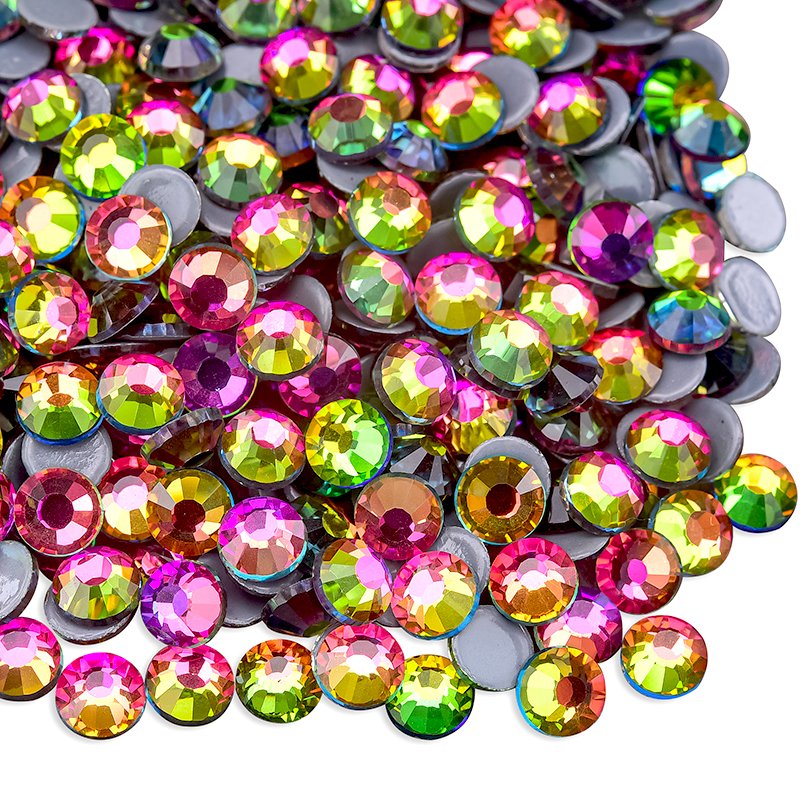
What Is a Rhinestone Transfer and How Does It Differ from Direct Application
A rhinestone transfer is a complete design of stones arranged on a heat-sensitive carrier film, with the adhesive side facing the fabric, so one press transfers the entire motif. Direct application places each stone onto the garment individually. The film, not the stone, is what defines a transfer.
Here is how the film works. Stones are positioned on a clear carrier with the glue-coated side down. When heat and pressure are applied, the glue melts into the fabric fibre and the crystal locks in place. The carrier is then peeled away — either while the piece is still warm or after it cools, depending on the film spec — leaving only the stones behind. Because the stones never move relative to each other before the press, spacing and orientation are identical across every unit in the run.
Direct application is the alternative. A machine or an operator places stones one at a time, following a template. It is flexible for one-off pieces and tight curves where a flat film struggles, and it lets you adjust on the fly. The trade-offs are real: alignment drifts, output per hour is lower, and the labour cost scales with every stone rather than staying flat. For a single couture gown, direct application can be the right call. For a streetwear drop of two thousand hoodies with the same chest logo, a transfer is faster, cheaper and cleaner.
| Rhinestone transfer | Direct application | |
|---|---|---|
| How stones arrive | Pre-set on carrier film | Placed one by one on the garment |
| Consistency across units | Fixed by the film, repeats exactly | Depends on operator and template |
| Speed on volume | Fast, one press per unit | Slower, scales with stone count |
| Best for | Logos, repeated motifs, bulk runs | One-offs, tight curves, flexible edits |
| Placement risk | Low once the film is approved | Higher, drift shows up over a run |
Behind both methods is the same stone supply, run from Guangzhou’s Baiyun district after 12 years of cutting and setting crystal. If you want the wider picture of how the stones themselves are made before you choose a decoration route, our Guangzhou hotfix rhinestone manufacturer with 12 years of glass crystal production page walks through the factory, the sizing and the export side.
If you are still comparing decoration routes rather than committing to a transfer, send us your artwork and garment type and our team will tell you within 12 hours whether a transfer, a patch or a sewn applique fits the design better.
What Stone Types and Sizes Go into a Custom Rhinestone Transfer
A custom transfer is built from K9 optical crystal glass, not acrylic, because the stone has to carry sparkle after the glue has done its job. Our range runs from SS6 up to SS30 across more than 400 colours held in stock, with Pantone matching for anything outside the standard range.
The crystal itself is where the appearance lives. K9 has a refractive index near 1.9, so it bends far more light than ordinary glass at roughly 1.5 or acrylic at about 1.49. The 12 to 14 facets on each stone are what break that light into the sharp flash buyers recognise, and Mohs hardness of 6 to 6.5 means the surface resists the scuffs that turn a cheap acrylic stone dull within a few wears. Acrylic stones are lighter and cheaper, and they have their place on a costume that will not be washed. They are the wrong choice for a retail garment with a wash-care label.
Size is a separate decision from appearance, and it drives both the look and the production time. SS is a naming standard rather than a millimetre value, so here is the conversion for the sizes actually run on transfers.
| Stone size | Diameter | Typical transfer use | Read at |
|---|---|---|---|
| SS6 | about 2.0 mm | Fine detail, small script, dense fill | Close up only |
| SS10 | about 2.8 mm | Standard logo work, mid-detail fills | Arm’s length |
| SS16 | about 4.0 mm | Bold logos, large graphics, hoodie chest pieces | Across a room |
| SS20 | about 4.8 mm | Statement lettering, sparse luxury motifs | Far, strong sparkle |
| SS30 | about 6.4 mm | Large-format graphics, glued accessory work | Very strong, heavier |
Smaller stones let you hold detail and build a gradient; larger stones fill a shape with fewer pieces and read from further away. Most logos mix two or three sizes so the main shape stays bold while the edges keep their definition. The full scale, including how to match a size to a garment area, is covered in our rhinestone size guide.
Colour is the last lever. More than 400 colours sit in stock, from Crystal and Crystal AB through the full solid range, and Pantone matching covers a brand colour that is not held. Send a Pantone reference or a physical swatch and the stones are matched to it. If a collection will run across several production batches, tell us up front, because a colour planned as one lot behaves far better than the same colour ordered twice.
What Adhesive Is Used on a Hotfix Transfer and Why It Decides Durability
Our transfers use a German imported heat-activated grey glue that melts between 150 and 170 °C, with a working temperature of 160 °C. The glue, not the crystal, is what fails first on a cheap transfer, and it is the single biggest predictor of whether the design survives a wash cycle.
Heat-activated glue works by changing state. Below its melt range it is a solid coating on the back of each stone. At the right temperature it turns fluid and wicks into the fibre of the fabric. As the piece cools, it cures into a mechanical and chemical bond that holds the stone against the weave. If the glue never reaches its melt range, it only sits on the surface and lets go the first time the garment is flexed or washed.
The melt range matters because it has to sit above the temperatures the finished garment will meet. A low-grade yellow glue that softens below 130 °C will fail the first time a garment sits in a hot car, goes through a warm dryer cycle or is pressed during finishing. The German grey glue used here melts between 150 and 170 °C and cures at a working temperature of 160 °C, which keeps the bond stable through normal retail wear and washing.
Glue coverage is the second half of the equation. A well-coated stone carries an even layer across its whole base, not a dot in the centre. Uneven coverage creates weak zones that lift under stress even when the press parameters are correct. Because the glue is applied under controlled conditions and inspected before stones go onto a film, a transfer from our line has the same bond quality across the whole design rather than a strong centre and a fragile edge.
For buyers, the practical takeaway is simple. Ask what glue is on the transfer and at what temperature it melts before you compare price. A cheaper quote that hides a low-melt glue is not a cheaper transfer; it is a garment that comes back as a return.
How Is a Custom Rhinestone Transfer Produced
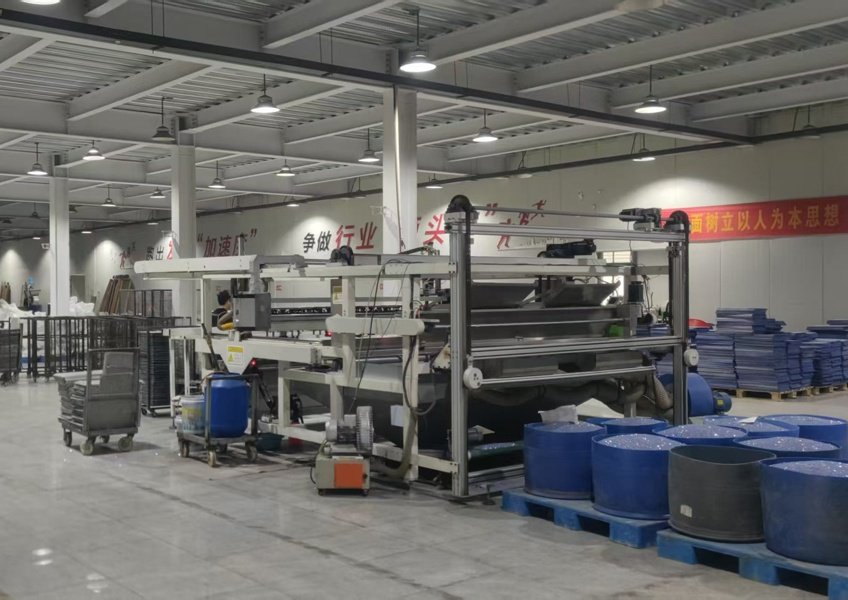
A custom transfer moves through four stages — design and layout, stone placement on the carrier film, heat pressing onto the garment, and a quality check. Bulk runs use automated stone placement, which is what keeps the ten-thousandth unit identical to the approved sample.
The first stage is the design file. Artwork is turned into a stone map, where every crystal has a defined position and size. This is where density is balanced against weight and where overlaps that would create weak bonding zones are removed. A logo that reads well on a screen does not always translate into a layout that presses evenly, and adjusting it here is far cheaper than adjusting it after the film is run.
The second stage is placement on the carrier film. Stones are positioned on the heat-sensitive film with the adhesive side down, either by automated equipment for bulk or by hand for very small or intricate runs. Automation holds the spacing and orientation constant, which is the whole reason transfer output is more consistent than direct application. The finished film looks like a negative of the final design, with the motif mirrored and the glue facing the viewer.
The third stage is the heat press. The film is positioned on the garment and pressed at the temperature, pressure and time the fabric calls for. The glue melts into the weave, and the carrier is peeled away — leaving the stones bonded and the layout exactly as designed. After that the piece is inspected before packing, with stone retention and alignment checked against the approved sample.
| Stage | What happens | What it controls |
|---|---|---|
| Design and layout | Artwork becomes a stone map | Density, weight, no weak zones |
| Film placement | Stones set on carrier film | Spacing, orientation, coverage |
| Heat pressing | Film pressed onto the garment | Bond strength, final alignment |
| Quality check | Piece checked against the sample | Retention, positioning, finish |
For a buyer, the value of an automated line is not just speed. It is that the sample you approve and the bulk you receive come off the same process, so what you signed off is what ships.
What Heat Press Settings Does a Rhinestone Transfer Need
A standard transfer presses at 150 to 170 °C for 10 to 15 seconds at medium to firm pressure, with the exact numbers set by the fabric rather than the stones. Cotton, spandex and silk each need a different point inside that window, and getting the temperature wrong is the usual cause of both failed bonds and scorched fabric.
Three variables have to line up. Temperature has to reach the glue’s melt range without damaging the fibre. Pressure has to be even across the whole film, because a soft or uneven surface leaves parts of the design under-pressed. Time has to be long enough to melt the glue through the carrier but not so long that the fabric or the stone coating is affected. On a proper press the pressure is set in PSI and applied flat, which is why a press beats a household iron for anything beyond a small patch test.
| Fabric | Temperature | Pressure | Time | Extra step |
|---|---|---|---|---|
| Cotton | 165 °C | 40 PSI | 15 seconds | None |
| Spandex and stretch knits | 150 °C | 30 PSI | 12 seconds | Lower heat protects the fibre |
| Silk | 140 °C | 20 PSI | 10 seconds | Add heat-protection paper over the film |
Two practical points beyond the table. First, the peel. Some films are removed warm, while the bond is still soft; others are left to cool and peeled cold. Follow the film spec, because peeling at the wrong moment can lift a stone before the glue has set. Second, the surface. Press on a hard, flat base, not a padded ironing board, so the pressure is even across the full motif.
Every transfer we ship goes out with the settings for its fabric, and our companion piece on rhinestone heat transfer temperature goes deeper on the temperature ladder, including how to adjust when you mix stone sizes in one design.
Which Fabrics Work and Which Need Testing
Cotton, cotton blends and fleece are the ideal surfaces for a transfer — they are stable, they take the full 165 °C press, and they hold the strongest resulting bond. Nylon, spandex and coated fabrics can work, but they need a pre-production heat test on an offcut before the run, because the coating or the fibre can react to heat in ways a flat fabric does not.
Stable wovens are the safe ground. Cotton and cotton-poly hold a flat surface, do not move under the press and accept the full temperature and pressure window. Fleece and sweatshirting have a brushed surface, but the fibre is thick enough that the glue still reaches it, and transfers on hoodies and crewnecks are one of the most common applications in the trade.
The three groups that need testing are the ones where heat and the fabric interact. Spandex and other stretch knits move and can scorch, so the temperature drops to 150 °C and the design has to allow the fabric to stretch without fighting the stones. Nylon is heat-sensitive and can discolour, so the safe window is tested rather than assumed. Coated or laminated fabrics — waterproof shells, PU-backed textiles — have a surface layer that can resist adhesive or distort, so a bond test comes before any production commitment.
| Fabric group | Behaviour with a transfer | Action |
|---|---|---|
| Cotton, cotton blends | Stable, takes full press, strong bond | Ideal, no special handling |
| Fleece and sweatshirting | Brushed but thick fibre, bonds well | Ideal, standard settings |
| Spandex and stretch knits | Moves and can scorch | Drop to 150 °C, test first |
| Nylon | Heat-sensitive, can discolour | Pre-production heat test |
| Coated and laminated | Surface layer may resist glue or distort | Bond test on offcut first |
| Highly textured surfaces | Uneven contact under the press | Not recommended |
The rule we give buyers is blunt. On any new fabric, press a sample before the bulk runs. A five-minute test on an offcut is cheaper than a ruined production batch, and it tells you the exact temperature that fabric wants rather than the one that happened to work on a different cloth.
How Durable Is a Rhinestone Transfer After Washing
On stable fabric with the correct press, a K9 crystal transfer set with the German grey glue holds through 50 machine wash cycles under the ISO 6330 standard with under 2% stone loss. The same test on cheap acrylic stones with low-grade glue shows more than 30% loss after only 5 cycles, which is the gap between a transfer that survives a season and one that survives a photo.
ISO 6330 is the standard wash-test method used across the garment industry, and quoting a wash-tested retention figure rather than a vague claim is what lets a buyer plan a wash-care label with confidence. A design tested to under 2% loss after 50 cycles tells your team that the transfer will not be the first component to fail.
How the garment is washed matters as much as how it was pressed. Turn it inside out, use cold water, skip the dryer, and keep harsh bleach away from the glue line. Stone loss almost always starts at the bond, not in the crystal, so the wash routine is really protecting the adhesive rather than the stone.
Here is the honest limit. On silk expect roughly 20 to 30 machine washes rather than 50, because the fibre is delicate and we lower the press temperature to protect it. On a highly stretchy or thin fabric, a hotfix transfer has less to grip than on a stable woven, so the wash count is a guideline rather than a guarantee. Our guide to washing rhinestone garments covers the cycle settings in detail, and for any single fabric the short version is the same cold-water, no-dryer routine.
How Is a Rhinestone Transfer Priced
A transfer is priced from four variables — stone count, stone size, design density and order quantity — plus a one-time setup cost for a new design. Stone count and quantity are the two levers a buyer can actually move, so they are the ones worth working.
Stone count is the base of the price, because every crystal is material and press time. A design with two thousand stones costs more than one with four hundred, even if the two covers the same area, because a dense layout uses more crystal. Stone size sits on top of that: an SS20 stone holds more glass than an SS6, so a design built from larger stones carries a higher material cost at the same count.
Quantity reshapes the whole number. Wholesale pricing is tiered, so the effective rate per piece drops as the run grows, and the one-time setup for a new design — building the stone map and running the film — is spread across more units. That is why the same logo is proportionally cheaper at five thousand pieces than at two hundred: the artwork work is fixed, and only the per-unit material and press time scale.
| Pricing variable | How it moves the price | What you can do about it |
|---|---|---|
| Stone count | More stones, higher cost | Simplify dense areas without losing the look |
| Stone size | Larger stones cost more each | Mix sizes, use big stones only where they read |
| Design density | Tight fills use more material | Trade some density for weight and cost |
| Order quantity | Higher volume, lower unit rate | Combine sizes into one run where possible |
| New-design setup | One-time artwork and film cost | Amortised across the run, lower per unit at volume |
Because the tiers are set per design and per quantity, they are confirmed on the quote rather than published as a single number that would mislead a buyer working at a different volume. Send the artwork, the garment and the expected run size and the quote comes back with the tier that fits.
What Is the HS Code and Delivery Time for Wholesale Transfers
The HS code for glass rhinestones and transfers is 7018.10, which is the code your customs broker will need for import clearance. Our stock stone line runs from a minimum of one colour and one size in 2 packs, and OEM and ODM private labelling are available for buyers who need their own branding on the packaging.
Delivery is fixed, not estimated. Stock colours ship the same day payment clears. Custom runs ship in 7 to 15 days depending on order quantity, because a dense multi-size design takes longer to lay and press than a simple single-size motif in the same colour. Either way the confirmed window goes on the proforma invoice alongside the shipping method, so your planning calendar has a real date rather than a range.
Two things are worth pinning down before the order. First, the duty your market applies to HS 7018.10 depends on your country’s current tariff schedule, so check with your broker using the code rather than a remembered rate — the correct code and documents come with the shipment so clearance goes through without a surprise. Second, freight choice changes the calendar more than production does. Air gets a transfer order to your door quickly, while sea freight cuts the cost per unit on volume and adds transit time.
For custom work the factory runs OEM and ODM, including private labels. Confirm the artwork and the packaging spec early, because those two items, not the crystals, are usually what extends a custom timeline. Our comparison of sea versus air freight for wholesale rhinestone orders sets out how to decide between them.
Transfer, Applique or Patch — Which Decoration Method Fits Your Garment
A transfer is the right choice for a flat, repeated motif on a washable fabric; an applique suits a design with a fabric base or a soft hand; a patch works for a rigid emblem or a sew-on badge. Picking the wrong method costs more than the decoration itself, because it shows up as returns.
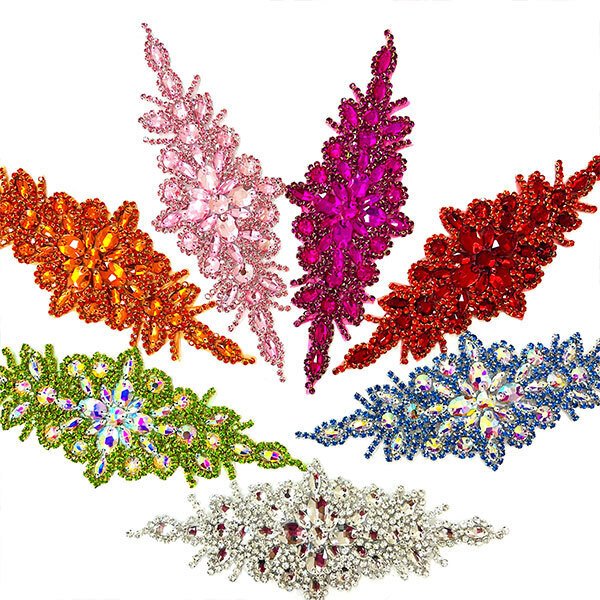
The three methods solve different problems. A rhinestone transfer is a film of stones pressed directly onto the garment, so there is no fabric base and the design sits flat against the cloth. A rhinestone applique is a stone design built on its own fabric or mesh backing, which can then be sewn or pressed on; it gives a softer hand and lets you work on stretch or curved areas where a flat film is awkward. A patch is a defined emblem, often stiffened or embroidered around a stone centre, made to be sewn on and to hold a fixed shape.
| Method | What it is | Best for | Fixing | Watch out for |
|---|---|---|---|---|
| Rhinestone transfer | Stones on a carrier film, pressed in one pass | Flat repeated logos on stable, washable fabric | Hotfix press only | Needs a heat-safe surface |
| Rhinestone applique | Stones on a fabric or mesh backing | Stretch, curves, soft hand, layered looks | Sew on or hotfix | Backing adds a little weight |
| Patch | Defined emblem with a stone centre | Rigid badges, uniforms, brand marks | Sew on | Stiffer hand, higher setup |
Choose the transfer when the design is repeated, the fabric is stable and the priority is consistency at volume. Choose the applique when the piece has to move, curve or feel soft against the skin. Choose the patch when the decoration has to read as a badge and hold a firm shape. Our rhinestone patches page covers the badge route if that is the direction your design is heading.
How Does Design Density Affect Weight and Drape
Density is a trade you make whether you plan for it or not. A tight, fully paved design increases garment weight, affects how the fabric falls, and puts more stress on the bond — so the densest layout is rarely the best one for a wearable piece.
Every stone adds weight, and a full-pave panel concentrates that weight in one area. On a hoodie chest logo or a bag front, that is not a problem. On the shoulder of a flowing dress or the front of a lightweight tee, a heavy paved area can pull the fabric out of shape and change how the garment hangs. The same density that looks dramatic on a flat graphic can look and feel wrong on a soft one.
Density also affects durability. A very tight layout gives the glue less fabric to grip per stone, because neighbouring stones compete for the same small area of weave, and it creates stiff zones that crack when the garment flexes. Spacing stones slightly — dropping some density and filling with smaller sizes at the edges — keeps the visual read while giving each stone a proper bond and letting the fabric move.
The practical rule is to design for the wear, not the photo. A stage costume can carry a full-pave bodice because it is not washed often and the drama is the point. A retail tee that will be worn weekly and washed after each wear wants a lighter, better-bonded layout in the same shape. If your artwork is very dense, ask us to quote an alternative version at lower density so you can compare weight, hand and cost side by side before you commit.
What Is the Ordering and Sampling Process from Inquiry to Delivery
The process is short and the same for a single sample and a bulk run. Knowing the steps in advance removes most of the uncertainty buyers feel about ordering decoration from a distance, and it keeps the bulk matched to what was actually approved.
You send the artwork, the garment type or fabric, the stone size and colour, and the expected run quantity. The factory reviews the design for density and weight, confirms the stone mix and the fabric settings, and quotes with the quantity tiers. A free sample is produced and sent so you can press it against your own fabric and check the look, the size and the bond before you commit.
Once the sample is approved, a proforma invoice follows with the specification, the delivery window — stock colours ship the same day payment clears, custom runs in 7 to 15 days depending on quantity — the HS code and the shipping method. Production then runs against the approved sample, followed by a quality check before packing. Shipping goes by air or sea depending on your deadline and volume, with tracking and export documents handed over.
Because the approved sample is the reference for production, and we retain a sample from your batch, a reorder has something concrete to match rather than a memory. That matters most when a design is reordered across seasons, which is where colour and density drift usually appear.
How Does Colour Stay Consistent Across Reorders
Colour drift is the complaint buyers raise most often about decorated garments, and it is almost always a batch problem rather than a crystal problem. Two production lots of the same named colour can sit a shade apart if nothing in the process controls them.
We handle it at three points. Stones are sorted by colour after coating, so a named colour matches its reference before it goes onto a film. Every batch runs through a quality check against the approved sample, so a shift is caught before packing rather than after the container arrives. And a retention sample is kept from each batch, which is what lets a reorder be matched months later against the exact run you first approved.
This matters more for a transfer than for loose stones, because a transfer is a single unbroken design. A faint shade change is invisible in a pile of stones and obvious across a logo. If a collection will run across several production batches, tell us up front so the colour can be planned as one lot, and the standard range’s fixed naming system plus Pantone matching gives you a stable reference for anything outside it.
Explore the Rhinestone Transfer Series
This is the pillar piece for our rhinestone transfer cluster, and it sits alongside two focused guides that go deeper on the parts buyers ask about most. Read them next depending on which decision is blocking your order.
– Rhinestone heat transfer temperature — the full temperature ladder by fabric and stone size, and how to adjust when one design mixes multiple sizes. – Rhinestone patches — the sew-on badge route, when a defined emblem beats a flat film, and how to spec it.
If you are still deciding on the stones rather than the decoration method, the wider wholesale rhinestone supplier hub covers sizing, colours, glue and export in one place.
Frequently asked questions
What is a rhinestone transfer? A rhinestone transfer is a design of crystal stones pre-set on a heat-activated carrier film. You place the film on the garment and press once, and the whole motif transfers in a single operation instead of being placed stone by stone. The layout is fixed on the film, so every unit in a run has identical spacing and orientation, which is why transfers are used for repeated logos and bulk decoration.
What stones are used in a custom rhinestone transfer? Our transfers use 100% K9 optical crystal glass with a refractive index near 1.9, 12 to 14 facets and Mohs hardness of 6 to 6.5, which gives a sharper flash and better scratch resistance than acrylic. Sizes run from SS6 at about 2.0 mm up to SS30 at about 6.4 mm, and more than 400 colours are held in stock with Pantone matching for anything outside the standard range.
What glue holds a hotfix transfer, and why does it matter? Our transfers use a German imported heat-activated grey glue that melts between 150 and 170 °C with a working temperature of 160 °C. The glue is the part that usually fails first on a cheap transfer, because a low-grade glue that softens below 130 °C lets go in a hot car or a warm dryer cycle. Asking what glue is on the transfer and at what temperature it melts is the fastest way to tell a good transfer from a cheap one.
What heat press settings does a transfer need? Press at 150 to 170 °C for 10 to 15 seconds at medium to firm pressure, with the exact numbers set by the fabric rather than the stones. Cotton runs at 165 °C, 40 PSI for 15 seconds; spandex at 150 °C, 30 PSI for 12 seconds; and silk at 140 °C, 20 PSI for 10 seconds with heat-protection paper over the film. Always press on a hard, flat surface so the pressure is even.
Which fabrics need a pre-production heat test? Cotton, cotton blends and fleece take a transfer with no special handling. Nylon, spandex and coated or laminated fabrics should each be tested on an offcut before the run, because the fibre or the coating can discolour or resist the adhesive. A five-minute test on a scrap is cheaper than a ruined production batch and gives you the exact setting that fabric wants.
How long does a rhinestone transfer last after washing? On stable fabric with the correct press, our K9 crystal with the German grey glue holds through 50 machine wash cycles under the ISO 6330 standard with under 2% stone loss, while cheap acrylic with low-grade glue loses more than 30% after only 5 cycles. Wash inside out in cold water and skip the dryer to protect the glue line. On silk, expect roughly 20 to 30 washes rather than 50.
How is a rhinestone transfer priced? The price is built from stone count, stone size, design density and order quantity, plus a one-time setup cost for a new design. Stone count and quantity are the levers a buyer can move: a denser layout uses more crystal, and higher volume lowers the effective rate because the setup is spread across more units. Tiers are confirmed on the quote for your specific design and run size.
What is the minimum order and delivery time for wholesale transfers? Our stock stone minimum is one colour and one size from 2 packs, which keeps a first trial small. Stock colours ship the same day payment clears. Custom runs ship in 7 to 15 days depending on order quantity. OEM and ODM with private labelling are available, and the HS code for glass rhinestones and transfers is 7018.10.
For a 12-hour quote and a free sample, message us on WhatsApp at wa.me/8613692450325, call or message +86 13692450325, or email rhinestonewholesale8@gmail.com. Send your artwork and garment type and the team will confirm the stone mix, the settings and the lead time before you commit to bulk.
Need a size or color recommendation for your next order? Send us your fabric type, design, and target price — we reply within one business day. WhatsApp +86 13692450325 · rhinestonewholesale8@gmail.com