
Pre-Production Checklist for Garment Factories Planning a 10,000-Unit Rhinestone Run
When you are managing a garment factory transition from small-batch samples to a massive 10,000-unit production run, the margin for error effectively vanishes. A minor oversight in adhesive compatibility or a 2-day delay in shipping can result in thousands of dollars in wasted labor and missed delivery windows for international clients. You need a systematized approach that treats every rhinestone as a critical component of the garment’s structural integrity. At Guangzhou Yiben E-Commerce Co., Ltd., we have spent 12 years refining the technical parameters of K9 optical glass rhinestones to ensure they meet the demands of high-volume industrial heat presses.
Success in large-scale rhinestone application is built on three pillars: material consistency, machine calibration, and logistical foresight. Whether you are producing bridal wear requiring 5,000 stones per piece or athletic jerseys with minimal accents, the pre-production phase is where your profit margin is protected. You must verify that your stones are OEKO-TEX Standard 100 certified and REACH compliant to avoid rejection at European or North American customs. This guide provides the granular checklist you need to navigate a five-figure unit run without compromising on the 12-14 facet precision that high-end fashion brands demand.
What should I check before placing a bulk rhinestone order
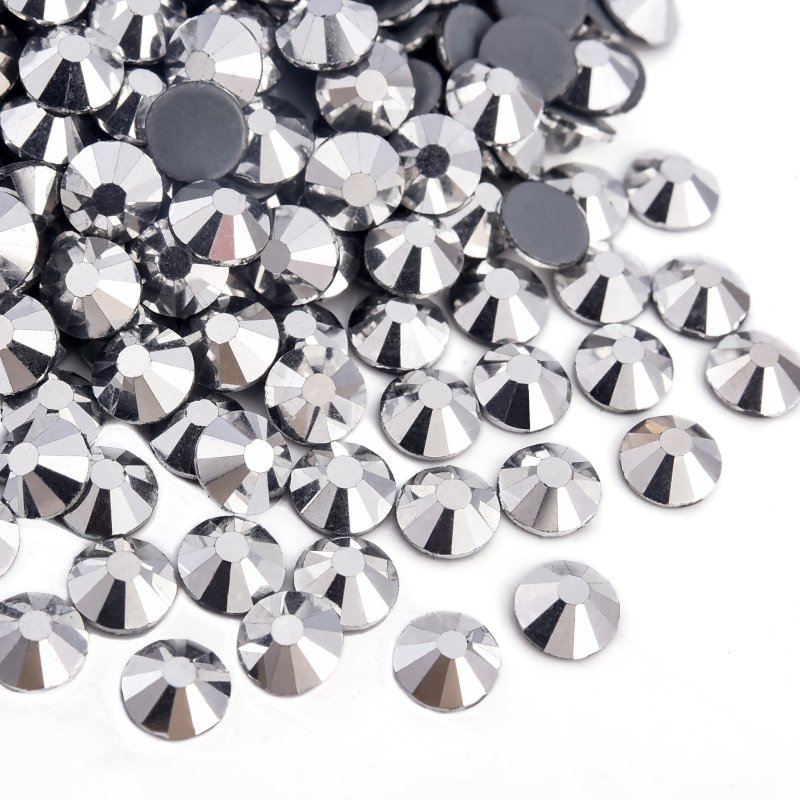
You should check the chemical compliance certifications, adhesive melting ranges, and color consistency across batches. Specifically, verify that the rhinestones are lead-free (OEKO-TEX Standard 100), use German-imported grey adhesive with a melting point of 150-170°C, and that the supplier can meet your MOQ requirements, such as our 2-pack minimum per color/size.
In a 10,000-unit run, material consistency is your greatest risk. If you order SS16 stones and the size varies by even 0.2mm between bags, your heat press templates will fail. You must demand K9 optical glass with a refractive index of approximately 1.9. Unlike cheap acrylic stones (RI ~1.49), K9 glass maintains its brilliance even after the intense pressure of industrial application. We recommend requesting a pre-shipment sample from the same batch that will fulfill your bulk order. This ensures the “Crystal AB” or “Siam” color you saw in the sample book matches the 500 bags arriving at your dock.
Furthermore, you need to audit the supplier’s stock capacity. For a run of this size, you cannot afford a “out of stock” notification halfway through production. We maintain over 400 colors in stock in our Guangzhou warehouse to prevent this exact scenario. Always confirm the lead times for custom OEM/ODM orders, which typically take 3-5 days for sampling, and ensure the shipping method aligns with your production calendar. Air shipping from Guangzhou to North America generally takes 5-7 days, whereas sea freight can take 18-25 days. Factor these into your procurement timeline to avoid idle machinery.
How do I QC incoming rhinestones at the factory
To QC incoming rhinestones, perform a visual inspection of facet clarity, an adhesive “flick test” to check for glue-to-glass bonding, and a size-mesh calibration. Ensure the stones have 12-14 precision facets and the adhesive is a uniform grey color, indicating high-quality German-imported hot-melt glue rather than low-quality yellow substitutes.
When the crates arrive, your QC team should pull random samples from different bags. Use a digital caliper to check the diameter of SS10 (2.8mm) or SS20 (4.8mm) stones. Even a minor deviation can cause the stones to sit improperly in a heat-transfer template. Check the bottom of the stones: the German grey adhesive should be thick and centered. Cheap yellow glues often melt at temperatures below 130°C, which sounds convenient but leads to high fallout rates during consumer use. Your factory standard should be a glue that requires 150-170°C to activate, ensuring a permanent bond.
Light reflection is another critical QC point. Place the stones under a standard D65 light source. K9 glass, with its Mohs hardness of 6-6.5, should show sharp, defined edges on its facets. If the edges look rounded or “soft,” you may have been shipped lower-grade glass or even high-lead crystal that doesn’t meet modern safety standards. Since we adhere to Prop 65 and REACH regulations, our stones undergo rigorous internal testing to ensure they don’t just sparkle, but also stay within the <90 ppm lead limit required for global retail.
What shipping documentation do I need for importing rhinestones
You need a Commercial Invoice, Packing List, and Bill of Lading (or Air Waybill), all correctly citing HS Code 7018.10. Ensure the documentation specifies the country of origin as China and includes any necessary compliance certificates like OEKO-TEX to facilitate smooth customs clearance and accurate duty assessment at your local port.
Importing 10,000 units’ worth of rhinestones involves significant customs scrutiny. In the United States, rhinestones classified under HS 7018.10 generally face a duty rate of approximately 6.6%. In the European Union, this rate is often lower, around 3.7%. If your documentation is vague—for example, simply listing “beads” instead of “glass rhinestones for garments”—you risk your shipment being held for inspection or reassessed at a higher duty tier. We provide detailed packing lists that specify stone sizes (SS6 to SS30) and weights to ensure your broker can file the entry accurately.
Logistics management for a 10,000-unit run usually involves a split-shipment strategy. You might fly in the first 10% of the order via air (5-7 days) to begin immediate production of high-priority sizes like SS16 or SS20, while the remaining 90% travels by sea (18-25 days) to save on freight costs. This requires precise documentation for each “portion” of the Bill of Lading. Always ensure your supplier provides a tracking number immediately upon dispatch from Guangzhou—stock items usually ship within 1-2 business days.

How do I calculate the total rhinestone quantity for a large run
To calculate the total quantity, multiply the number of stones per garment by 10,000, then add a 5-10% buffer for production waste and QC rejects. For example, if a design uses 1 square foot of SS16 stones (~576 pieces), a 10,000-unit run requires approximately 6,048,000 stones including a 5% waste allowance.
Large-scale production cannot rely on “rough estimates.” You need to know exactly how many “gross” or “packs” to order. In the wholesale industry, SS16 stones are typically packed at 10 gross (1440 pieces) per pack. If your design is dense, like a bridal bodice requiring 3,000 stones, you are looking at over 20 packs per garment. Across 10,000 garments, that is 200,000 packs. You must also account for “flyaway” stones during the transfer process. In a high-speed factory environment, a 3% loss during the vacuum-suction or template-filling phase is standard.
Consider the area coverage if you are doing “all-over” patterns. For reference, 1 square foot of surface area requires roughly 576 SS16 stones or 400 SS20 stones. If you are mixing sizes—perhaps SS10 for fine details and SS30 for impact—your calculation must be segmented by size. Since Yiben’s MOQ is just 2 packs per color and size, it is easy to top up your order if your initial calculation was too lean, but it is always more efficient to order the bulk of your needs in a single shipment to maintain color dye-lot consistency.
What is the best way to store bulk rhinestones in a factory
The best way to store bulk rhinestones is in a temperature-controlled, low-humidity environment away from direct sunlight. Keep stones in their original sealed bags to prevent dust accumulation and oxidative damage to the adhesive. Avoid temperatures above 30°C, as prolonged heat can prematurely soften the German-imported grey hot-melt glue.
When you are holding stock for 10,000 units, your storage room becomes a high-value asset. Dust is the enemy of hotfix rhinestones; if a layer of fine factory lint settles on the adhesive backing, the bond strength will plummet. Always store the bags on pallets or shelving, never directly on a concrete floor where moisture can seep in. Organize your inventory by size (SS6, SS10, SS16, etc.) and color to minimize the time workers spend handling the bags. Excessive handling can cause the stones to rub against each other, potentially scratching the K9 glass facets.
Labeling is also crucial. Each bin should clearly state the batch arrival date and the compliance status (e.g., “OEKO-TEX Certified – Batch A”). For factories in humid climates, like those in Southeast Asia or coastal China, using industrial dehumidifiers in the storage area is highly recommended. If the German grey adhesive absorbs moisture, it may “bubble” or steam during the heat-pressing process, leading to a weak bond that fails the 50-wash durability test.
How do I test rhinestone adhesive before full production
You test rhinestone adhesive by conducting a standardized wash test and a “cross-cut” adhesion test on your production fabric. Apply a sample set at 150-170°C, then subject the garment to 50 machine washes at 40°C. A successful test should result in less than 2% stone loss, confirming the German grey glue’s integrity.
Before the first of the 10,000 units goes under the press, you must run a “Strike-Off.” This is a production-quality sample using the exact fabric, exact machine settings, and exact stones from your bulk order. For cotton fabrics, we recommend 165°C at 40 PSI for 15 seconds. For Spandex or performance blends, drop the temperature to 150°C and 30 PSI for 12 seconds to prevent fabric scorching. Once applied, wait 24 hours for the adhesive to fully cure before testing.
The “Pull Test” is another factory-floor staple. Use a specialized tension meter or a firm manual tug to ensure the stone doesn’t pop off cleanly. If the stone comes off and the glue is still on the fabric, the bond between the glass and the glue is the problem. If the stone comes off with the glue attached, the heat/pressure settings weren’t sufficient to penetrate the fabric fibers. Our German-imported adhesive is designed to “lock” into the weave, ensuring that even under heavy industrial use, the loss rate remains negligible.
What payment terms are standard for large rhinestone orders
Standard payment terms for large rhinestone orders typically involve a 30% deposit to initiate production or lock in stock, with the remaining 70% balance due before shipment (T/T). For established long-term factory partners, some suppliers may offer Letter of Credit (L/C) or Documents Against Payment (D/P) terms for very large-scale bulk contracts.
In the world of 10,000-unit runs, financial trust is paramount. Most wholesalers, including us at Yiben, require the 30/70 split for new clients to cover the cost of raw K9 glass and the intensive 12-14 facet cutting process. We accept various payment methods, including bank transfers and Western Union, to accommodate global garment hubs. For OEM/ODM custom orders where we are creating a specific size or color for your brand, the deposit ensures that materials are allocated exclusively to your project.
Always factor in the “Total Landed Cost” when negotiating. This includes the unit price, shipping (Air GZ to NA 5-7 days), and the 6.6% US duty. While it might be tempting to go with a “cheaper” supplier, a failure in the adhesive of a 10,000-unit order would be a catastrophic financial loss. Investing in quality-certified stones from a 12-year manufacturer ensures that your “total cost” doesn’t include the price of 10,000 returns or a damaged brand reputation.
For any questions regarding your upcoming large-scale production or to request a sample for testing, contact us via WhatsApp at +86 13692450325 or email rhinestonewholesale8@gmail.com. We are ready to support your 10,000-unit run with the highest quality K9 rhinestones in the industry.
Need a size or color recommendation for your next order? Send us your fabric type, design, and target price — we reply within one business day. WhatsApp +86 13692450325 · rhinestonewholesale8@gmail.com