
Rhinestone Patches Wholesale, How to Spec Custom Iron On Patches for Bulk Production
Quick answer A rhinestone patch is a finished piece of embellishment, with crystal stones already set on a base material and a heat-activated adhesive on the back, so you press or sew it onto a garment as one unit instead of placing stones individually. Our patches use 100% K9 optical crystal glass (refractive index near 1.9, 12 to 14 facets, Mohs hardness 6 to 6.5) set with a German imported heat-activated grey glue that melts between 150 and 170 °C and works at 160 °C. Pressed correctly, K9 patches hold through 50 ISO 6330 machine washes with under 2% stone loss. Stones run SS6 to SS30, the factory holds more than 400 colours with Pantone matching, and stock stone MOQ is one colour and one size from 2 packs.
A patch looks like the simplest thing in the catalogue. It is also the format where buyers get surprised the most, because two patches that photograph identically can behave like different products once one lands on a cotton hoodie and the other is pressed onto a stretch leotard. The stone is rarely the problem. The backing, the glue, the press parameters and the base material decide whether the order comes back, and none of those show up in a product thumbnail. So this guide is written the way a sourcing manager needs it. What a patch actually is, what you can change, which backing fits your garment, how to press it, how it survives washing, and what to lock down before you commit to bulk.
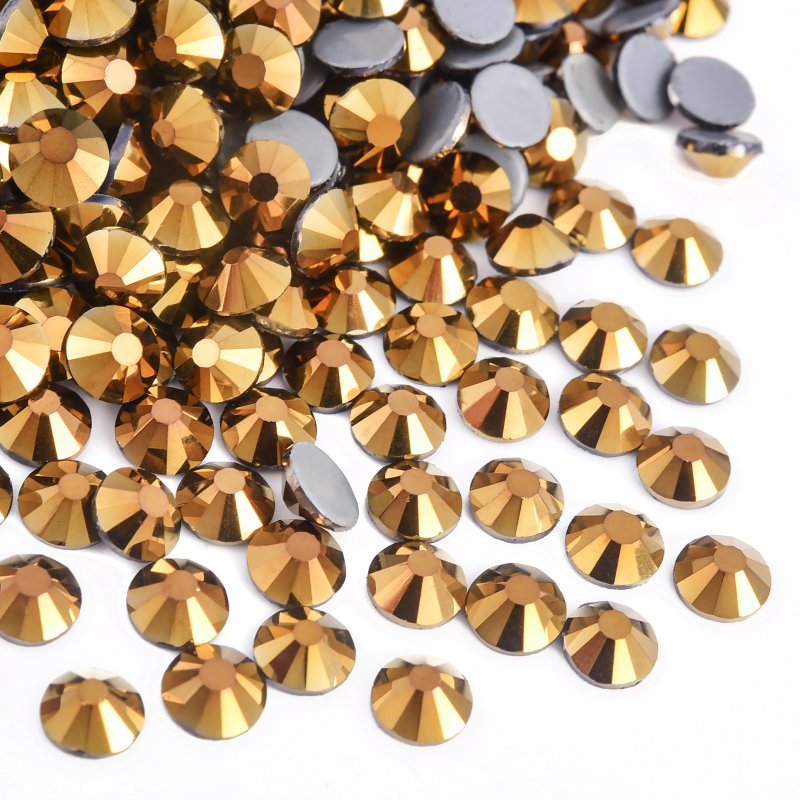
What Is a Rhinestone Patch and How Does It Differ from an Embroidered Patch or an Applique
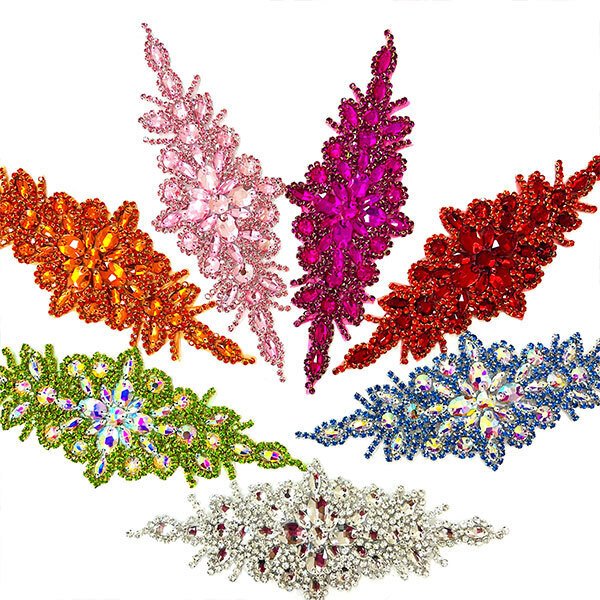
A rhinestone patch is a pre-assembled design of crystal stones bonded to a base material such as felt, twill or clear mesh, backed with a heat-activated adhesive. You apply the whole design in one pass, which is why it suits production lines that do not want to place stones by hand.
The base is the part buyers misunderstand. A felt or twill base sits under the stones and gives the design a solid edge, while a clear mesh base mostly disappears once the patch is pressed, so a spaced design reads as if the stones were placed directly on the fabric. Neither is better. A mesh base flexes with a knit and keeps weight down; a felt base holds a crisp border and is easier to handle in a small studio.
Compared with an embroidered patch, the difference is material, not just look. An embroidered patch is stitched thread, so it stays matte, holds fine lettering well and takes years of abuse without any stone to lose. A rhinestone patch carries facets that each catch light separately, which is the reason dance studios, pageant teams and fashion brands choose it. The trade-off is care. Embroidery shrugs off a hot wash; a crystal patch needs a cooler, gentler routine to protect the glue line.
An applique sits somewhere between the two. Traditional appliques are cut fabric shapes, lace, or beaded motifs, and they are usually sewn on. A rhinestone patch is closer to an iron-on applique once it carries hotfix adhesive. If you are weighing a patch against the wider family of pre-set stone work, our guide to rhinestone transfers and pre-set crystal designs explains how a transfer differs from a patch and when each one wins on a production floor.
What Can You Customise on a Rhinestone Patch
Six variables carry almost every custom patch order: size, shape, stone colour, stone size, border style and design pattern. Change one and the price, the weight and the press behaviour can all move, so treat them as a set rather than a menu of independent choices.
Size and shape come first. A small left-chest logo reads as branding; a large back panel reads as a statement piece. Shapes range from simple circles, ovals and rectangles to fully cut-out silhouettes that follow your logo edge. Bear one limit in mind: a cut-out shape needs enough base material around the stones to hold together, so a very thin, spiky outline is harder to run cleanly than a rounded one.
Stone colour and stone size are the two that most affect perceived value. A single named colour across a whole design looks clean and consistent, while a gradient or a two-tone mix adds depth but needs a tighter colour match between batches. Our rhinestone size guide breaks down the SS scale if you are deciding how fine the detail can go.
Border style is the detail buyers forget and then notice. A patch can finish with a raw cut edge, a stitched satin border, or a row of larger edge stones that frames the design. The stitched border adds a textile hand and hides the base edge on felt; a stone border adds sparkle but adds weight and a second size to keep in stock.
Design pattern is where the artwork goes. Simple text and logos press in seconds. A dense full-pave panel with thousands of stones takes longer to set and costs more per piece, because the labour and the crystal both scale with stone count. Send a vector file where you can, because a clean outline is easier to convert into a production-ready template than a low-resolution image.
What Stone Sizes and Colours Are Available
We set 100% K9 optical crystal glass and carry SS6 through SS30 as standard, with more than 400 colours in stock and Pantone matching for anything outside the standard range. K9 is worth explaining, because it is the difference between a patch that stays bright and one that fogs over in a few months.
K9 is a clear optical glass with a refractive index near 1.9 and 12 to 14 facets cut per stone, and it sits at Mohs 6 to 6.5 on the hardness scale. That combination is why it throws more light and resists scratching better than acrylic, which typically lands around Mohs 2 to 3 and dulls quickly against a zip or a seat belt. The higher facet count is also what gives a K9 patch depth from an angle rather than a flat shine straight on.
The size range covers both ends of the job. SS6 is about 2.0 mm and suits fine lettering and delicate lines. SS10, at about 2.8 mm, is the everyday workhorse for garment logos. SS16 around 4.0 mm and SS20 around 4.8 mm fill a shape faster and read from across a room. SS30 at about 6.4 mm is for bold statement pieces and decor. Mixed-size designs are common, and they are usually the ones that look hand-set rather than printed.
| Stone size | Diameter | Best on a patch for | Feel |
|---|---|---|---|
| SS6 | about 2.0 mm | Fine lettering, small logos, delicate lines | Subtle, sparkles close up |
| SS10 | about 2.8 mm | Standard chest logos and small motifs | Balanced, most versatile |
| SS16 | about 4.0 mm | Medium panels, initials, medium borders | Clear read at arm’s length |
| SS20 | about 4.8 mm | Bold back panels and edge borders | Strong, heavier |
| SS30 | about 6.4 mm | Statement pieces, large decor patches | Very bold, best kept flat |
Colour is where batch consistency matters most. Two dye lots of the same named colour can sit a shade apart if nothing controls them, and a patch is a single solid block of colour, so any drift shows immediately. We sort stones by colour after coating, run every batch against the approved sample, and keep a retention sample from each run. If a collection will ship across several batches, tell us up front so the colour can be planned as one lot, and send a Pantone reference or a physical swatch for anything outside the stock range.
Which Backing Should You Choose, Iron On, Sew On or Self Adhesive
Pick the backing from the fabric and the wear, not from the price. Iron-on is the fastest and bonds strongly on heat-safe fabric, sew-on is the most secure on stretch and delicate cloth, and self-adhesive is for pieces that will not be machine washed repeatedly.
Iron-on patches carry a heat-activated adhesive, which in our line is a German imported grey glue that melts between 150 and 170 °C and works at 160 °C. On cotton, polyester blends and denim this gives a fast, clean bond with no needle work, which is why it fits contract production. The catch is heat sensitivity. A fabric that scorches below the glue’s melt window is a poor match, so confirm the fibre before you commit a whole run to hotfix.
Sew-on patches have no adhesive to fail. You stitch around the border or through the base, so the patch stays put as long as the thread does. This is the safer choice on spandex, silk, coated shells and anything that has to move with the body, and it is the standard on uniforms and costumes that see heavy use. The cost is labour, and on a dense patch that labour is real.
Self-adhesive patches are peel-and-stick. They are genuinely useful for samples, photo shoots, temporary styling, display and craft work, where there is no press and no washing. They are not for garments that go through repeated machine washing, because a pressure-sensitive film cannot hold a stone through that cycle. Treat them as a one-event tool and choose hotfix or sew-on for anything that ships to a customer who will wash it.
| Backing | How it bonds | Best fabric | Wash life | Tools needed |
|---|---|---|---|---|
| Iron-on | Heat melts a pre-coated adhesive into the fibre | Cotton, polyester blends, denim | Up to 50 ISO 6330 washes on stable fabric | Heat press or iron |
| Sew-on | Thread through the base or around the border | All textiles, including stretch and delicate | Lasts as long as thread and fabric | Needle and thread, machine optional |
| Self-adhesive | Pressure-sensitive peel-and-stick film | Flat, rigid, no-wash surfaces | Not built for repeated washing | None |
A practical rule for mixed orders is to standardise one backing per collection. If your hoodie line is iron-on and your swimwear is sew-on, that is logical and easy to explain to production. If the same garment uses both with no plan, your wash behaviour becomes unpredictable for the end customer.
What Temperature and Time Do You Press a Rhinestone Patch At
Press a rhinestone patch at 150 °C to 170 °C for 10 to 15 seconds with medium to firm pressure. That is the window for our German grey glue, which melts inside it and cures at a working temperature of 160 °C. Too cool and the adhesive never fully flows; too hot and you damage the fibre under the stones.
The glue is the reason the window exists. A heat-activated adhesive that melts between 150 and 170 °C locks into the fibre when it cools, which is what makes the bond survive washing. A cheap low-temperature glue that softens below 130 °C lets go the first time the garment sits in a hot car or takes a warm cycle. A patch and a bag of loose stones can use the same crystal and still behave completely differently on wash day, because the glue, not the stone, decides.
Where you press matters almost as much as the setting. Work on a hard, flat surface, not a padded ironing board with give in it, because uneven pressure is the usual reason part of a patch lifts later. Pre-heat the garment area for a few seconds to drive off moisture, place the patch, and press evenly across the whole design rather than in a corner. Let the piece cool fully before you handle it, because the bond is still soft while warm.
| Fabric | Temperature | Pressure | Time | Extra step |
|---|---|---|---|---|
| Cotton | 165 °C | 40 PSI | 15 seconds | None |
| Polyester and blends | 160 °C | 35 PSI | 12 seconds | Test on an offcut first |
| Spandex and stretch knits | 150 °C | 30 PSI | 12 seconds | Lower heat protects the fibre |
| Silk and delicate fibres | 140 °C | 20 PSI | 10 seconds | Add heat-protection paper over the patch |
For a bigger picture of how the glue window behaves across different decoration formats, our guide to rhinestone heat transfer temperature walks through the same parameters from the transfer side. If you are working without a press, an iron can handle a small trial but it is hard to control pressure evenly, and uneven pressure is what causes a patch to fail at one edge.
How Durable Is a Rhinestone Patch After Washing
On stable fabric with the right press settings, a K9 patch holds through 50 machine wash cycles under the ISO 6330 standard with under 2% stone loss. The same test on cheap acrylic stones with low-grade yellow glue shows more than 30% loss after only 5 cycles, which is the gap between a patch that lasts a season and one that survives a photo.
Stone loss almost always starts at the bond, not in the crystal, so the wash routine protects the adhesive more than it protects the stone. Turn the garment inside out, use cold water, skip the dryer, and keep bleach and fabric softener away from the glue line. Fabric softener in particular leaves a residue that weakens adhesive over time, and a hot tumble dry softens the glue that a cold wash leaves alone.
There is an honest limit worth stating before you order. On silk expect roughly 20 to 30 machine washes rather than 50, because the fibre is delicate and we drop the press temperature to protect it. On highly stretchy or thin fabric, choose a sew-on backing and treat the wash count as a guideline rather than a promise. And on a coated or waterproof shell, run a bond test on an offcut before production, because the coating can resist adhesive no matter how good the glue is. Telling your customer the real number is better business than promising a number the garment cannot keep.
What Is the MOQ and What Is the Delivery Time
Our stock stone minimum is one colour and one size from 2 packs, which keeps a first trial small, and the patch minimum follows the specification once we quote. Delivery is fixed rather than estimated. Stock colours ship the same day payment clears. Custom runs ship in 7 to 15 days depending on order quantity. The confirmed window goes on the proforma invoice along with the shipping method, so your planning calendar is not built on a guess.
The reason a custom run needs that window is straightforward. A new design has to be converted from artwork into a production-ready template, the stones have to be set and the base cut, and a dense full-pave panel takes longer to run than a simple text patch in the same colour. Artwork and packaging are the two items that stretch a custom timeline the most, so approving both early is the single best way to hit your date.
Pricing on patches moves with stone count, stone size, shape complexity and order quantity rather than with a flat per-piece number. Two patches of the same finished size can differ a lot if one carries 300 stones and the other carries 1,200. That is why we quote per specification and per quantity rather than publish a rate that would mislead a buyer working at a different volume.
Is Custom Design and OEM Available and What Does the Sampling Process Look Like
Yes. We run OEM and ODM, including private-label packaging, so a patch can ship with your own branding. The sampling process is short and the same whether you are testing one design or preparing a full collection.
You send the artwork, the intended fabric, the finished size, the stone size and colour, and the backing you need. Our team converts the artwork into a production-ready template and confirms the specification, then quotes per piece with the quantity bands. A free sample patch is produced for you to press or sew against your own fabric, and that sample becomes the reference for the production run. Once you approve it, a proforma invoice follows with the specification, the delivery window and the shipping terms.
Two things are worth locking early. The base material, because a felt base and a mesh base read differently on the finished garment and change how the patch handles. And the packaging spec, because custom printed backing cards or branded bags take longer than the stones do. Because we retain a sample from your batch, a reorder has something concrete to match months later rather than a memory of what the first run looked like.
Where Do Rhinestone Patches Ship and What About the HS Code
We ship worldwide from Guangzhou, by air for speed and by sea for volume, and the export documents travel with the order so your broker can clear it without a surprise. The HS code for glass rhinestones is 7018.10, which is the code your customs broker will need for a patch order, and the duty your market applies depends on your country’s current tariff schedule.
Freight choice moves the calendar more than production does. Air gets a small patch order to your door quickly, while sea freight cuts the cost per unit on volume and adds transit time. For a first order where you want the sample in your hands fast, air is usually the sensible call. For a repeat run against a fixed retail date, sea is usually cheaper and the lead time is easier to absorb.
Because patches are a light, low-cube product compared with bulky trim, they usually ship efficiently by either method. Pack the order against your own deadline and volume rather than against habit, and confirm the shipping method on the proforma invoice so nothing shifts later.
How Does a Rhinestone Patch Compare with a Heat Transfer and an Applique
The three formats solve different problems, and choosing the wrong one is a common reason a decoration project runs over budget. Both a patch and a heat transfer arrive pre-set with stones and hotfix adhesive. The difference is structure. A patch has its own base material, so it is a standalone piece you can hold, sample and press as one object, and it can carry a stitched border. A heat transfer is set on a clear carrier film with no visible base, so a spaced design reads as stones placed directly on the fabric, and it is the usual choice for full-front and all-over layouts. An applique is a cut fabric or lace shape, normally sewn, that adds a textile layer rather than only sparkle.
| Format | Base | Applied by | Best for | Watch out for |
|---|---|---|---|---|
| Rhinestone patch | Felt, twill or mesh with hotfix backing | Press or sew as one unit | Logos, initials, small quantities, mixed sizes | Base edge can show if the shape is very thin |
| Heat transfer | Clear carrier film, no visible base | Press onto a flat heat-safe panel | Full-front and all-over designs, large layouts | Needs a flat surface and even pressure |
| Applique | Cut fabric, lace or beaded motif | Usually sewn on | Adding a textile layer, bridal and couture detail | Labour-intensive and heavier |
A quick way to decide. If you want a self-contained branded piece that is easy to stock, sample and apply, choose a patch. If you want a large layout that looks like the stones sit directly on the cloth, choose a heat transfer. If you want a fabric layer rather than only sparkle, choose an applique. Many collections use more than one, and that is fine as long as each format matches its garment’s fabric and wash life.
Explore the Rhinestone Transfer and Patch Series
This page sits in our rhinestone decoration cluster alongside two focused pieces that go deeper on the parts buyers ask about most. Read them next depending on which decision is blocking your order.
– Rhinestone transfer — how a pre-set transfer differs from a patch, how the carrier film works, and when a full-front layout beats a stitched patch. – Rhinestone heat transfer temperature — the press window explained across fabrics, and how to set heat and pressure so the glue bonds instead of scorching.
For a 12-hour quote and a free sample patch, message us on WhatsApp at wa.me/8613692450325, call or message +86 13692450325, or email rhinestonewholesale8@gmail.com.
Frequently asked questions
What is a rhinestone patch made of? A rhinestone patch is crystal stones bonded to a base material such as felt, twill or clear mesh, with a heat-activated adhesive on the back. Our patches use 100% K9 optical crystal glass with a refractive index near 1.9 and 12 to 14 facets, set with a German imported grey glue that melts between 150 and 170 °C. The base can be stitched or heat pressed onto the garment.
Can you iron a rhinestone patch onto polyester? Yes, at a lower setting than cotton. Polyester and blends press at 160 °C for around 12 seconds with medium to firm pressure, and it is worth testing on an offcut first because some coated or low-melt synthetics need more care. Cotton takes the full 165 °C for 15 seconds. The correct window is 150 °C to 170 °C for 10 to 15 seconds across heat-safe fabrics.
How many washes does a rhinestone patch survive? On stable fabric with a proper press, a K9 patch holds through 50 ISO 6330 machine wash cycles with under 2% stone loss. On silk, expect roughly 20 to 30 washes because the fibre is delicate and the press temperature is lowered to protect it. Wash inside out in cold water and skip the dryer to protect the glue line.
What is the minimum order for custom rhinestone patches? Stock stone minimum is one colour and one size from 2 packs, which keeps a trial small. The patch minimum follows the specification, because a simple text patch is easier to run in small quantity than a dense full-pave panel, so the exact figure is confirmed on the quote. OEM and ODM with private labelling are available.
How long does delivery take? Stock colours ship the same day payment clears. Custom runs ship in 7 to 15 days depending on order quantity, because a new design has to be converted into a template and a dense design takes longer to run than a simple one. The confirmed window goes on the proforma invoice.
What HS code applies to rhinestone patches? The HS code for glass rhinestones is 7018.10, which is the code your customs broker will need. The duty your market applies depends on your country’s current tariff schedule, so confirm it against your latest national tariff before you calculate landed cost.
Can I get custom colours and my own packaging? Yes. More than 400 colours are held in stock, with Pantone matching for anything outside the standard range, so send a Pantone reference or a physical swatch. OEM and ODM include private-label packaging, and the packaging spec is worth approving early because it often extends a custom timeline more than the stones do.
Which backing should I choose for a stretch garment? Sew-on is the safer choice on spandex, silk and other stretch or delicate fabric, because there is no adhesive to fail and the patch moves with the cloth. Iron-on is faster and bonds strongly on cotton, polyester blends and denim. Self-adhesive is for samples and no-wash pieces only, since it is not built for repeated machine washing.
Need a size or color recommendation for your next order? Send us your fabric type, design, and target price — we reply within one business day. WhatsApp +86 13692450325 · rhinestonewholesale8@gmail.com