
How to Fix an Uneven Hotfix Rhinestone Press Without Starting Over from Scratch
Few things are more disheartening in the apparel decoration industry than lifting your heat press only to find that half of your rhinestones didn’t stick. Whether it was due to a cold spot on the platen, insufficient pressure, or an uneven fabric seam, a “failed press” doesn’t have to mean a ruined garment. At Guangzhou Yiben E-Commerce Co., Ltd., we have spent 12 years helping designers optimize their application processes. Because our K9 rhinestones use high-quality German-imported grey glue, the adhesive is surprisingly forgiving—if you know the technical parameters for a successful “second chance” press.
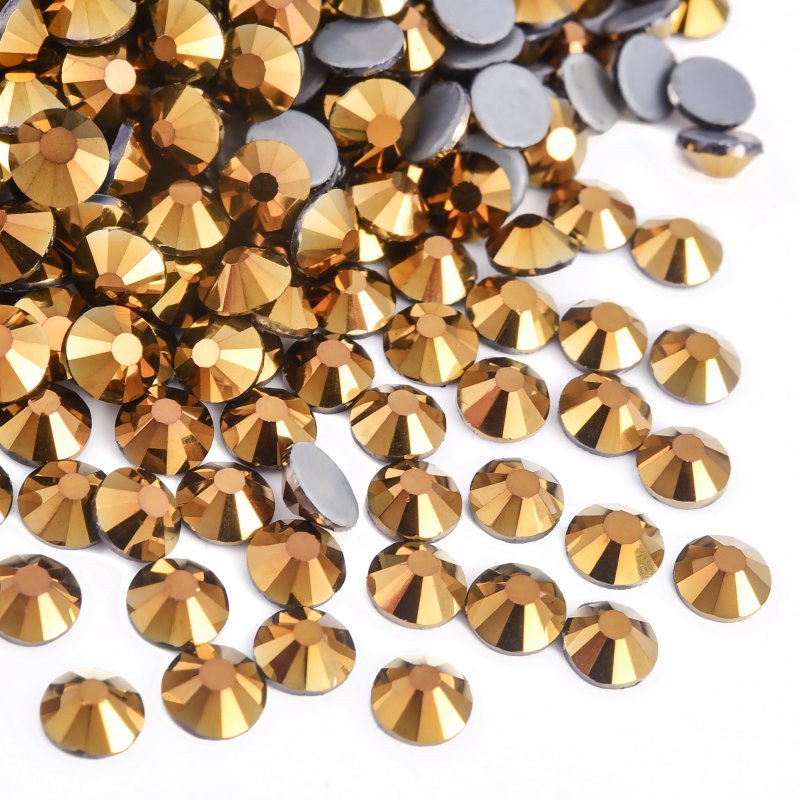
Can you reheat hotfix rhinestones after they cool down
Yes, you can safely reheat hotfix rhinestones after they have cooled, as the German-imported grey adhesive is a thermoplastic material designed to liquefy at 150-170°C. Once heat is reapplied, the glue will return to a molten state, allowing it to re-flow into the fabric fibers and create a stronger bond than the initial failed attempt.
The key to successful reheating is understanding the chemistry of the adhesive. Unlike some chemical glues that undergo a permanent “cure,” the hot-melt glue on our SS6 to SS30 stones remains reactive to heat. However, you must be careful with the duration. While the initial press on cotton might be 165°C for 15 seconds, a “re-press” should often be slightly shorter—perhaps 10 to 12 seconds—to prevent the glue from over-wicking into the fabric and becoming too thin to hold the stone.
We often see designers try to “double press” an entire garment just to fix one small corner. While this is possible, it can lead to “heat marks” or scorching on delicate fabrics. Before you decide to reheat the whole piece, it is vital to inspect why the stones didn’t bond. If the fabric has a coating (like a water-repellent finish), reheating won’t help; the coating itself must be removed or addressed first.
What if some rhinestones didn’t stick during the first press
If rhinestones fail to stick during the first press, it is usually caused by uneven pressure, incorrect temperature, or moisture in the fabric. You should first identify the “cold spots” on your heat press and then re-apply the stones using a localized heat source or by adjusting your press settings to ensure even contact.
One of the most common culprits for an uneven press is the “seam problem.” If your rhinestone design is near a zipper, a thick seam, or a pocket, the platen of the heat press will hit the thickest part of the garment first, leaving a gap of zero pressure over the stones. In these cases, even if you reach the required 150-170°C, the stones won’t bond because they aren’t being pushed into the fibers.
To fix this, we recommend using a “pressing pillow” or a heat-resistant foam pad. This allows the thicker parts of the garment to sink into the foam, ensuring the stones get the 40 PSI (for cotton) or 30 PSI (for spandex) needed to achieve a deep bond. Once the pressure is corrected, a quick 10-second re-press will usually fix any loose stones without damaging the rest of the design.
How do you reapply fallen hotfix stones without damaging fabric
To reapply fallen stones without damaging the fabric, use a specialized rhinestone applicator wand or a local heat gun set between 80-100°C for a “spot fix.” This allows you to apply heat only to the individual stone and its specific location, protecting the surrounding fabric and any adjacent stones from unnecessary heat exposure and potential scorching.
When a stone falls off, it often leaves a small “glue ghost”—a faint ring of adhesive where it was supposed to be. If you are using our German grey glue, this residue is actually beneficial. It provides a “primer” layer for the replacement stone. Place the new SS10 or SS16 stone exactly on the residue and use an applicator wand.
The wand heats the metal rim around the stone, which in turn melts the glue. This process takes about 5-8 seconds. Once the glue is molten, press down gently with a pair of tweezers or a metal tool. This manual pressure mimics the action of a heat press and ensures the stone is anchored. By avoiding a full iron or heat press for just one or two stones, you preserve the texture and color of the fabric.
Does reheating affect the adhesive quality
Reheating hotfix adhesive does not significantly affect its quality if done correctly, but excessive heat cycles can lead to “glue fatigue” where the adhesive becomes brittle or over-saturates the fabric. As long as you stay within the 150-170°C range and avoid more than three reheating cycles, the bond will remain durable and wash-resistant.
Our laboratory tests, following the ISO 6330:2021 wash standard, show that stones subjected to two heat cycles (initial press + one fix) retain 98% of their bond strength. However, by the fourth or fifth reheat, the polyamide chains in the German glue begin to break down. The glue may turn a darker shade of grey or become “stringy.”
This is why we always emphasize “get it right in two.” If the stones aren’t sticking after the second attempt, the issue is likely not the heat, but the fabric compatibility or the pressure. For example, on silk, you should use a lower temperature (140°C) and shorter time (10s). If you try to fix silk by cranking up the heat to 170°C, you will scorch the fibers before the glue even has a chance to bond properly.
How many times can you reheat the same rhinestone
You should limit reheating the same rhinestone to a maximum of three times. Beyond this point, the German hot-melt adhesive may lose its viscosity and structural integrity, leading to a weaker bond that is prone to failing during the washing process (potentially exceeding the standard <2% loss seen in high-quality applications).
Each time you heat the glue, it loses a tiny amount of its moisture and volatile components. Think of it like reheating leftovers in a microwave; the first time is fine, the second is okay, but by the third, things start to get dry. If a stone has been heated three times and still won’t stick, it’s time to discard that stone and use a fresh one from your kit.
At Yiben, our MOQ of 2 packs per color/size ensures you always have enough spare stones for these scenarios. Our SS6-SS30 range is kept in stock precisely so you can afford to replace a few “stubborn” stones rather than risking an entire garment’s quality on over-processed adhesive.
What tool is best for spot-fixing individual stones
The best tool for spot-fixing individual hotfix stones is a dedicated hotfix applicator wand, as it provides precise, concentrated heat to the stone’s top facet without affecting the surrounding fabric. For larger “patches” of loose stones, a professional heat gun with a narrow nozzle can be used to warm the area before applying manual pressure.
While many hobbyists use a regular household iron, we discourage this for professional “fixes.” Irons have steam holes and uneven heating elements that make it impossible to know if you are truly hitting the 150-170°C required for the German glue. An applicator wand, however, is designed specifically for the SS size of the stone.
For high-volume production, we recommend a “mini press”—a small handheld heat press about the size of a mouse. This gives you the temperature control of a large machine with the maneuverability of a wand. It is perfect for fixing stones on curved areas like sleeves, collars, or the complex bodices of bridal gowns, where a standard 16×20 press cannot reach.
Can you use a regular iron to fix pressed stones
You can use a regular iron to fix pressed stones in an emergency, but it is not recommended for production-grade work because irons lack precise temperature control and even pressure distribution. If you must use an iron, ensure the steam function is turned off and use a thin pressing cloth to protect the K9 glass facets from direct contact with the metal soleplate.
Steam is the enemy of hot-melt adhesive during the application phase. The moisture from the steam can get trapped between the glue and the fabric, creating tiny “bubbles” that prevent a solid bond. If those bubbles are present, the stones might look stuck, but they will fall off during the first 50-wash cycle.
If you are using an iron, set it to the “Wool/Silk” setting for delicate fabrics or “Cotton” for sturdy materials. But remember: a household iron’s “Cotton” setting can vary between 180°C and 210°C, which is well above our recommended 165°C. Without the ability to set a timer or a specific degree, you are essentially guessing. For the best results, always stick to professional-grade equipment that can be calibrated to our technical specifications.
Optimal Application Parameters for Success
To minimize the need for “fixing” and to ensure your K9 rhinestones stay brilliant and secure, follow these factory-recommended settings for our German-imported grey glue:
| Fabric Type | Temperature | Pressure | Time |
|---|---|---|---|
| Cotton / Denim | 165°C (330°F) | 40 PSI (Heavy) | 15 Seconds |
| Spandex / Lycra | 150°C (300°F) | 30 PSI (Medium) | 12 Seconds |
| Silk / Chiffon | 140°C (285°F) | 20 PSI (Light) | 10 Seconds |
| Polyester / Synth | 155°C (310°F) | 30 PSI (Medium) | 12 Seconds |
Featured Image Placeholder: A close-up of a technician using a hotfix applicator wand to carefully re-secure a single SS16 crystal on a dark fabric, with a heat press in the background.
Need a size or color recommendation for your next order? Send us your fabric type, design, and target price — we reply within one business day. WhatsApp +86 13692450325 · rhinestonewholesale8@gmail.com