
Rhinestone Sizes SS6 to SS30 Explained for Designers
The fastest way to pick a rhinestone size: for dance and stage costumes, fill with SS16 (4.0 mm), outline with SS20 (4.8 mm), and anchor with SS30 (6.4 mm). For everyday apparel, drop to SS10 or SS12 so the stones stay proportional to the garment. For nail art, use SS6 or SS8. For swimwear, stay at SS16 or smaller. Viewing distance and fabric weight decide the size — not habit, and not what you happen to have in stock.
This page is the hub of our rhinestone sizes cluster. Below you’ll find the SS numbering system explained, a full SS6 to SS30 diameter chart, project-by-project size rules, the quantity math that turns a design into an order count, how size shapes visual density and sparkle, and the mistakes that cause most reorders. Each section points to the deeper guide that covers it, so you can go as deep as your project needs.
What Do SS Numbers Mean in Rhinestone Sizes?
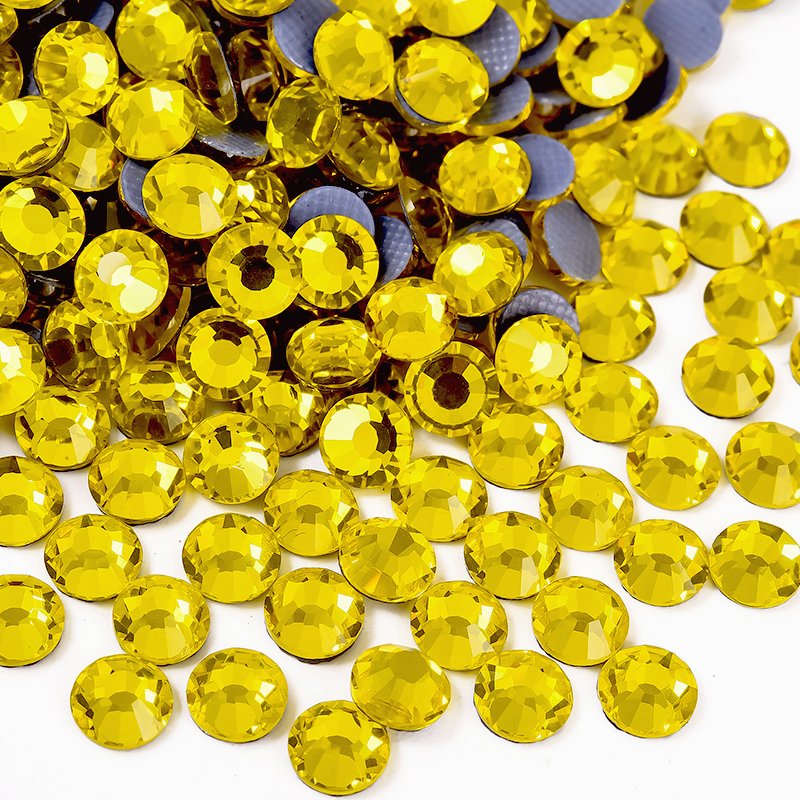
SS stands for stone size, and the number refers to the diameter of the stone’s flat base in millimeters — the wider the stone, the higher the SS number. SS6 measures about 2.0 mm across the base, SS10 about 2.8 mm, SS16 about 4.0 mm, SS20 about 4.8 mm, and SS30 about 6.4 mm. The system traces back to quartz pebbles gathered along the Rhine River; the name stuck even though every stone is now factory-cut glass.
Two things trip up buyers new to the scale. First, the number tracks the base, not the top face, and that distinction matters once a stone sits on a heat press — a wider base grips more adhesive area and stands up to more wash cycles. Second, millimeters vary slightly between manufacturers. A stone cut with 12 facets sits a touch differently than one cut with 14, even at the same nominal SS, so always confirm the base diameter in millimeters when you’re matching an existing design. If you want the full walk-through of how the scale behaves across every size, our guide to what SS6 to SS30 mean covers the numbering system in depth.
The SS6 to SS30 Rhinestone Size Chart at a Glance
Here is the chart that covers every size a designer actually orders, with the diameter of the flat base and the work each size does best:
| SS size | Diameter (approx.) | Best for |
|---|---|---|
| SS6 | 2.0 mm | Nail art, micro-fills, tight lettering |
| SS8 | 2.3–2.5 mm | Detail work, children’s wear |
| SS10 | 2.8 mm | All-over coverage on casual tops |
| SS12 | 3.0–3.2 mm | All-over coverage, versatile default |
| SS16 | 4.0 mm | The workhorse: costumes, stage, swimwear |
| SS20 | 4.8 mm | Outlines, accents, bold detail |
| SS30 | 6.4 mm | Focal points, statement pieces |
The jump from SS16 to SS20 is where the visual change is biggest relative to the millimeter increase, because stone area grows with the square of the radius. A SS30 is not three times the size of a SS10 in coverage terms — it covers roughly five times the surface area, which is exactly why quantity estimates change so sharply between sizes. The same SS6 to SS30 spread is available across most color programs; for a worked example of ordering the full range in a single color, our bulk citrine SS6-SS30 program shows how LA fast-fashion brands spec the whole range in one line.
What Is the Most Popular Rhinestone Size for Dance Costumes?
SS16 is the most popular rhinestone size for dance costumes, because it carries sparkle at stage distance without weighing down stretch fabric. Competition and pageant pieces layer it with SS20 for outlines and SS30 for focal points — belt stones, neckline statements, and pieces meant to catch a single spotlight.
A dancer seen from the back of a house needs bigger stones and bolder lines than a performer on a small studio stage; drop below SS12 on a costume and the effect blurs into texture instead of sparkle. A full-coverage competition costume carries roughly 15,000 to 30,000 stones across the SS6 to SS16 range, which is why dance studios order by the tens of thousands every season. One caution for sequined leotards: high-friction zones — under arms, inner thighs — take abuse no glue fully absorbs, so keep the biggest stones off those areas and let the fabric absorb the movement.
If you’re sourcing for a troupe or a season of costumes, our guide to bulk SS16 and SS20 for dancewear manufacturers covers the ordering pattern and pack math, plus how the sizes go down on the garment.
How Many SS16 Rhinestones Do I Need for a Dress?
Count by square footage, not by guess. Full coverage takes about 576 SS16 stones per square foot, while roughly 400 SS20 stones cover the same area. Measure the panel you’re decorating, multiply, add 5–10% for breakage and defects, and you have a number your supplier can quote against.
Real projects fall into a consistent band. A wedding dress bodice with accent work uses roughly 2,000 to 5,000 SS16 and SS20 stones mixed, depending on whether the design traces the neckline or covers the whole front panel. A full-crystal dance costume runs 15,000 to 30,000 stones across SS6 to SS16. A single swimwear piece uses about 500 to 2,000 SS10 to SS16 stones depending on the pattern. Stones sell by the gross — 144 pieces — and a pack of SS16 typically holds around 1,440 stones, or ten gross, which puts a square foot of coverage at just under half a pack.
The counterintuitive part is cost. Smaller stones cost less per piece but more per design, because a given area needs roughly double the piece count at SS10 versus SS16 — about 1,150 pieces per square foot for SS10 against 576 for SS16. That’s why the “cheaper size” is often the more expensive choice once you run the quantity math. Our guide to how much rhinestones cost in bulk walks through the per-pack economics across sizes so you can compare finished-design cost instead of sticker price.
What Size Rhinestone Should You Use for Nail Art?
SS6 and SS8 are the nail art sizes. A nail is a small canvas, and stones above SS10 start to overwhelm it — SS6 at 2.0 mm reads as a delicate crystal line, while SS10 already takes over a full nail bed and shortens the wear life of the manicure.
The same logic applies to every micro-fill: tight lettering, small logos, jewelry findings, and the fine details on a bodice that need precision rather than presence. When a design needs to be seen from a distance, go big. When it needs to sit precisely in a small space, go small. The fabric is the tiebreaker — a SS10 that sits perfectly on a cotton tee will disappear into a sequined leotard and dome on lightweight jersey. Our guide to which rhinestone size fits which project walks through the decision order garment by garment, from bodysuits to party dresses.
What Size Rhinestones Should You Use on Swimwear and Stretch Fabric?
SS16 is the sweet spot for most swimwear — large enough to carry the design, light enough not to fight Lycra’s stretch, and small enough that a full chest pattern stays flexible. Use SS12 for dense, full-coverage patterns where you want a tight, uniform crystal-fabric effect, and reserve SS20 for accents along necklines and waist seams.
Swimwear is where size choices get unforgiving, because Lycra stretches and snaps back hundreds of times per garment life. Stones that are too heavy for the fabric pull at the stretch direction; stones that are too large create stiff spots that crack the glue line. Keep the biggest stones off the center of stretch panels, and remember the pressing settings change with the fabric — a stretch-fabric application needs a lower temperature and shorter dwell than cotton, so a size that works on a tee cannot be assumed to work on a swimsuit. If the stone is right for the design but the application is the problem, the fix is usually the press settings, not the size.
How Rhinestone Size Changes Visual Density and Sparkle
Size controls density, and density controls the story the design tells. Identical coverage in SS10 versus SS16 reads completely differently: SS10 creates a smooth, glittering fabric effect, while SS16 reads as distinct stones that catch light individually. From a stage, that distinction is the difference between texture and sparkle.
Designers exploit this deliberately. A common three-level hierarchy runs SS20 for the outline, SS16 for the fill, and SS30 for the anchor — the eye reads the outline first, the fill second, and the focal point last. Mixing two or three sizes in one garment is not just allowed, it’s how designed pieces beat “covered in bling.” A cheer skirt might use SS10 as the base fill, SS16 for the lettering, and SS20 for the border line; the variation gives the eye a path through the design.
What you should never mix is quality. K9 glass refracts at roughly 1.9 against acrylic’s 1.49, and the difference is obvious the moment light hits a mixed garment — glass flashes white and rainbow, acrylic looks flat and milky beside it. If the design calls for mixed sizes, keep the material constant. Our guide to the best rhinestones for clothing explains why the material decision matters more than the size decision in the long run.
What Are the Common Rhinestone Size Mistakes Designers Make?
The first mistake is sizing by habit. “We always use SS16” fails on kids’ wear, where SS8 is the practical ceiling for infant bodysuits, and it fails on nail art, where the same stone looks like a dinner plate. The second is sizing for the photo instead of the viewing distance — a size that looks right in a close-up mockup disappears at the distance a costume is actually seen, so you design for the back row, not the zoom.
The third is ignoring the fabric. Heavy stones on lightweight jersey dome the fabric and crack the glue line; stones on stretch fabric need to move with the material. The fourth is skipping the wash test. A stone that survives five machine cycles with the glue line intact has a chance; one that lifts in the first wash never does, and that failure shows up in the first customer wash, not the sample photo.
Every one of these mistakes has a fix that costs less than a reorder. Test candidate sizes on a swatch of the actual fabric, wash it the way the end user will, and look at the result — the fabric will tell you more than any chart. For the application and pressing side of the equation, our guide to rhinestoning clothes that survive the wash covers temperature, dwell, and the test that settles every size debate.
What Size Should You Order for a New Line?
Start with the garment — fabric weight, stretch, wash cycle, and wear distance all matter more than aesthetics. Then settle the size that survives all four, and only after that do the quantity math: measure the coverage area, multiply by the stones-per-square-foot for your chosen size, add the waste allowance, and confirm the pack count with your supplier.
If you’re between two sizes, order a swatch run and test on the real fabric before committing to production. A size chart tells you what the stone is; a swatch test tells you what it does on your product. For a first order, keep it small and ask for samples from the same batch structure you’ll actually receive, because a vendor sample that doesn’t match production tells you nothing.
What This Means for Your Next Order
The size decision compounds. Get it right on paper, and your stone count, your cost estimate, and your press time all fall into line. Get it wrong, and you reorder — which costs more than the size difference ever saves, in both money and deadlines.
Guangzhou Yiben has been cutting K9 glass crystal hotfix rhinestones for 12 years, and the full SS6 to SS30 range is stocked across our color program, so you can sample sizes before you commit to volume. For a current size chart, quantity estimates for your specific design, or samples to test on your fabric, our guide to buying rhinestones direct from a Guangzhou factory shows how the ordering process works. Tell us your fabric, your design area, and your viewing distance, and we’ll suggest the size mix before you place the order.
FAQ
What does SS mean in rhinestone sizes? SS stands for stone size and refers to the diameter of the stone’s flat base. Higher numbers mean wider stones, and SS16 at about 4.0 mm is the industry default for apparel and costume work.
What is the most popular rhinestone size for dance costumes? SS16 is the most popular, layered with SS20 for outlines and SS30 for focal points on competition and stage pieces. A full-coverage costume carries 15,000 to 30,000 stones in the SS6 to SS16 range.
How many SS16 rhinestones do I need for a dress? Full coverage takes about 576 SS16 stones per square foot. A wedding bodice uses 2,000 to 5,000 stones, while a full-crystal dance costume runs 15,000 to 30,000.
What size rhinestone should I use for nail art? SS6 and SS8 are the nail art sizes. Stones above SS10 overwhelm a small canvas and shorten the manicure’s wear life.
What size rhinestones are best for swimwear? SS16 is the sweet spot for most swimwear, with SS12 for dense full-coverage patterns and SS20 reserved for accents only.
Need a size or color recommendation for your next order? Send us your fabric type, design, and target price — we reply within one business day. WhatsApp +86 13692450325 · rhinestonewholesale8@gmail.com