
Applying Hotfix Crystals to High Stretch Spandex and Lycra Pressing Settings That Prevent Fabric Scorching
For custom costume ateliers, dancewear manufacturers, and competitive swimwear designers, few manufacturing challenges are more nerve-wracking than applying heat-activated embellishments to high-stretch synthetic fabrics. In disciplines like competitive gymnastics, rhythmic calisthenics, figure skating, and synchronized swimming, garments are constructed from premium four-way stretch textiles, primarily blends of 80% to 85% Nylon (Polyamide) and 15% to 20% Spandex (Elastane or Lycra). These fabrics provide the explosive recovery and form-fitting aerodynamic compression that elite athletes demand.
However, elastane is chemically vulnerable to thermal stress. When decorators attempt to apply hotfix rhinestones using standard commercial settings—often designed for heavyweight cottons or durable polyester twills—disaster routinely strikes. The heated platen leaves permanent, glassy shine marks across matte Lycra panels, metallic foils blister and lose their mirror sheen, and delicate illusion mesh burns or puckers beyond repair. Conversely, if an atelier lowers the temperature too far in fear of burning the substrate, the hotmelt glue fails to melt thoroughly, causing thousands of dollars worth of crystals to shed during the athlete’s first high-energy routine.
Mastering the precise balance between adhesive thermal activation and fabric integrity requires an engineering approach. At Guangzhou Yiben E-Commerce Co., Ltd., our 12 years of precision hotfix manufacturing experience has taught us that high-stretch apparel requires calibrated dwell times, specialized platen accessories, and elastic adhesive chemistry. When coordinating wholesale hotfix rhinestones for Australian gymnastics and swimwear, ateliers must pair advanced crystal components with industrial application discipline. By implementing modified pressing curves and protective workstation barriers, workshops can achieve flawless, permanent stone bonds without leaving a single scorch mark on sensitive Lycra garments.
—
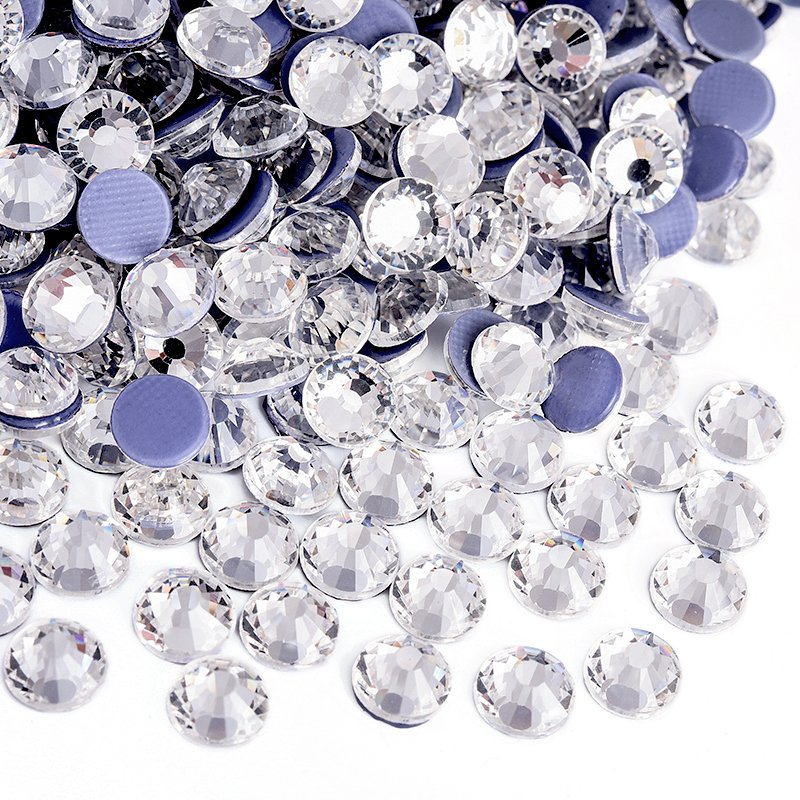
The Thermal Vulnerability of Spandex and High Stretch Performance Fabrics
Understanding the Molecular Breakdown Threshold of Elastane Filaments
To safely apply heat-set crystals, garment makers must first understand the structural chemistry of stretch synthetics. Lycra and Spandex are block copolymers composed of alternating rigid urethane segments and flexible polyether or polyester chains. The flexible segments provide elasticity, allowing the textile to elongate up to 500% at the molecular level, while the rigid segments anchor the fibers together.
| Synthetic Polymer Base | Safe Continuous Working Window | Onset of Fiber Glazing and Burn | Complete Melting Point Threshold |
|---|---|---|---|
| Cotton and Cellulosic | Up to 180°C | 200°C – 210°C | Decomposes above 240°C |
| Standard Polyester (PET) | Up to 160°C | 175°C – 180°C | 250°C – 260°C |
| Nylon 6,6 (Polyamide) | Up to 150°C | 165°C – 170°C | 255°C – 265°C |
| Elastane (Spandex/Lycra) | 135°C – 148°C | 155°C – 160°C | Thermal Breakdown at 170°C |
When temperatures exceed 155°C to 160°C, the polyurethane elastomer bonds begin to undergo irreversible thermal degradation. The soft segments lose their elastic memory, while the surface filaments melt and flatten under mechanical platen pressure. This structural collapse manifests as three distinct manufacturing defects:
1. Fiber Glazing (Shiny Scorch Marks): The rounded microscopic fibers of matte Lycra melt into flat, highly reflective plastic ribbons. Under overhead stage lights or competition spotlights, these patches cast unsightly, oily-looking reflections that ruin the visual depth of the garment. 2. Elastic Brittleness and Sagging: Thermal degradation destroys the recovery tension of elastane. The fabric surrounding the rhinestone design loses its elasticity, becoming baggy, wavy, and prone to tearing when stretched over the athlete’s body. 3. Puckering and Distortion: Differential thermal shrinkage occurs when nylon and spandex contract at different rates under intense heat, creating permanent ripples across the chest and sleeve panels.
The Problem with Generic High Heat Fast Press Instructions
Most generic craft websites and hobbyist tutorials advocate applying rhinestones at 165°C to 175°C for 8 to 10 seconds. While this approach works passably on non-elastic cotton t-shirts, applying it to performance Lycra is catastrophic.
Because glass crystals are dense thermal insulators, a brief 8-second burst at 170°C creates an extreme temperature gradient. The top platen scorches the exposed fabric surfaces between the stones before sufficient heat can conduct downward through the crystal body to melt the adhesive underneath. The decorator ends up with a burned leotard bearing under-cured, brittle crystals that pop off under light manual pressure.
—
The Low Heat Extended Dwell Pressing Curve for Performance Wear
Engineering the 140 to 148 Degree Thermal Conduction Window
The solution to the Lycra scorching dilemma is an extended-dwell, low-temperature thermal curve. Instead of shocking the fabric with intense heat, the platen temperature is calibrated to 140°C–148°C, while extending the dwell time to 16–20 seconds under medium mechanical pressure.
| Layer Sequence | Workstation Component | Thermal Function and Protection Mechanism |
|---|---|---|
| 1. Heat Source | Top Heating Platen (142°C – 148°C) | Provides steady, calibrated downward heat below elastane glazing threshold |
| 2. Thermal Shield | Virgin PTFE Teflon Cover Sheet | Distributes heat uniformly across platen and eliminates localized hot spots |
| 3. Optical Gem | K9 Optical Crystal Crown and Table | High-purity borosilicate glass conducts heat steadily into stone base |
| 4. Adhesive Interface | German Industrial Grey Adhesive Bed | Liquefies at 145°C into low-viscosity polyamide resin to encapsulate fibers |
| 5. Performance Fabric | Nylon-Spandex (80/20) Knit Filaments | Base fibers fully encapsulated by liquid resin without scorching |
| 6. Lower Cushion | Soft Silicone Foam Pad (5–8 mm) | Compresses under thick seams to guarantee uniform pressure across every stone |
At 140°C to 148°C, the temperature remains comfortably below the 155°C glazing threshold of high-grade elastane. By maintaining this temperature for 16 to 20 seconds, heat conducts progressively through the crystal crown and reflective mirror into the German grey adhesive backing. The polyamide adhesive liquefies completely, flowing between the micro-filaments of the nylon knit without boiling or charring the synthetic yarns.
Calibrated Settings Matrix Across Four Performance Fabric Types
Different stretch fabrics require subtle adjustments to dwell time, pressure, and application orientation. Our technical laboratory has validated the following production parameters:
| Fabric Substrate Type | Platen Temperature | Dwell Time | Pressure Metric | Heat Application Method |
|---|---|---|---|---|
| Heavy Matte Nylon-Lycra | 145°C – 148°C | 15 – 18 sec | 2.5 – 3.0 kg/cm² | Top Face Direct Press |
| Holographic and Metallic Foil | 140°C – 142°C | 18 – 22 sec | 2.0 – 2.5 kg/cm² | Reverse Backing Press |
| Four-Way Stretch Illusion Mesh | 138°C – 142°C | 12 – 15 sec | 1.5 – 2.0 kg/cm² | Top Press with Dual PTFE Sheets |
| Sublimated Poly-Elastane | 144°C – 146°C | 16 – 18 sec | 2.5 – 3.0 kg/cm² | Top Press with Protective Barrier |
When working with four-way stretch illusion mesh, lower the pressure to 1.5–2.0 kg/cm². Because mesh possesses an open knit structure, excessive pressure forces molten adhesive through the holes onto the lower platen, gluing the garment to the workstation. Always insert a sheet of baking parchment or silicone-coated paper inside the garment sleeve or torso tube to prevent the front and back panels from fusing together during pressing.
—
Reverse Pressing and Protective Workstation Architecture
Reverse Pressing to Protect Delicate Foils and Wet Look Finishes
Metallic foil Lycra and iridescent “wet-look” fabrics are staples of competitive gymnastics and cheerleading leotards. However, the delicate metallic surface layer is highly susceptible to heat-induced delamination, clouding, and scratching from metal platen contact.
For these sensitive substrates, the gold standard industrial technique is reverse pressing (underside heat transfer):
1. Position the Transfer: Position the rhinestone transfer tape face down onto the front of the garment as usual. 2. Invert the Workpiece: Flip the entire garment panel upside down on the heat press so that the back (inner face) of the Lycra fabric is facing upward toward the heated platen, while the glass crystal faces downward resting on the lower platen. 3. Direct Heat Path: When the platen closes, heat conducts directly through the thin fabric substrate directly into the adhesive bed, without passing through the glass stone or contacting the surface metallic foil. 4. Thermal Protection: Because the front metallic foil remains pressed against the cool silicone base pad, it is completely protected from direct metal contact and thermal distortion.
Reverse pressing allows decorators to achieve complete adhesive melt at 142°C in just 14 to 16 seconds, entirely eliminating foil blister defects.
Lower Platen Cushioning with Soft Silicone Foam Pads
Standard heat press lower platens are constructed from dense, rigid silicone rubber. While adequate for flat panels, competitive leotards are covered in thick seams, zipper teeth, leg elastic bands, and armhole bindings.
When a garment with thick seams is placed on a rigid platen, the top plate bottoms out on the raised seams, absorbing all mechanical pressure. The flat fabric areas between the seams receive almost zero pressure, resulting in cold, unbonded rhinestones that shed immediately.
To overcome this, workshops must install a soft silicone foam bed (5 mm to 8 mm thickness, 20–25 Shore A hardness): – When pressure is applied, thick seams sink deep into the resilient foam pad. – The platen makes intimate, uniform contact across both raised seams and recessed flat fabric areas. – Every individual crystal receives consistent, calibrated downward pressure, ensuring uniform adhesive penetration.
The Role of High-Grade PTFE (Teflon) and Release Paper
Never allow a raw metal heating platen to come into direct contact with synthetic stretch fabrics. Always utilize a high-grade, virgin PTFE (polytetrafluoroethylene) cover sheet. PTFE sheets serve three essential functions: – They eliminate localized hot spots caused by uneven heating elements inside older platens. – They act as a slick, non-stick barrier that prevents plastic transfer films from curling or sticking to the platen. – They prevent stray airborne plasticizers or adhesive vapors from depositing back onto the clean performance fabric.
—
Preventing Stone Bridging on Dynamic 4-Way Stretch Garments
The Mechanism of Stone Bridging and How to Avoid It
In high-performance sportswear, the leading cause of premature stone loss is not improper temperature, but a mechanical flaw known as stone bridging.
When an atelier applies a dense rhinestone motif onto a completely relaxed, unstretched leotard, the crystals sit touching one another edge-to-edge. When an athlete wears the garment, the underlying Lycra expands horizontally by 150% to 200%. Because glass does not stretch, the expanding fabric attempts to pull the stone bases apart. If adjacent stones are touching, their adhesive bases form a rigid, continuous bridge. Under tension, the expanding fabric rips the stones off the substrate, or shears the delicate nylon filaments along the motif border.
| Application State | Crystal Placement Method | Behavior Under 180% Athletic Stretch | Final Performance Outcome |
|---|---|---|---|
| Incorrect (Relaxed State) | Stones placed touching on unstretched fabric | Glue bases fuse into rigid bridge that snaps under tension | Premature stone loss and torn fabric filaments |
| Correct (Pre-Stretched State) | Garment mounted on 15%–20% stretch board with 1.0 mm gaps | Fabric stretches freely between isolated anchor pads | 98% stone retention across intensive competition wear |
Pre-Stretching Panels on Custom Boards Prior to Pressing
To eliminate stone bridging, experienced leotard decorators employ a pre-stretching protocol:
1. Fabricate Tension Boards: Cut smooth cardboard or high-density foam boards shaped to match the torso, hip, or sleeve profiles of the target garment size. 2. Mount the Garment: Stretch the leotard smoothly over the form, expanding the high-tension body zones by approximately 15% to 20% of their relaxed measurement. 3. Apply the Rhinestones: Apply the transfer film or hand-set the stones while the garment is held under gentle tension. Maintain a minimum separation gap of 0.8 mm to 1.2 mm between individual crystal edges. 4. Press and Cool: Heat press the motif onto the pre-stretched panel. When the garment is removed from the form and relaxes, the fabric will gather microscopically between the stones. When the athlete dons the uniform, the fabric expands back to its intended tension without exerting mechanical shear stress against adjacent stone bases.
The Mandatory Cold-Peel Rule
One of the most frequent mistakes in fast-paced production lines is peeling the clear transfer carrier tape while the garment is still hot.
When a leotard is freshly removed from the heat press, the polyamide adhesive is in a semi-liquid, molten state. If the operator pulls the plastic carrier film upward while the glue is hot, the upward peel force stretches the molten adhesive into fine strings, lifting the stone bases away from the fabric filaments.
Always adhere to the cold-peel discipline: – Transfer the pressed garment immediately from the heat press to a flat, cool granite or aluminum cooling table. – Allow the garment to cool completely to room temperature (approximately 45 to 60 seconds). – Once the adhesive has solidified into a tough, rubbery polymer, peel the carrier tape back smoothly at a flat 180-degree angle against the fabric surface. – Cold peeling ensures zero upward tension on the adhesive bond, leaving every crystal locked firmly in place.
—
Adhesive Chemistry and Post-Application Polymerization
German Polyamide Hotmelt vs Ordinary EVA Backings
The ultimate durability of an athletic rhinestone application depends entirely on adhesive chemistry. At Guangzhou Yiben, our stones are backed exclusively with German-engineered industrial hotmelt grey glue, rather than the clear EVA (ethylene-vinyl acetate) used on generic craft stones.
Polyamide adhesives provide critical technical advantages on dynamic stretch synthetics: – High Elastic Recovery: Unlike brittle EVA, our polyamide formulation possesses an elongation recovery exceeding 220%, flexing in perfect harmony with Lycra fibers during acrobatic movements. – Superior Mechanical Interlock: When liquefied at 145°C, the adhesive exhibits low melt viscosity, enabling it to penetrate deep between the woven filaments of the nylon knit before solidifying into a permanent mechanical anchor. – Extreme Chemical Resilience: The cross-linked polyamide matrix is chemically inert, providing impervious resistance to swimming pool chlorine, ocean saltwater, and acidic perspiration.
For details on technical laundering certifications, review our guide to industrial wash test standards and ISO 6330 protocols.
The 24-Hour Polymerization Window and Quality Testing
While hotfix glue achieves tactile set within seconds of cooling, full molecular cross-linking is not instantaneous. Polyamide hotmelt formulations continue to crystallize and cure at room temperature for several hours following application.
The Golden 24-Hour Rule: Never stretch, package tightly, wear, or wash an embellished athletic garment within 24 hours of heat pressing. Subjecting the garment to mechanical stress before the polymer chains have fully locked compromises bond strength by up to 40%.
Once the 24-hour curing window has elapsed, workshops should perform a standardized transverse snap test: 1. Grip the fabric firmly with both hands on either side of the rhinestone motif. 2. Snap-stretch the fabric horizontally to 150% elongation three consecutive times. 3. Inspect the stone borders under bright magnification. Quality German grey glue will show zero edge lifting, zero micro-cracks, and zero crystal detachment.
—
Sourcing Industrial Grade Hotfix Components for Performance Ateliers
Achieving flawless application results on high-stretch fabrics requires both process discipline and premium raw materials. When leotard workshops rely on low-grade craft stones with irregular adhesive thickness, application consistency becomes impossible.
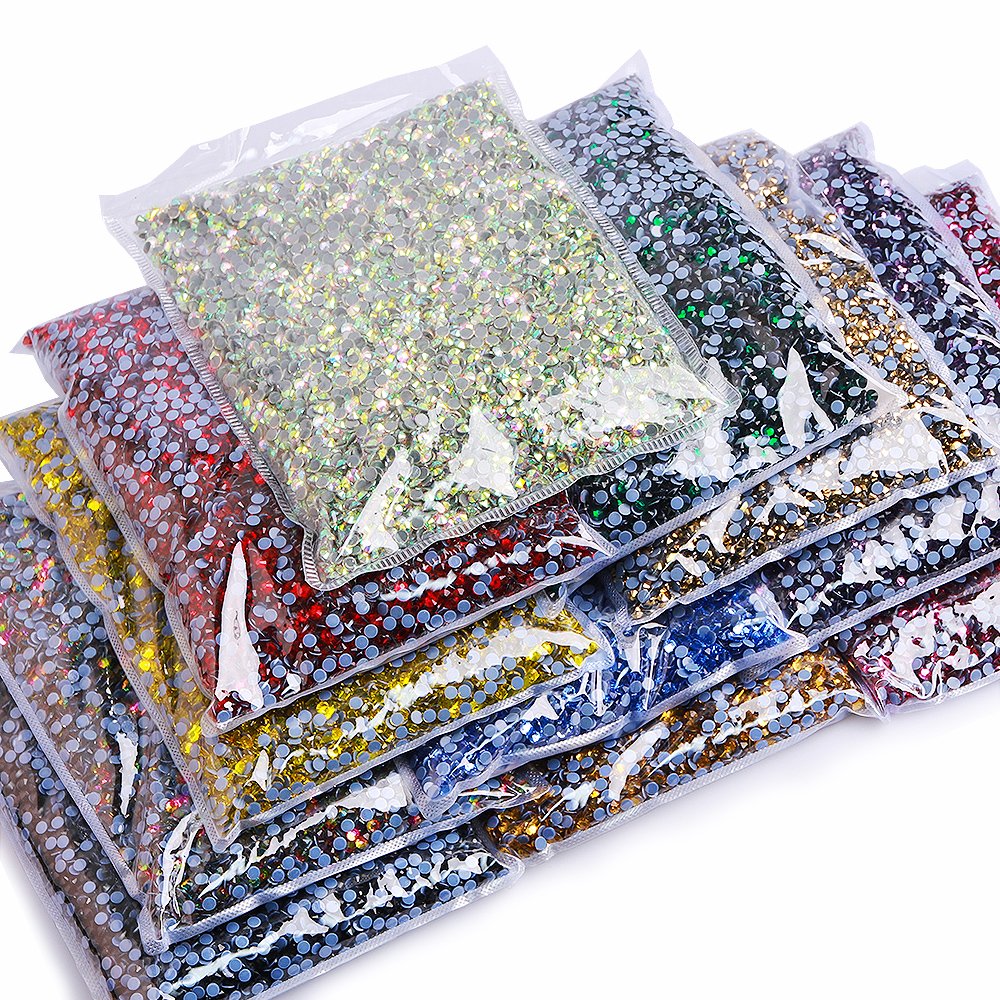
At Guangzhou Yiben E-Commerce Co., Ltd., we manufacture our complete line of K9 optical crystal hotfix rhinestones with strict robotic glue dosing. Every single crystal features a flat, uniform layer of German industrial grey adhesive that melts evenly under our calibrated low-heat pressing curves. We maintain over 400 stock colors, complete size ranges from SS6 to SS30, and provide direct air courier delivery to Australian, European, and American costume workshops in just 3 to 5 business days.
Explore our comprehensive analysis on direct international air cargo and express courier rates and learn how customs compliance and GST regulations support seamless direct factory sourcing.
Upgrade your leotard production standards. Contact Guangzhou Yiben today via WhatsApp or email to request free physical sample cards and discover how engineering precision elevates competitive costume design.
—
Frequently Asked Questions About Applying Rhinestones to Spandex and Lycra
Can you apply hotfix rhinestones to spandex without scorching or glazing the fabric
Yes, scorching is completely preventable by avoiding high-heat fast pressing. Calibrate your heat press to an extended-dwell curve of 140°C to 145°C for 16 to 20 seconds under medium pressure (2.5 kg/cm²). Always place a virgin PTFE Teflon cover sheet over the garment, and ensure your lower platen is cushioned with a soft silicone foam pad to distribute heat evenly.
Why do rhinestones fall off dance leotards after the first wear
Stone shedding on performance wear is almost always caused by one of three issues: using cheap clear EVA craft glue that cracks under fabric elongation, stone bridging where adjacent stones fuse together on unstretched fabric and tear off during movement, or peeling the transfer carrier tape while the glue is still warm before full crystallization has occurred.
What is reverse pressing and when should it be used on leotards
Reverse pressing involves turning the garment panel upside down and applying heat from the inner backside of the fabric, rather than pressing down onto the crystal faces. This technique is mandatory for heat-sensitive metallic foil Lycra, wet-look synthetics, and iridescent fabrics because it channels heat directly to the glue bed while shielding the delicate surface foil from direct contact with the heated metal platen.
How long should you wait before stretching or washing a newly pressed rhinestone garment
You must wait a minimum of 24 hours at room temperature (20°C to 24°C) before stretching, wearing, or laundering a newly pressed rhinestone garment. Polyamide hotmelt adhesives require a 24-hour polymerization window to complete their internal cross-linking and reach maximum tensile shear strength.
Need a size or color recommendation for your next order? Send us your fabric type, design, and target price — we reply within one business day. WhatsApp +86 13692450325 · rhinestonewholesale8@gmail.com