
Hotfix Rhinestone Wholesale from Guangzhou — Price Benchmarks, MOQ Reality and Supplier Checks
A garment factory owner in Texas forwarded us a price list last month. The supplier quoted hotfix rhinestones at $4.50 per pack of 1,440 pieces — about 40% below the Guangzhou average. The catch showed up in the fine print: “color tolerance ±5%,” “MOQ 50 packs per color,” and a lead time of 45 days that the sales rep would not put in writing. The Guangzhou hotfix rhinestones manufacturer behind these price benchmarks runs the melting, cutting and coating in-house.
That list is a good example of what wholesale rhinestone buying actually looks like in 2026. The market is full of real factories, capable traders, and brokers who quote prices they cannot deliver. The difference between a smooth first order and a three-month headache is rarely the price itself. It is knowing which numbers on the quotation to trust and which to verify.
This guide covers the benchmarks that matter for wholesale hotfix rhinestone buyers — realistic price ranges, how MOQ really works in Guangzhou, how to tell a factory from a middleman, and the checks that prevent a bad batch from reaching your warehouse.
What Does a Wholesale Hotfix Rhinestone Price List Actually Look Like
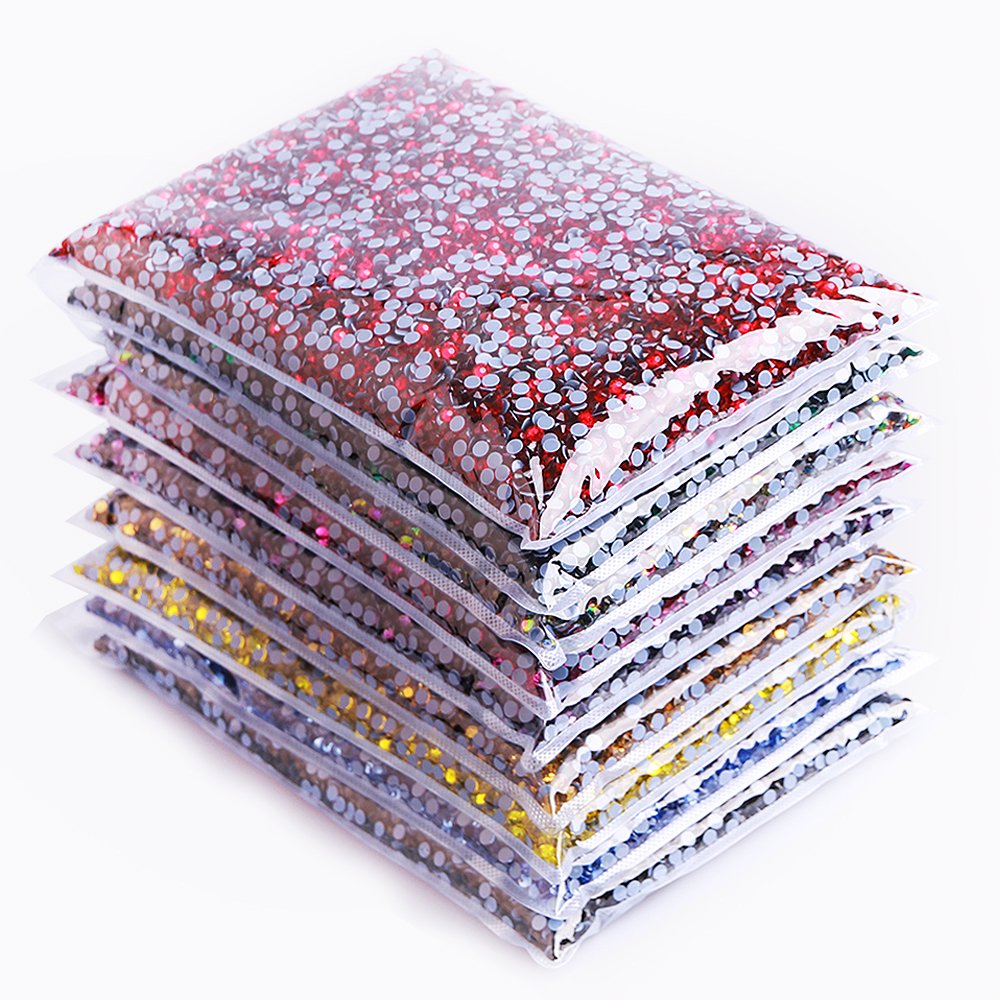
Hotfix rhinestones are quoted per pack or per 1,000 pieces, never per kilogram. A standard pack of SS16 (4.0 mm) holds 1,440 pieces, and that unit is the anchor for most comparisons.
For K9 glass hotfix stones with industrial hot-melt adhesive, wholesale prices from a Guangzhou factory typically fall in these ranges for normal colors:
– SS6–SS10 (2.0–2.8 mm): $3.50–$6.00 per pack of 1,440–2,880 pieces – SS16 (4.0 mm): $5.00–$9.00 per pack of 1,440 pieces – SS20 (4.8 mm): $8.00–$14.00 per pack of 1,000–1,440 pieces – SS30 (6.4 mm): $15.00–$28.00 per pack of 500–1,000 pieces
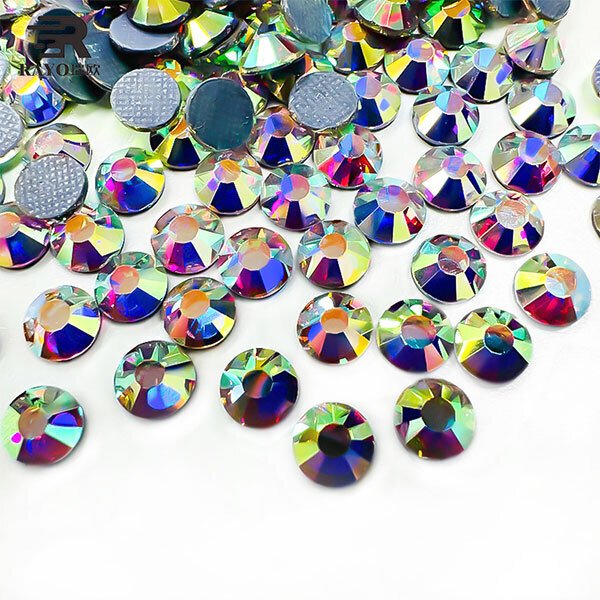
Two variables move these numbers more than anything else. The first is adhesive grade — the German grey hot-melt adhesive used by quality manufacturers costs roughly three times more than the cheap yellow glue, and it shows in the quote. The second is finishing: AB-coated stones (Aurora Borealis) run 20–40% higher than the same size in a normal color because of the vacuum-coating step.
A price below $4 per pack of SS16 K9 should trigger questions, not excitement. At that level the seller is either using acrylic (PMMA), which has a refractive index around 1.49 versus roughly 1.9 for K9 glass, or thinning the adhesive layer. Both problems only become visible after your customer washes the garment.
What Is the Real MOQ for Hotfix Rhinestones from Guangzhou
The honest answer: a genuine factory with a stocked warehouse will accept a small trial order. Our own MOQ at Guangzhou Yiben is two packs per color and size — enough to test application, color accuracy, and wash performance without tying up capital.
Here is what to watch for on the MOQ line of a quotation:
– “MOQ 2 packs” — normal for stocked colors; you can mix colors and sizes across the order. – “MOQ 10–50 packs per color” — this is the trader tell. It means the seller does not stock the goods and is aggregating demand before placing a factory order. Your risk: your color gets dropped or substituted when they consolidate. – “MOQ applies per color, not per order” — read this carefully. A 10-pack-per-color MOQ across 12 colors is 120 packs, not 10.
Custom colors and custom adhesive colors (such as clear glue for light fabrics) are a different story. Those require a production run, and a factory will reasonably ask for a larger minimum or a custom setup fee. That is legitimate — what is not legitimate is a “stock” quotation that suddenly demands production-run MOQs after you place the order. If you are negotiating from a small starting budget, our guide on MOQ and custom rhinestone orders shows how much room for negotiation a factory actually has.
How to Tell a Factory from a Trading Company Before You Pay
Both can sell you good stones. The question is what happens when something goes wrong — a color batch mismatch, a delayed shipment, a quality claim. A factory controls the production line and can rework or replace; a trader must go back to their own supplier and hope.
Three checks separate the two in under ten minutes:
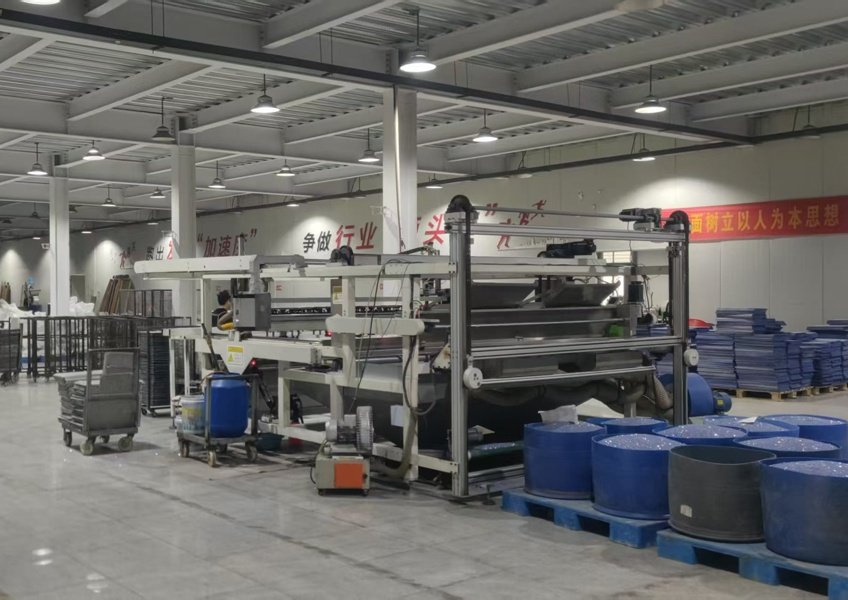
1. Ask for the factory address and verify it independently. A real manufacturer in Guangzhou can give you a specific address in Baiyun, Panyu, or Huadu district. Cross-check it on a map and ask for photos of the workshop, not just the office. Look for grinding, coating, and packaging equipment in the same facility. 2. Ask for a video call of the production floor. A factory that does its own production can show you the assembly line in real time. A trader will offer excuses — “the factory is in another city,” “the line is down today.” 3. Compare the price list structure. Factories quote per pack with consistent unit costs across sizes. Traders often quote per size with irregular jumps that reflect their own reseller margins.
None of this is about distrusting everyone. The garment accessory market in Guangzhou includes thousands of legitimate traders who provide real value for small orders. But if your order size justifies factory pricing, you should know which one you are paying for. Our guide to partnering with a China rhinestone manufacturer walks through the verification process in more detail. If you would rather skip the detective work, send us your quantity and we will confirm directly whether your order fits our factory pricing — the answer is usually yes from two packs up.
What Should a Wholesale Rhinestone Quotation Include
A complete quotation answers five questions before you ask them: unit price, MOQ, lead time, shipping cost, and payment terms. If any of the five is missing, get it in writing before you commit.
– Unit price and unit definition. Confirm the count per pack (1,440 for SS16, for example) and whether the price includes the adhesive layer. Some low quotes are for loose stones without hot-melt glue — useless for hotfix application. – Payment terms. Standard terms from Guangzhou are 30% deposit and 70% balance before shipment via T/T, with PayPal accepted for trial orders. Be cautious with “100% in advance” from a first-time supplier, and equally cautious with full payment before quality inspection. – Lead time in writing. Stocked colors ship in 1–3 days. Production runs take 10–20 days depending on quantity. Get the date on the quotation. – HS code and documentation. Hotfix rhinestones fall under HS 7018.10 (glass beads, including imitation gemstones). Import duty for the US is roughly 6.6% (HTS 7018.10.5000) and about 3.7% for the EU (CN 7018 10 90). A supplier that cannot state the correct HS code is a warning sign — they likely have not shipped this product before. First-time importers should also review the full documentation chain, from commercial invoice to packing list, before the goods leave the warehouse; our step-by-step guide on importing rhinestones from Guangzhou for the first time covers the paperwork in detail.
How Long Does Shipping Take and What Does It Cost
From Guangzhou, your options are air and sea, and the choice depends on order size and urgency.
– Air freight (DHL, FedEx, UPS): 5–7 working days to North America and Europe. Cost for a 10–20 kg shipment of rhinestones typically runs $80–$250 depending on destination and season. Good for sample verification and first trial orders. – Sea freight: 18–25 days to the US West Coast, 25–35 days to the East Coast. Cost is calculated by volume (CBM = length × width × height in meters), with a reference of roughly $150–$300 per CBM for a consolidated (LCL) shipment. A 100-pack order of SS16 fits comfortably in under 1 CBM.
Most first-time wholesale buyers under-estimate the value of paying slightly more for air freight on the first order. You get the stones in a week, verify quality against your samples, and then commit to a sea-freight volume order with confidence. That sequence prevents the worst outcome in this trade: receiving 50,000 stones that match neither your sample nor your color reference, six weeks after you paid.
One more shipping detail worth negotiating: who covers the import side. Most Guangzhou quotations are EXW or FOB, which means customs clearance, import duties, and inland delivery on your side are your responsibility. A supplier that offers DDP terms usually builds the handling cost into the price, so compare both options on total landed cost rather than the freight line alone. For LCL sea shipments, also confirm whether the price includes port handling and whether the forwarder consolidates at origin — both are common sources of surprise charges.
The Wholesale Quality Check That Prevents a Bad Batch
Before you release the final payment, run the batch through five checks. You can do the first two on a video call with the supplier.
1. Color check against your approved sample. Lay the production stones next to the approved sample under daylight, not warehouse LED. K9 stones hold color well batch to batch; cheap acrylic shifts visibly. 2. Adhesive check. Rub the flat back of a few stones. Quality industrial adhesive has a consistent, even layer. Cheap glue looks patchy and melts at a lower temperature — the German grey adhesive melts around 150–170°C, while economy yellow glue softens below 130°C and releases under heat or sun exposure. 3. Facet check. Standard K9 stones have 12–14 facets. A quick count under magnification separates real glass cutting from pressed imitations with 8 or fewer facets. 4. Size consistency. Spot-check 20 stones with calipers. SS16 should measure 4.0 mm ±0.1 mm. Wider variance means the batch came from mixed sources. 5. Wash test on your actual fabric. Press a dozen stones onto the fabric you use and run one industrial wash cycle. K9 stones with quality adhesive survive 50+ standard machine washes with under 2% loss; the threshold to watch is the first 5 washes, where weak adhesion fails early.
Our quality control guide for bulk rhinestone manufacturing covers inspection standards in depth, including what to put in the claim if a batch fails.
How Many Stones Do You Actually Need per Garment
Buying wholesale means buying in volume, which makes accurate quantity planning part of the negotiation. Under-ordering forces a second shipment with extra freight; over-ordering locks cash into unused stock.
Size selection is the other half of the quantity question, and it is the one that trips up first-time buyers most often. The two numbers that matter are the millimeter diameter and the stone count per square foot. SS6 (2.0 mm) reads as texture from a distance, SS16 (4.0 mm) reads as sparkle, and SS30 (6.4 mm) reads as statement. Mixing two adjacent sizes — say SS16 for the body and SS20 for the borders — gives a professional gradient without doubling your SKUs. If you are unsure which size suits your garment type, our guide on choosing the right hotfix rhinestone size breaks down the options by application.
Use these planning anchors for SS16 as the base unit:
– A fully covered square foot takes roughly 576 SS16 stones; with SS20 it drops to about 400. – Partial decoration on a garment typically uses 500–2,000 stones (SS10–SS16). – A fully rhinestoned dance costume runs 15,000–30,000 stones (SS6–SS16 mixed). – Bridal gowns with heavy embellishment use 2,000–5,000 stones (SS16/SS20 mixed).
Add 5–10% for breakage and test pieces. If your project uses more than 20,000 stones, ask the factory about mixing sizes in a single order — the price per thousand drops on the larger sizes, and the cost benefit often beats using one size throughout.
What This Means for Your Next Order
The pattern behind every failed rhinestone order we see is the same: the buyer optimized for the lowest unit price and skipped verification. The fix is not paying more — it is spending twenty minutes on checks that cost nothing.
Run the sequence once, and it becomes routine. Get the factory address and confirm it. Compare the quotation against the benchmarks in this guide. Ask for stock photos and a video call. Order a small air-freight batch first, test it against your fabric, and only then commit to the volume order. If you want the numbers tailored to your exact color list and garment type, our team can prepare a quotation with the real MOQ and shipping timeline — send your color list and quantities to rhinestonewholesale8@gmail.com or WhatsApp +86 13692450325, and we will reply within 12 hours.
Need a size or color recommendation for your next order? Send us your fabric type, design, and target price — we reply within one business day. WhatsApp +86 13692450325 · rhinestonewholesale8@gmail.com